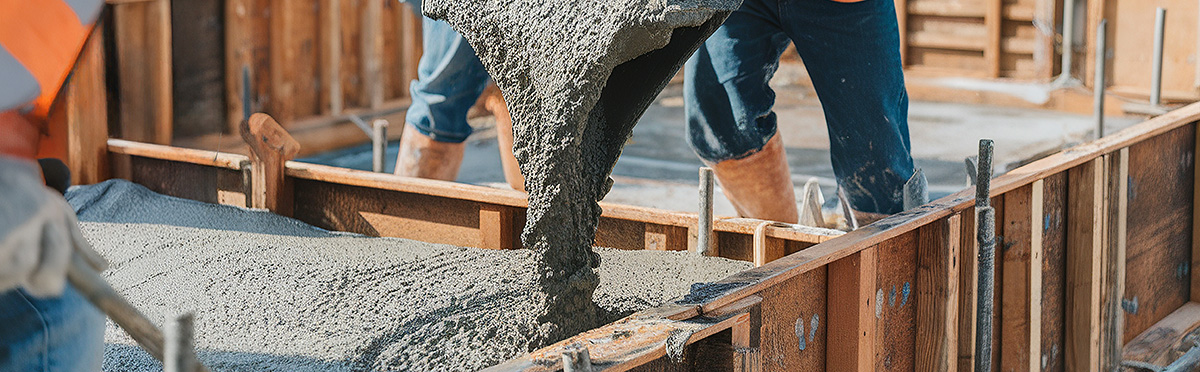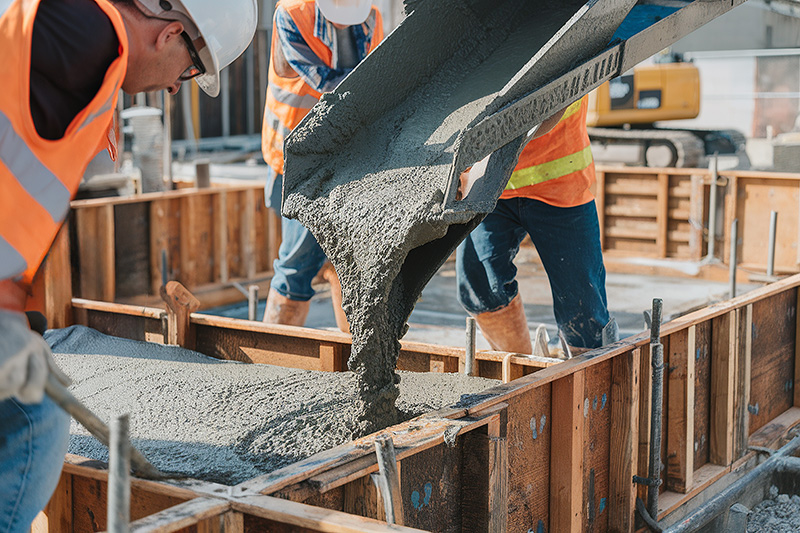
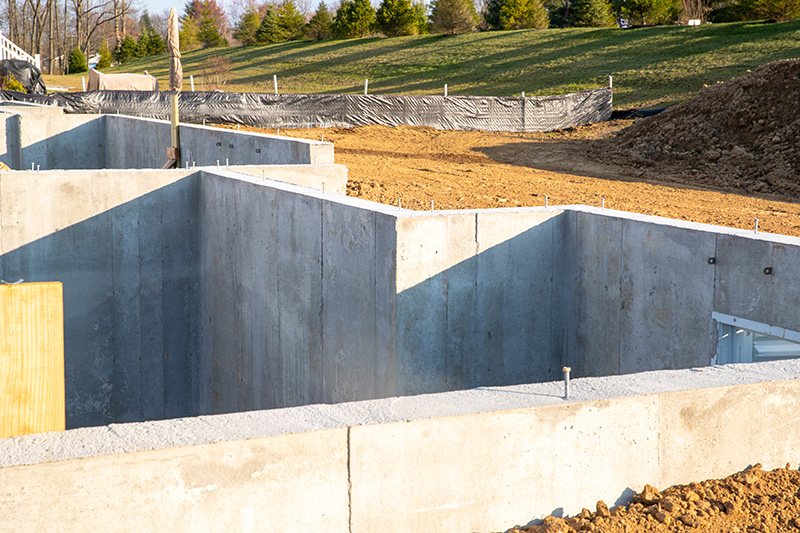
Ground-level slabs and crawl space bases done right.
A slab-on-grade foundation pours the floor and the foundation as one piece of concrete sitting directly on prepared ground. There is no basement and no deep crawl space underneath, just a thick, reinforced slab with thickened edges that carry the walls above. Done right, it is one of the most efficient and durable ways to build, because you skip the cost and the moisture problems that come with digging a hole and pouring walls. Done wrong, on the soil we have here, it becomes a slab that lifts, tilts, and cracks within a few seasons.
That last part is why slab-on-grade work matters so much on the Front Range. Much of the metro and the foothills sit on expansive clay that swells when it gets wet and shrinks when it dries. A slab is only as good as the base, the vapor barrier, the reinforcement, and the soil detailing under it. We build crawl space bases and slab-on-grade foundations to resist that movement instead of fighting it after the fact. Get those layers right and the slab stays flat and sound for the life of the structure.
The slab you see is the last thing that goes in. Underneath it is the work that decides whether it lasts. We start by stripping unsuitable soil and compacting an engineered base in lifts, so the slab bears on something stable instead of loose fill that settles later. On top of the base goes a vapor barrier, a continuous plastic sheet that stops ground moisture from wicking up through the concrete and into your floor finishes. Then comes reinforcement, either rebar or a steel mat tied and chaired off the base, and thickened edges where the walls and point loads land. Each of those layers does a specific job. Skip one and the slab pays for it, usually within a few winters.
This is the concern that should be on your mind, and we will not gloss over it. On expansive clay, a slab poured straight on native soil can heave when that soil takes on water, lifting in the middle or tilting at an edge, and cracking the concrete and the walls framed on top of it. The fix is not a thicker slab alone. It is keeping water away from the soil and detailing the slab so movement does not telegraph into the structure. We grade the site to drain away from the slab, build the compacted base the soil report calls for, and reinforce so the slab acts as one stiff unit. When a soil report flags real expansion, our structural engineer specifies what that lot needs, whether that is a deeper base section, a different reinforcement layout, or void detailing. We build to the soil, not to a generic spec.
A crawl space gives you access to plumbing and mechanicals without a full basement, but the base of that crawl space still needs to be handled. A bare dirt crawl space breathes ground moisture into the home, which is exactly what you do not want under a Colorado house that is sealed up tight for half the year. We pour clean crawl space bases over a vapor barrier and compacted ground so the space stays dry and workable, and so the footings and the slab sections tie together the way the design intends. The result is a crawl space that protects the framing above instead of feeding it moisture.
Concrete shrinks a little as it cures, and on a slab that big, that shrinkage has to go somewhere. We saw or tool control joints at planned spacing so the slab cracks along clean, hidden lines instead of randomly across the floor. Curing matters just as much here. At altitude, with low humidity and strong UV, concrete can lose water too fast and cure weak at the surface. We use the right mix for the conditions, including air entrainment where the slab will see freeze and thaw, and we cure it properly. You can usually walk on the slab in 24 to 48 hours, and it reaches full strength around 28 days. Rushing either step is how slabs end up dusting, scaling, or cracking early.
From homes to commercial sites across the Front Range, here is where crawl space & slab-on-grade earns its place.
A full slab-on-grade foundation for a new house or accessory dwelling where a basement is not part of the plan.
Tying a new slab section into an existing home for a room addition, sunroom, or bumpout.
A monolithic slab with thickened edges that carries the walls of a detached garage or workshop.
A ground-level foundation for a backyard studio, office, or storage building.
A clean, dry base poured over a vapor barrier so the crawl space protects the framing above.
Slab foundations for small commercial buildings and structures across the Front Range.
Concrete behaves differently at altitude. Our expansive clay soils swell with moisture and shrink when they dry, and the freeze and thaw cycle works on any surface that takes on water. Every crawl space & slab-on-grade project we pour accounts for both, from base preparation and drainage to air-entrained mixes, proper reinforcement, and control joints cut on time. That is how the work holds its shape and finish through Colorado winters instead of failing by spring.
You also get a written estimate before anything starts, a structural engineer on staff for the jobs that need one, and a crew that pulls and manages permits when the project calls for them. Licensed, bonded, and insured, with finishes that range from a clean broom texture to stamped, colored, and sealed.
Foundations are engineered, not estimated, and that is exactly why they hold up on Front Range soil. Here is what shapes a Slab-on-Grade project.
The single most important thing you can do for a crawl space & slab-on-grade is control water. Keep gutters and downspouts carrying water well away from the foundation, maintain positive grading so the ground slopes away from the house, and watch for any new horizontal or stair-step cracking, which is worth a professional look. And whatever the project, the same rule applies across the Front Range: keep water from sitting on or soaking into the surface, and the concrete will reward you with decades of service.
You always know what is happening and what it costs before we mix a single yard. Here is the path from first call to final walkthrough.
We visit the site, measure, check drainage and soil, and hand you a clear written quote. No charge, no pressure.
We set the grade, thickness, reinforcement, and finish. Structural work gets engineered and permitted.
Forms, rebar, and a clean pour. We screed, float, and finish to the texture you picked, then cut control joints.
You can walk it in 24 to 48 hours. We walk the job with you and explain how to care for it through the first winter.
Still unsure about something?
Call the crew at (303) 569-4046 and we will talk it through.
Get a free, no-obligation estimate from a crew that knows Colorado soil, Colorado weather, and how to finish concrete that lasts.
Accessibility
Adjust the site to fit how you read and browse. Your choices are saved on this device.