
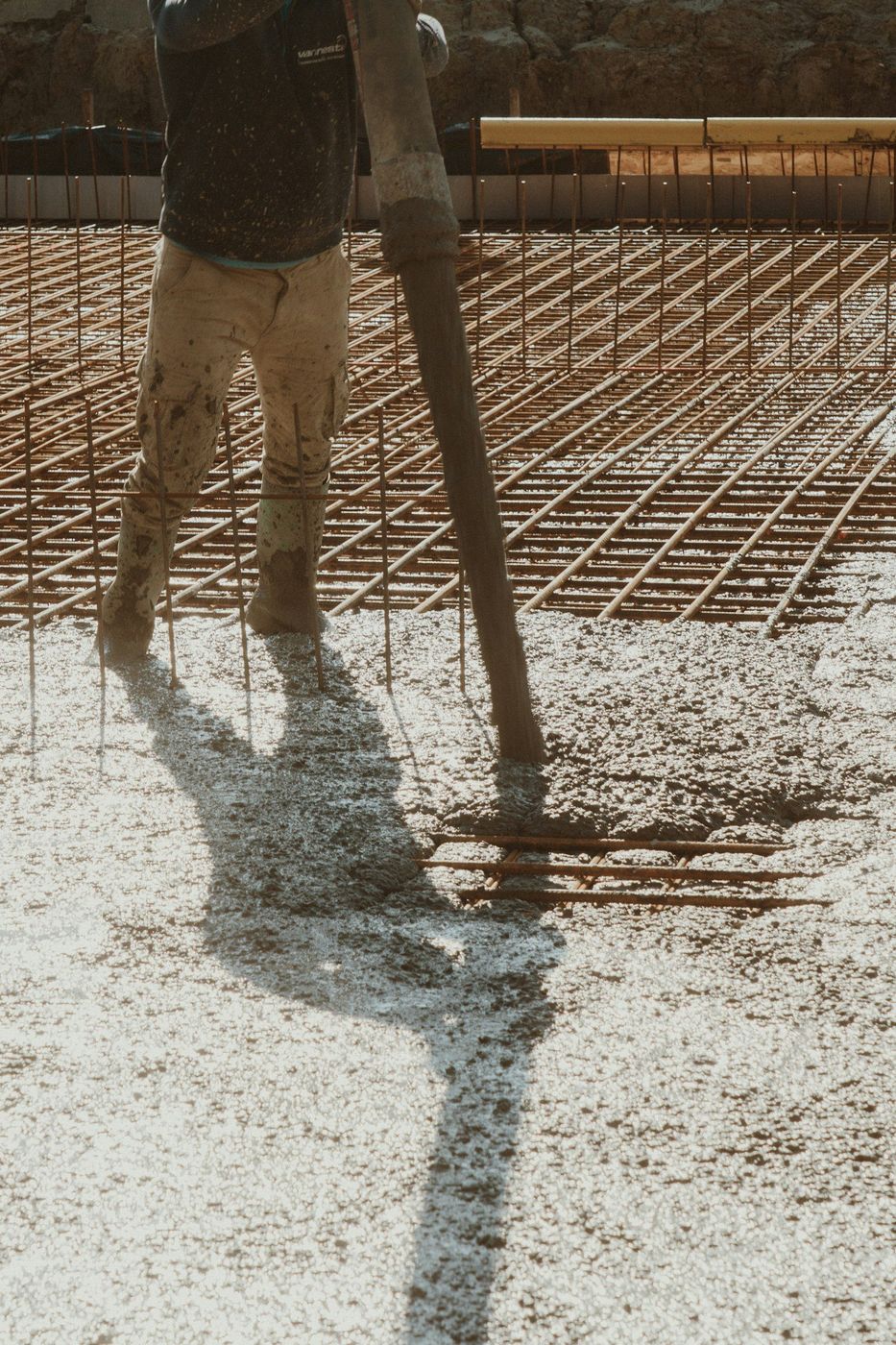
You're buying a floor. What you're paying for is the eighteen inches of nothing much underneath it.
Nobody hires a concrete crew for the part of a slab that decides its life. You want a floor: flat, clean, ready for a vehicle or a workbench. What you're buying is everything below it. Proven dirt. Base placed in shallow lifts and compacted through. Clean angular rock. A sheet of plastic that crews still argue about. Then, last and least interesting, four or more inches of concrete.
Aurora makes that under-slab work matter more than it would somewhere flatter and more uniform. The city covers a lot of ground and the dirt doesn't stay the same across it. A shop floor near Murphy Creek and a garage slab out toward Saddle Rock can want different assemblies underneath, and the way to find out is to open it up and look.
Once the old floor is gone we run weight across the exposed dirt and watch what it does. Ground that pumps, springs, or ruts under a loaded machine is telling you it won't hold a slab no matter how much rock goes on top. That's the moment to spend money. Digging out a soft pocket costs a few hours. Finding it later means the floor cracked and stepped, and the tool for that is a jackhammer.
Compaction can't be faked either. Base dumped in one deep pile and rolled across the top stays loose underneath, and loose base is a slower version of bad dirt. Shallow lifts, every one run. Moisture counts as much as effort: too dry and it won't lock together, too wet and it moves around under the plate.
Then the retarder argument. Plenty of crews skip the plastic under a garage and shrug. Concrete isn't waterproof. It's a strong sponge that passes whatever the ground offers straight up into your epoxy, your flooring adhesive, or the boxes stacked on it. Anything heated, coated, floored, or lived on gets one from us.
| What's under there | How it got that way | What we do before pouring |
|---|---|---|
| Soft spots that pump under a loaded machine | Fill placed wet or never compacted during the original build | Dig it out, replace with material that compacts, verify with weight before rock goes down |
| An open void between the old slab and the dirt | Fines washed out by roof or irrigation water finding a path under the edge | Find the water source and cut it off, then rebuild the base. Otherwise it happens again |
| A soft ribbon along a plumbing trench | The ditch got backfilled loose because concrete was going over it | Recompact that line in lifts, and add steel across it in the new slab |
| Bone dry, powdery clay under a long-heated garage | Years of a warm slab drying the ground beneath it | Moisture condition the subgrade so it isn't primed to swell the first time water reaches it |
| Old base still clean and well compacted | Somebody did it right the first time | Reuse it. We top up, recompact, and spend your money elsewhere |
We'll open a test hole, look at what's underneath, and price the actual assembly instead of guessing. (303) 569-4046.
A floor spreads load. A wall collects it into a line, and a uniform slab under a bearing wall dishes and cracks every time. Wherever a wall, a post, a lift, or a masonry run lands, we drop a thickened section poured monolithically with the slab, detailed off the framing plan. Same thinking at overhead door openings, where a slab most wants to crack.
Interior slabs hand us a scheduling advantage nothing else does. A garage that closes, a basement, a shop with walls and a roof: heat the space, thaw the ground, and January pours like June. Access becomes the only real limit, since a pump line still has to reach inside.
Exterior slabs follow the Front Range calendar. Summer means early starts and an eye on the western sky, because a hard cell during finishing beats water into fresh paste and the bill arrives later as scaling. Fall is the best stretch of the year. Winter needs warm water, blankets, and unfrozen ground. Whatever month it goes in, keep salt off it the first winter. Shovel, sweep, sand for grip.
Still unsure about something?
Call the crew at (303) 569-4046 and we will talk it through.

Get a free, no-obligation estimate from a crew that knows Colorado soil, Colorado weather, and how to finish concrete that lasts.
Accessibility
Adjust the site to fit how you read and browse. Your choices are saved on this device.