
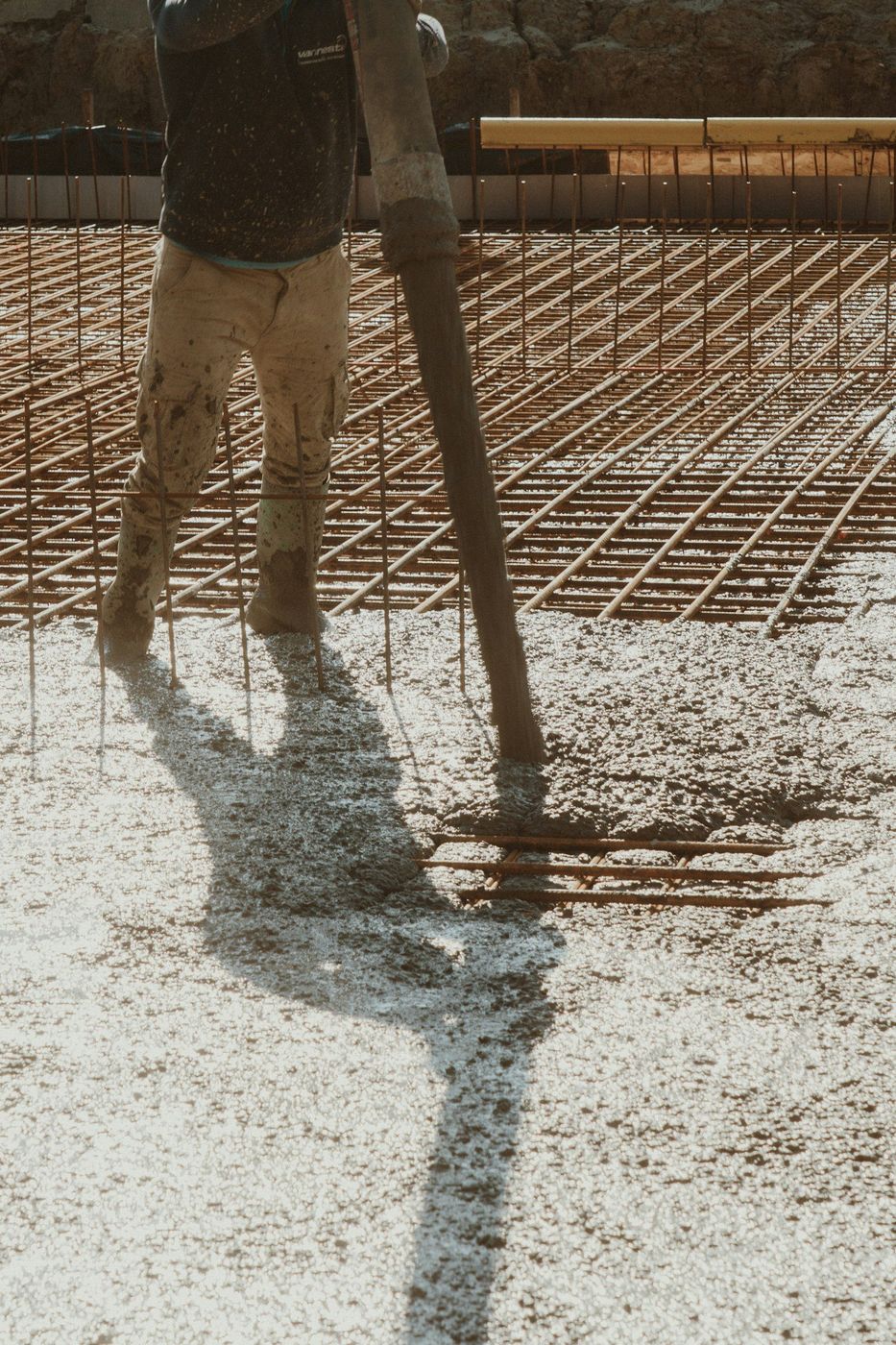
Half of finishing a slab well is knowing what the sky is about to do.
Mid-July, about two in the afternoon. The slab went down at seven that morning, the bull float has been through, and a crew is on knee boards working the surface. Out west, over the foothills, a cell is stacking up the way it does almost every summer afternoon at this altitude. Somebody checks radar. Somebody else starts pulling plastic off the truck. That five minutes of judgment is worth more to your slab than any product we could add to the mix.
Slab-on-grade work looks like the easiest concrete there is. It's flat, it's at ground level, and there's nothing to hold up. It's also the least forgiving, because everything you'll ever see is the surface, and the surface is decided in a two-hour window while the concrete is still making up its mind.
Subgrade first, compacted in lifts and proof-rolled rather than raked smooth and hoped over. Then aggregate base, clean and compacted, giving the slab a rigid, draining platform. Then a vapor barrier anywhere the space will be heated, finished, or storing anything that minds moisture, lapped and taped at the seams and turned up at the edges.
Then the shape of the concrete itself. Thickened edges where the slab carries a wall or a garage door track. Thickening under interior bearing points. Steel sized to the loads instead of a default. And a joint layout drawn before the pour, not improvised with a saw while everyone stands around. On the newer builds through Lagae Ranch and BellaMesa we see a lot of slabs where all of that was compressed into one hurried afternoon. You can tell which ones, ten years later, without getting out of the truck.
Summer here doesn't just bring heat; it brings dry heat and hard sun. Water leaves a fresh slab surface faster than it can bleed up from below, and when that happens you get plastic shrinkage cracking before the concrete has even set. So we pour early, shade what we can, keep evaporation retarder in the truck, and get cure protection down fast.
Autumn is the sweet spot. Warm days, cool nights, low storm risk, and enough runway to reach real strength before the first hard freeze. Spring is fine once overnight lows quit dipping. And hail deserves its own line, because a Castle Pines hailstorm can pit a green surface into something you'll be looking at forever. If the forecast has a real chance of it, we move the pour. Losing a day is cheaper than losing a slab.
Tell us the date and we'll tell you honestly whether the weather odds are worth it. Estimates are free either way.
| Season | What works against us | How we adjust |
|---|---|---|
| Spring | Wet subgrade, overnight lows still dropping below freezing | Dry the base before we place, watch the low temps, keep blankets staged |
| Summer | Fast surface evaporation, afternoon storms, hail risk | Early start, evaporation retarder, plastic on hand, and a willingness to reschedule |
| Fall | Shorter finishing daylight, cold nights arriving quickly | Our preferred window; we start early and cover before the temperature drops |
| Winter | Frozen subgrade, slow set, no margin for a bad night | Heated mix water, non-chloride accelerators, insulated blankets, ground thawed first |
People think a rained-on slab is always ruined. It depends entirely on the hour. Rain during finishing works water into the paste and you get a chalky, scaling surface within a couple of winters. Rain the next morning is a free curing bonus.From the crew lead on these jobs
Stay off it for a day, then walk it. A car can sit on it at one week. Keep the heavy stuff off until the calendar hits twenty-eight days, and that includes the moving truck, the dumpster, and the neighbor's trailer. Concrete gains strength on a schedule that doesn't care how good it looks.
Then the first winter, which is the one that actually tests it. No deicing chemicals, especially anything with magnesium chloride in it, because a young surface has no defense against that stuff. Shovel instead, and use sand for traction. Keep runoff moving away from the edges so nothing washes out from underneath. Do those three things and you'll get decades out of it, which is the entire point of paying attention to a two-hour window back in July.
Still unsure about something?
Call the crew at (303) 569-4046 and we will talk it through.
Get a free, no-obligation estimate from a crew that knows Colorado soil, Colorado weather, and how to finish concrete that lasts.
Accessibility
Adjust the site to fit how you read and browse. Your choices are saved on this device.