
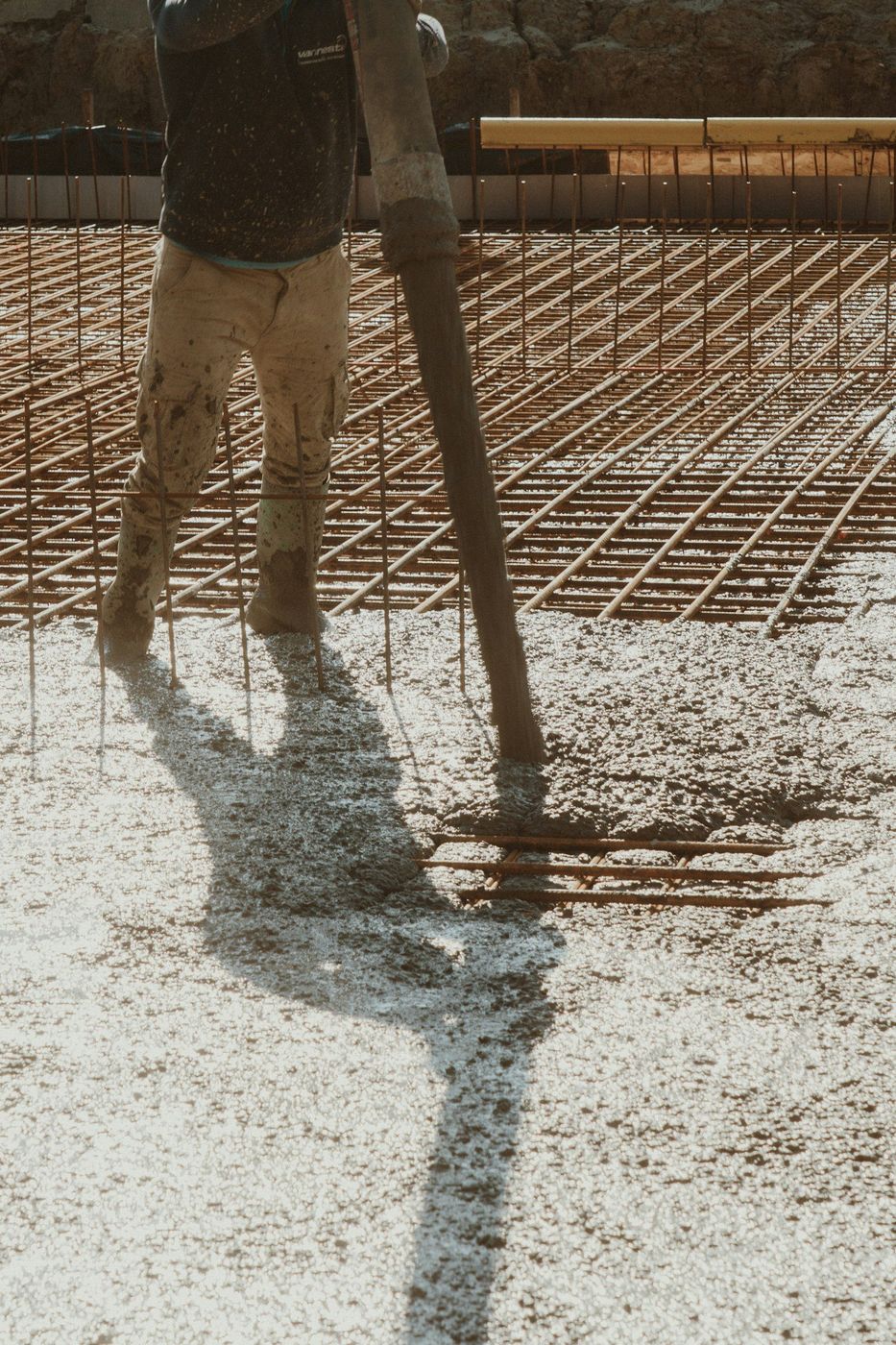
Forty minutes of concrete, then a full day of the work that decides how it turns out.
The loud part of a walkway job is short. One truck, one chute, and most residential runs are placed in well under an hour. Then our crew stands at the forms with a float and a broom and waits, and that wait is where a path either sets up flat and tight or turns into a surface that sheds sand by its third spring. Homeowners watch the truck. We watch the clock.
So here is the day, start to finish, because almost nobody has seen one. It runs differently depending on which part of town you are in. A short porch-to-drive run on a flat Belmar lot is a simple morning. A side path pinched between the house and the fence over in Applewood means every load gets wheeled in by hand. Step a path down a Green Mountain slope and gravity joins the crew, with opinions about how fast the concrete wants to travel.
By the time we order concrete, your walk already exists in string line and paint. Width comes first. We argue for four feet on any run the household crosses daily, because three feet is single file and somebody is always stepping into wet grass to let another person by. Then fall. Every path we build leans a little to one side, away from the house, so water leaves on its own instead of parking in a dip that turns into a February skating rink.
Then dirt. Topsoil comes off, we cut deeper than the slab alone needs, and road base goes in packed in lifts rather than dumped and raked. Steel rides on chairs near mid-depth. Locates get marked, sprinkler heads move clear of the forms, and we walk the route with you one last time. Once the concrete is rolling, the shape of your path stops being a conversation.
| Stage | How long it stays open | What closes it early |
|---|---|---|
| Placing | Under an hour on a typical residential run | A truck that cannot reach the forms and a long haul with buggies |
| Screed and bull float | The first stretch right behind the concrete | Direct sun and dry wind tightening the top before we get across it |
| Bleed water rising | Anywhere from twenty minutes to two hours | Nothing. This one waits on the slab, not on us |
| Edging and troweling | Once the sheen is gone and not one minute sooner | A crew in a hurry, which seals water in and buys you a dusty surface |
| Broom finish | One pass, one direction, no second attempt | Texture pulled too late, which leaves a slick patch you feel in socks |
| Saw cutting joints | Same afternoon, before the slab is a day old | Waiting until tomorrow, by which point the walk has chosen its own crack lines |
Tell us where the path goes and who crosses it. Written estimates, no charge. (303) 569-4046.
Right after the screed, mix water rises and stands on top of the slab. Until it goes, nobody touches that surface with steel. Work it early and the water gets trapped in the top skin, and the top skin is exactly the part that later flakes, powders, and comes off on the bottom of your shoes. So we hold off. From the driveway it looks like a coffee break. It is the most consequential twenty minutes on site.
A mile of elevation makes that window short and moody. The air here is thin and dry, the sun is direct even in October, and a breeze rolling off the foothills will skin over a slab while the concrete under it is still soft. On days like that we set wind screens, keep evaporation retarder on the truck, and start at daybreak so the finishing happens before the sun climbs. A calm fall morning gives us room to work. A hot July afternoon gives us minutes.
Cuts go in the same afternoon, spaced at roughly the width of the walk, and on a curve they run square to the arc instead of slicing it at a lazy angle. Where the path meets a porch, a stoop, or the garage apron, we set isolation material in the seam so the two pieces can move on their own schedules. They will move. A four-foot ribbon carries a lot of exposed edge for very little concrete, so when the ground below swells with frozen moisture there is no mass up top to push back. That is the whole reason a path lifts while the driveway ten feet away never budges.
Late April through October is our stretch, and September is the prize month: cool mornings, warm afternoons, and a full cure before the ground turns. We do pour in cold weather, and a narrow run is among the easier things to blanket end to end, but frozen subgrade stops us cold and we will not shorten a cure to hit somebody's calendar. First winter, keep the ice melt in the garage. Sand for grip, plastic shovel for snow.
Still unsure about something?
Call the crew at (303) 569-4046 and we will talk it through.
Get a free, no-obligation estimate from a crew that knows Colorado soil, Colorado weather, and how to finish concrete that lasts.
Accessibility
Adjust the site to fit how you read and browse. Your choices are saved on this device.