
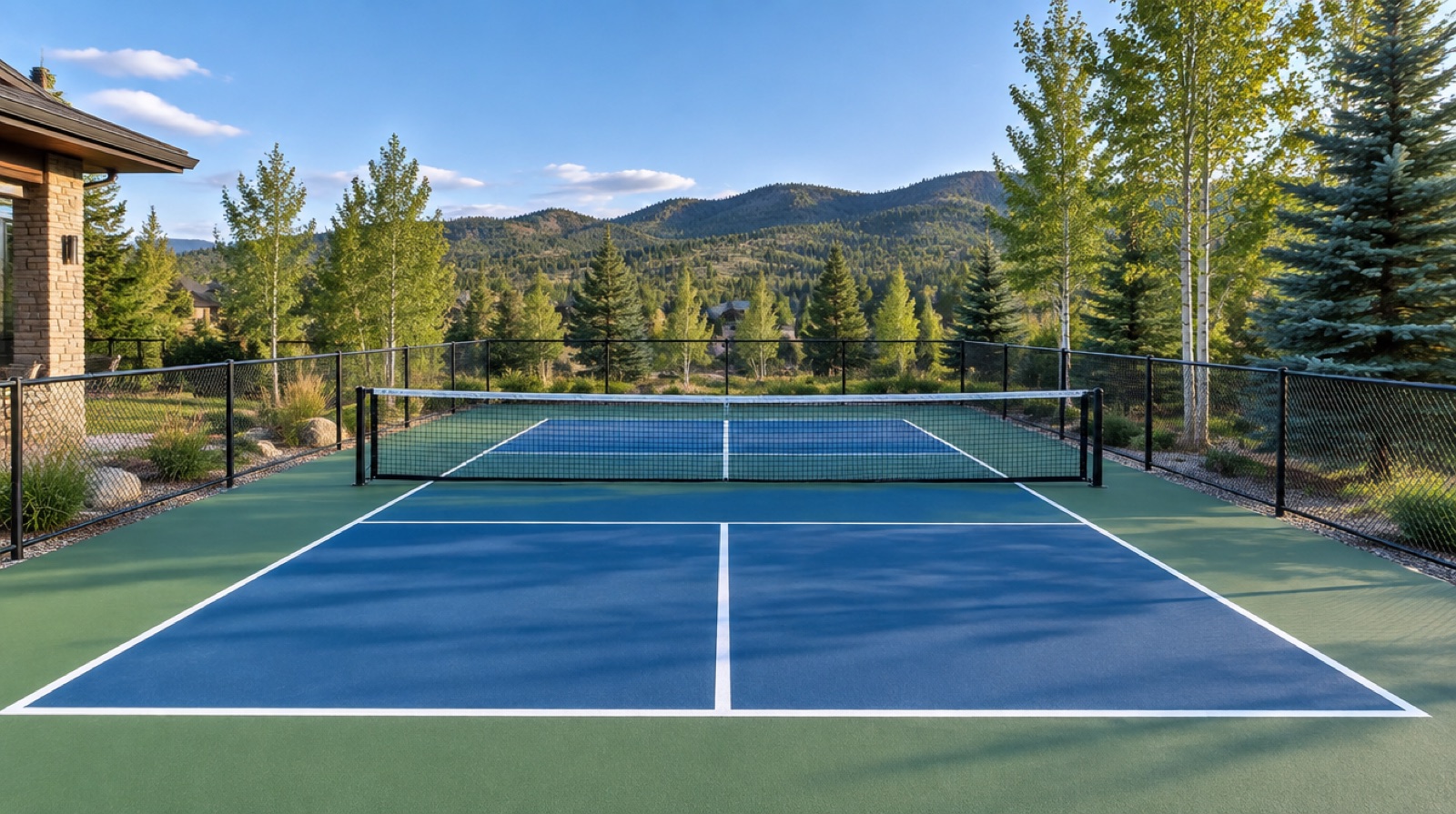
The slab is a third of the budget and all of the risk.
Boards and property owners ask what a court costs. The better question is what the money is buying, because two courts of the same size can differ enormously depending on what the site demanded and how the slab was built. Earthwork on a sloped parcel, the reinforcement strategy, whether you're building one court or a bank of three, fencing, lighting, and the surfacing system all move the number. The concrete itself is rarely the biggest line, and it's the one where cutting costs hurts the most.
We pour court slabs for HOA amenity sites, clubs, and private properties across the south metro. Our part is the foundation and flatwork: grading, base, slab, and a surface flat and sound enough to color coat. Get that right and the court plays true for decades. Get it wrong and every crack in the concrete telegraphs straight through the acrylic within a season or two.
| Factor | Concrete slab | Asphalt |
|---|---|---|
| Day one cost | Higher, sometimes noticeably | Lower, which is why it still gets specified |
| Cracking behavior | Cracks where you planned for it, if the slab is designed right | Random cracking that reopens through every resurface |
| High-altitude sun | Largely indifferent to UV | Binder oxidizes, surface hardens and ravels |
| Freeze-thaw at 6,450 feet | Air-entrained concrete handles the cycling | Water in a crack widens it every winter |
| Resurfacing cadence | Color coat renewal only, long cycle | Color coat plus crack chasing, more often |
| Twenty-year total | Lower, in most cases we've seen | Higher once repeated crack repair is counted |
| Play quality over time | Stays true as long as the base holds | Slowly softens and gets less consistent |
Site work leads, almost every time. Courts want a flat rectangle and the ground around Castle Pines rarely offers one. A parcel that needs cut and fill, a retaining wall on the uphill side, or drainage rerouted around the pad can cost more than the slab. Flat, well-drained ground is the cheapest thing a client can bring us.
Number of courts matters next, and it works in your favor. Building three side by side costs far less per court than building one, because the mobilization, the earthwork setup, and the pour day are shared. If your association is thinking about expanding later, pour the whole pad now and stripe what you need. Adding a court next to a finished slab means a cold joint, and cold joints show through color coating.
Then reinforcement strategy. A conventionally reinforced slab needs control joints, and joints under a court surface affect a bounce and eventually reflect through the coating. The alternative is a heavier jointless approach: more money up front, cleaner playing surface. We walk boards through that trade honestly instead of quoting whichever version wins the bid.
After that come the expected items: fencing height and gates, lighting and its trenching, net post sleeves, wind screens, and whatever acrylic system your surfacing contractor recommends.
Amenity areas near Lagae Ranch and BellaMesa usually offer room and modern drainage. Older sites, whether in Castle Pines North or tucked inside The Village at Castle Pines, more often mean fitting a court into ground that's already committed. That's where the site work line grows.
Send us the proposals. We'll show your board which line items one contractor included and the other quietly left out.
Court projects have two weather windows, not one, and that catches people off guard. The concrete needs a stretch of decent pouring weather. Then the acrylic surfacing needs temperatures above roughly fifty degrees and no rain. Chain those together and the practical build season here runs from late spring into early fall.
Pour in June or early July. That gives the slab its full twenty-eight days, leaves room for a delay or two, and puts the surfacing crew on site during a stable stretch of late summer. September pours work, but the color coat may wait until spring, and a board expecting October play will not enjoy that conversation.
Summer storms are the usual complication, and rain on a court slab during finishing is worse than on ordinary flatwork, because a court has to be flat and dense and a downpour ruins both. Early start, covers ready, and we'll call a pour off rather than gamble the flattest slab of our year on a radar guess.
The cracks people blame on the color coat came from the slab. Nine times out of ten somebody saved money by pouring on ground that was never compacted properly, and two winters later there's a line running diagonally across the kitchen that no resurfacing will hide.What the crew sees on site
Still unsure about something?
Call the crew at (303) 569-4046 and we will talk it through.
Get a free, no-obligation estimate from a crew that knows Colorado soil, Colorado weather, and how to finish concrete that lasts.
Accessibility
Adjust the site to fit how you read and browse. Your choices are saved on this device.