
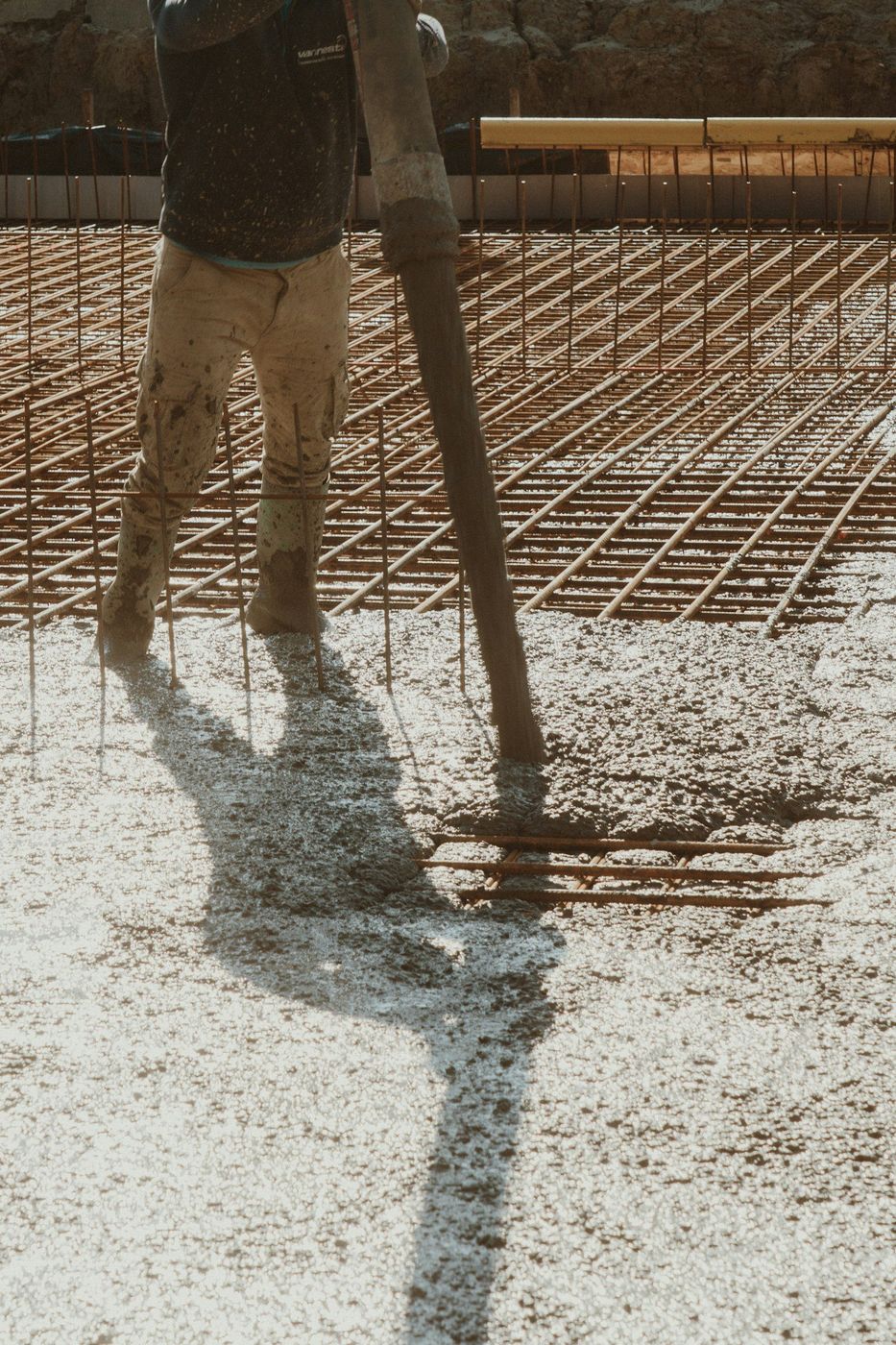
A floor is a report card on the ground beneath it, and the ground gets graded before we pour, not after.
A slab on grade has no beams, no joists, and nothing clever holding it up. It sits on dirt. Whatever that dirt does over the next thirty years, your floor does with it, which means the interesting decisions on this job all happen while the hole is still open and nothing is buried yet.
That's a bigger deal in Adams County than it would be somewhere with friendlier soil. The clay under a lot of Thornton takes on water and pushes back, and it does not push evenly. We pour garage floors, shop and outbuilding pads, addition slabs, and basement floors, from the older properties near Eastlake where the original pour went straight onto native ground to the newer builds in North Creek Farms where the pad was engineered and we still want to see the compaction record.
Strong concrete on bad ground is still bad ground. A slab that loses support under one area cracks and steps, and there's no mix design, no fiber, and no amount of steel that changes that outcome. Steel decides how a crack behaves after it happens. Support decides whether it happens.
On soil that swells, there are only a few honest approaches, and which one you get should come from the soils report rather than from habit. Dig out the reactive material and replace it with something that doesn't care about moisture. Moisture condition the subgrade so it's already wet and already expanded before the floor goes on. Isolate the slab so it can lift and drop without dragging the walls with it. Or, where the loads and the risk justify it, hang the floor off the foundation entirely and leave a void underneath so the soil has room to move without touching concrete.
Most residential floors here land in the middle of that list. What we won't do is scrape the topsoil, dump a couple inches of rock, and call it a base because the schedule was tight.
Ask where a slab problem started and the answer is nearly always water arriving somewhere it wasn't supposed to. Roof runoff finding a path under an edge. An irrigation zone soaking the same corner twice a week for fifteen years. A service line weeping quietly under a garage. Snowmelt collecting where a driveway pitches back toward the door.
Under an interior floor there's also plain ground moisture, and concrete has no opinion about stopping it. Concrete is a strong sponge. Whatever the soil offers, it passes upward into your epoxy, your flooring adhesive, or the cardboard boxes stacked in the corner. So a conditioned space gets clean angular rock as a capillary break and a lapped, taped sheet over that, sealed at every penetration. A detached, unheated, bare-floor shed does not need the same treatment, and we'll say so.
Where the water table or a perched layer sits high, an under-slab drain earns its place. That's a design decision the engineer makes off the report and what we see in the excavation, and it's a lot cheaper as a line item than as a retrofit through a finished floor.
| The check | What it tells us | What a bad result changes |
|---|---|---|
| A test pit dug before anybody prices the job | What's actually down there, in layers, instead of what a bid assumed | The whole assembly, and it's the cheapest time in the project to find out |
| Proof rolling with a loaded machine | Whether the exposed subgrade holds up under weight or pumps and ruts | Soft pockets get dug out and replaced before a single load of rock goes down |
| Density and moisture testing by a lab | Whether the fill was compacted to the spec and at a workable moisture | The lift gets reworked and retested. On commercial floors this is not optional |
| Swell potential from the soils report | How reactive the clay is, which decides whether the floor floats or gets carried | Isolation details, void space, or over-excavation and replacement of the top layer |
| A depth rod through the base after each lift | Whether the rock is as deep as the estimate promised, everywhere and not just at the door | More material, which is a small correction now and a jackhammer later |
Let us dig where the floor is going, find out what we're building on, and price the assembly that ground actually asks for. (303) 569-4046.
A floor spreads load; a wall concentrates it into a line. Pour a uniform slab under a bearing wall or a post and the concrete dishes and cracks there, every time. Wherever framing, a masonry run, a lift, or heavy racking lands, that section gets thickened in the same pour, sized off the plan rather than added by eye. Openings get the same attention, since the corner of an overhead door is where a slab most wants to fail. Joints get sawed the day of the pour, laid out to match the room and those thickened sections. Cut late and the slab has already picked its own crack line.
Interior work is the scheduling loophole. Close the building in, put heat in it, and a January floor behaves like a June one. Outdoor slabs follow the Front Range calendar: fall is the sweet spot, spring works once the ground thaws and drains, summer means early starts and an eye on the sky. And keep salt off new exterior concrete the first winter. Shovel it, sweep it, throw sand for traction.
Still unsure about something?
Call the crew at (303) 569-4046 and we will talk it through.

Get a free, no-obligation estimate from a crew that knows Colorado soil, Colorado weather, and how to finish concrete that lasts.
Accessibility
Adjust the site to fit how you read and browse. Your choices are saved on this device.