
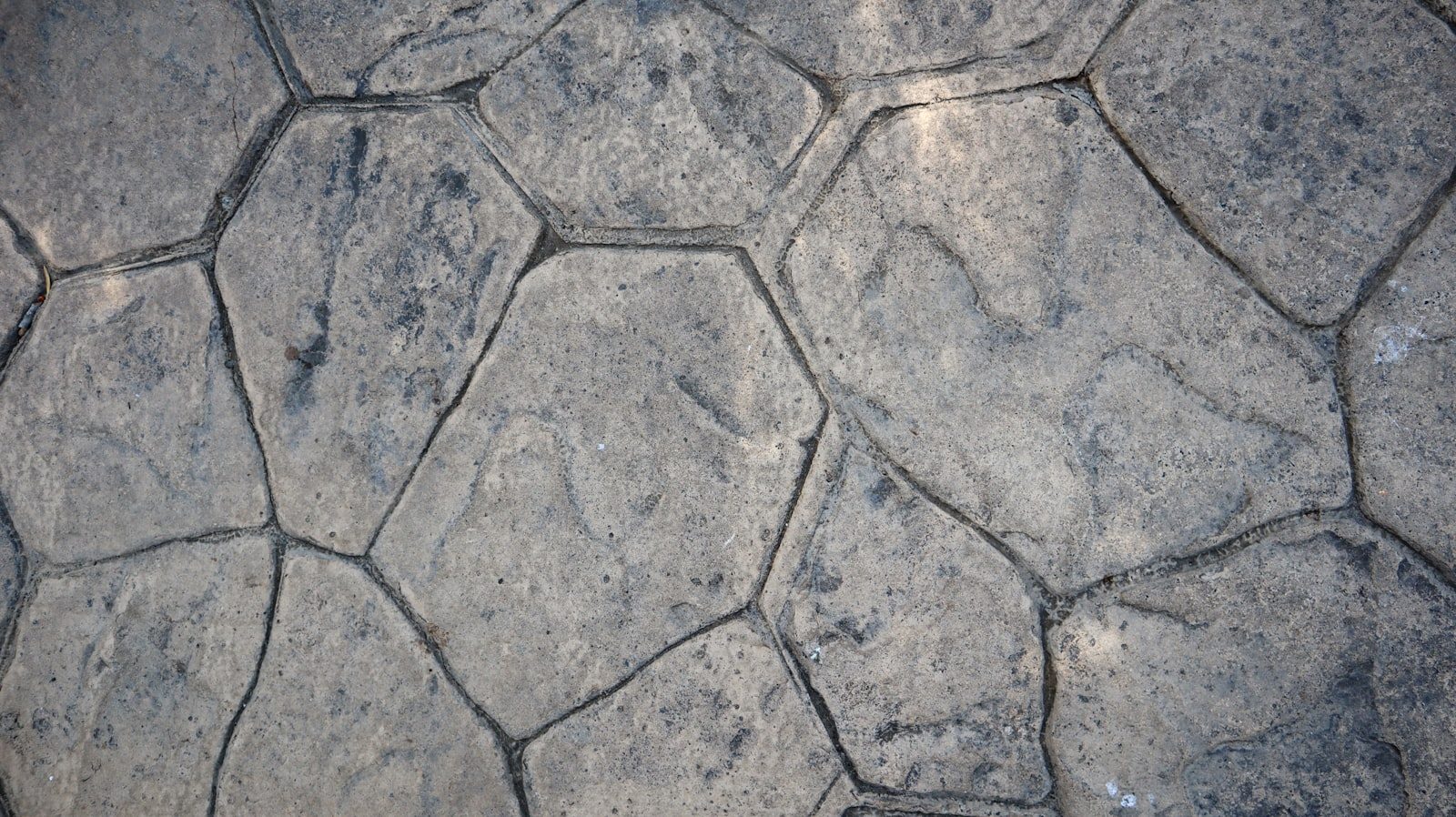
In August the second vehicle of the day is a saw, and it pulls up after dinner because the slab picks the hour, not the calendar.
There's a particular kind of August evening around here. The heat breaks around seven, the light goes long and orange, and somewhere in Lakewood one of our trucks pulls back up to a driveway we poured that morning, headlamps out, because the concrete is finally hard enough to cut and soft enough not to fight. Scoring runs on the slab's schedule. It has never once run on ours.
Cut lines are the cheapest way to make a plain slab look designed, and the result comes down to two decisions: where the lines go, and when the blade touches. Get the layout right and a gray rectangle reads as a floor with proportions. Get the timing wrong and you either ravel every groove edge or arrive to find the slab already cracked wherever it felt like.
Concrete keeps hardening from the minute it's placed. The cutting window opens when the blade won't tear the surface and closes when the slab is hard enough that cutting starts causing random cracks elsewhere. On a hot dry Lakewood afternoon that window can open four hours after placement. On a cool cloudy May morning it might not open until evening. Either way, somebody is coming back the same day.
Two kinds of cuts happen. Control joints, the ones doing structural work, go in early with a saw that rides on skid plates and doesn't need fully hard concrete. Decorative lines can wait a little longer, and on some jobs we cut them the next morning when the light is better and we can chase a chalk line precisely. Scoring a slab poured years ago is a different animal: a dry cut, a different blade, dust collection running, and more time than people picture.
| Pour day conditions | When we cut | Why |
|---|---|---|
| Hot, dry, breezy afternoon | Early evening, sometimes sooner | The slab sets fast and shrinkage risk climbs by the hour |
| Cool overcast morning | Late evening, occasionally under lights | Set is slow, and cutting early ravels the groove edges |
| Shaded pour under mature trees | Split across two visits | The sunny half is ready long before the shaded half |
| Cold October pour, freeze coming | As soon as it holds an edge, before we blanket it | Nobody pulls blankets off a slab at midnight to cut it |
| Rain landed during finishing | Later, after we look at the surface | A rained-on surface is fragile and cutting can tear the top |
| Existing slab, poured years ago | Any dry day, scheduled on its own | Cured concrete gets a dry cut with vacuum collection, no clock at all |
Most bad scoring jobs come from missing this. A control joint is a deliberate weak plane cut about a quarter of the way through the slab, so that when the concrete shrinks, and it will, the crack happens in that groove where nobody sees it. On a four inch patio that's a full inch deep. A decorative line is a fraction of that, cut for looks and nothing else.
Which means decorative lines relieve nothing. Cut a beautiful diamond pattern, skip the real joints, and the slab cracks straight through it on its own terms. The two systems get planned together. We lay out the decorative grid first, then place structural joints so they land on pattern lines wherever spacing allows. Where they can't, we widen the joint slightly or add a border, so the eye reads design rather than an apology.
We chalk it full size so you can stand on it and look before a blade ever runs. Free estimates, licensed and insured. Call (303) 569-4046.
Grooves collect things, and what they collect depends on where you live. Under the old trees in Bear Creek and Applewood the lines fill with needles and leaf litter every fall, so they want a stiff broom or a blower before winter. Green Mountain catches wind-driven grit and the sand that goes down for winter traction. Solterra deals mostly with construction dust until the landscaping matures. None of it does damage.
Winter worries people, mostly without cause. Water freezing in a shallow groove does not split a sound slab, since the groove is far too shallow to act as a wedge. Deicing chemical sitting in the lines is the real problem, which is why we ask for sand instead of salt. New pours with integral scoring happen whenever we can pour. Dry cutting existing slabs is a spring through fall job.
Still unsure about something?
Call the crew at (303) 569-4046 and we will talk it through.

Get a free, no-obligation estimate from a crew that knows Colorado soil, Colorado weather, and how to finish concrete that lasts.
Accessibility
Adjust the site to fit how you read and browse. Your choices are saved on this device.