
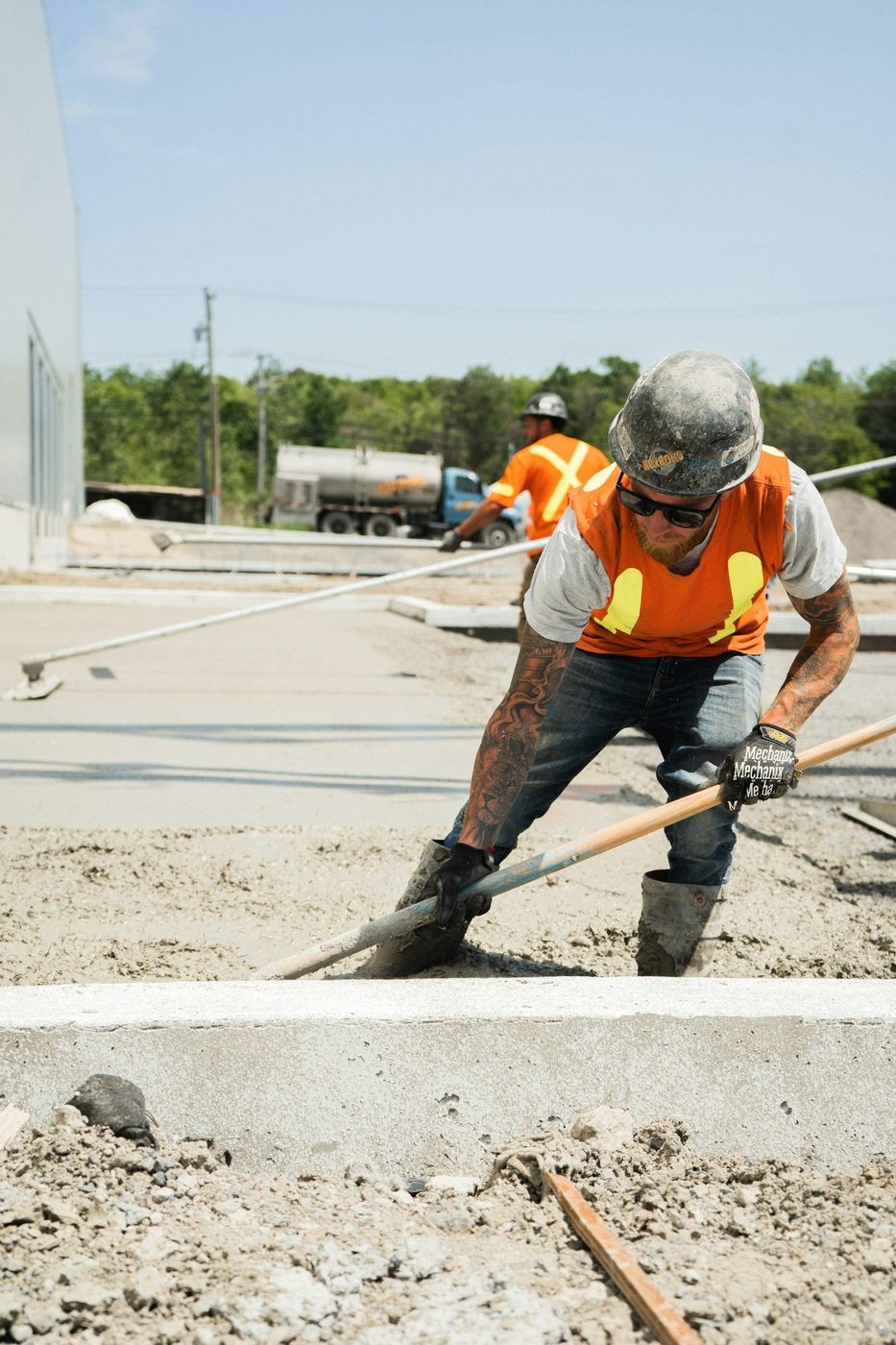
The hardest thing a finishing crew does all day is stand there and not touch the slab.
Pull up to one of our pours around ten in the morning and you may see five people leaning on shovels doing absolutely nothing. That's not a break. That's the most disciplined part of the job. Between placing concrete and putting a texture on it there's a stretch where the slab has to be left alone, and working it during that stretch is how you get a driveway that sheds gray powder for twenty years.
A finish isn't a product. There's no bucket of broom finish in the trailer. It's the last hour of a sequence that started with base compaction and ends with a saw, and the tools are simple. What separates a good slab from a bad one is timing, and timing at fifty-five hundred feet in dry air runs faster than the textbook says.
The truck backs in and concrete comes down the chute in piles that get raked into rough position. Nobody is trying to make it pretty yet. We're getting the right volume into the right places at roughly the right height, keeping it moving so nothing stiffens in a corner. Then the screed rides the forms and cuts the whole thing to grade, which is where the slope you live with gets locked in. Water has to leave your patio somewhere, and it's decided right here.
Behind the screed comes the bull float. It pushes coarse rock down, pulls paste up, and closes the surface so everything after this works with cream instead of gravel. That pass ends the loud part of the morning.
Fresh concrete pushes water to the top. It has to, since the solids are settling. That sheen must rise and then leave before anyone touches the slab again, because troweling water back down produces a weak layer that scales off in sheets. Every dusty, flaking driveway you've seen started as somebody in a hurry.
Colorado makes this harder. Our air is dry enough that on a breezy afternoon bleed water evaporates as fast as it arrives, so the top looks ready while the concrete underneath hasn't set. Wind off Green Mountain does that to a slab in twenty minutes. Shade does the opposite, and a pour tucked under mature trees in Bear Creek or Applewood holds a sheen long after the sunny half is ready. We read each area separately and finish in stages.
| Window | What the concrete is doing | What we do | What missing it costs |
|---|---|---|---|
| Placement | Still plastic and workable | Rake, shovel, screed to grade | Low spots that hold water for the slab's whole life |
| Bull float | Aggregate settling, paste rising | One or two passes to close the surface | Rock at the surface and an uneven texture |
| The wait | Bleeding, then setting | Nothing at all, and we watch the sheen | Scaling and dusting a few winters out |
| Edge and joint | Firm enough to hold a shape | Tool the perimeter, isolation joints tight to structures | Chipped edges and cracks fanning off the house |
| Texture | Stiff but still open | Broom, float, or trowel, by where the slab lives | Fading broom lines or a slick winter surface |
| Saw cut | Hard enough to cut, soft enough not to fight | Control joints at the right spacing, same day | Random cracking that picks its own route |
| Cure | Gaining strength | Cure compound or wet cure, protection if weather turns | A slab that never reaches the strength it could have |
We walk the property, look at sun, slope, and how you use each area, then spec it. Free estimates, licensed and insured. Call (303) 569-4046.
Texture follows use and exposure. Driveways and anything on grade in Green Mountain get a real broom pulled across the direction of travel, because grip on a slope in January beats a smooth photograph in July. Patios behind newer Solterra homes usually want a softer float finish, since bare feet live there. Front walks in Belmar and Applewood get a medium broom that hides the mineral staining older irrigation leaves behind. Interior slabs and garage floors get a hard trowel, which belongs indoors and nowhere else out here.
Season matters as much as texture. April through October is the comfortable stretch, with midsummer pours starting at first light so the window doesn't collapse under afternoon sun. We do pour in winter with heated water, non-chloride accelerator, and insulated blankets, and we will not put concrete on frozen ground. If a hard freeze is coming the night after placement, we blanket it properly or we move you.
Anybody can pull a broom. Knowing the exact minute to pull it is the part that takes years, and the slab is the only thing that tells you.
Straight from the crew
Still unsure about something?
Call the crew at (303) 569-4046 and we will talk it through.
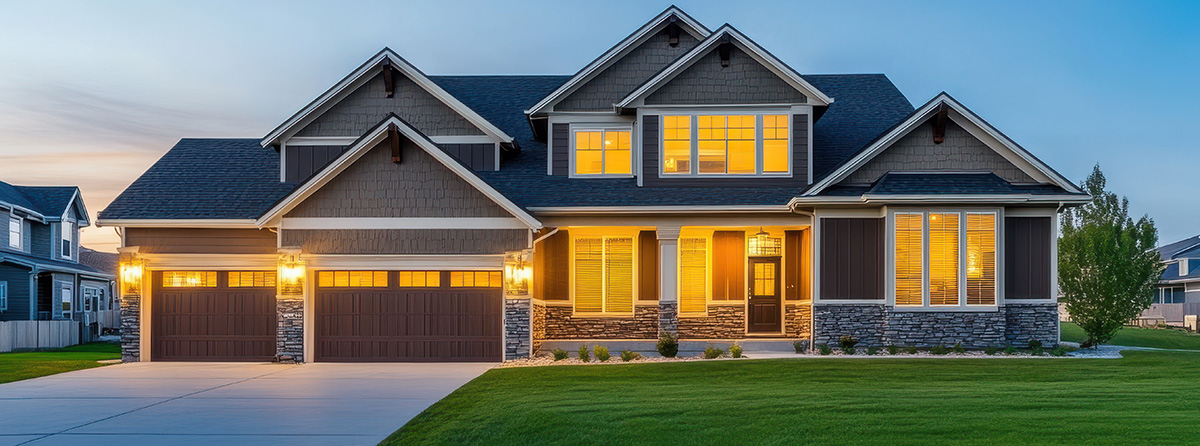
Get a free, no-obligation estimate from a crew that knows Colorado soil, Colorado weather, and how to finish concrete that lasts.
Accessibility
Adjust the site to fit how you read and browse. Your choices are saved on this device.