
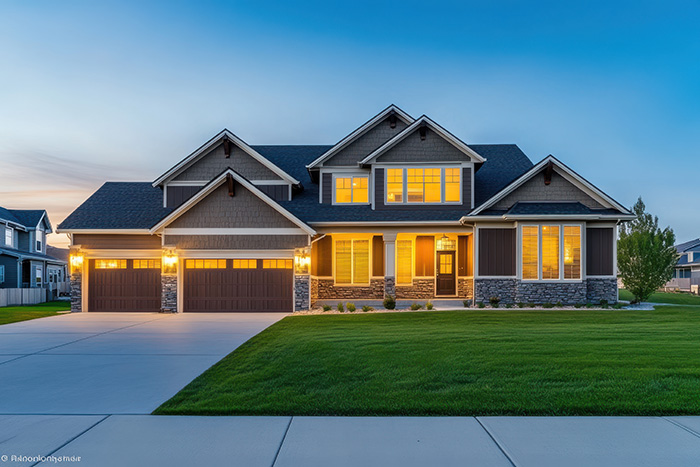
An outdoor concrete top usually cracks for reasons that start three feet below it, in dirt nobody thought about.
Every concrete top we build is a beam. A thin, heavy, brittle-in-tension beam that happens to have a sink hole in it and a person leaning on the end. Beams fail at their supports, which is why our questions on a countertop call have so little to do with color.
Indoors that means cabinet boxes, spans, and how much unsupported edge hangs over the stools. Outdoors it means the masonry island, the slab holding it, the base under the slab, and the Jefferson County dirt under all of that. A kitchen island doesn't move. A grill island in a Lakewood backyard sits on ground that swells, drains, freezes, and settles, and the counter is the piece with the least tolerance for any of it. That's where cracks come from. Not from hot pans.
Take the outdoor case first, since it gets built backward. Somebody pours a patio, lives on it a few years, then adds a grill island on top. Now a stack of block, stone veneer, an appliance, and a concrete slab all bear on four inches of concrete designed for a table and four chairs. Sometimes that's fine. Often the island wants a thickened footing under it, poured to frost depth on properly compacted material, and the smart move is building that before the patio.
Drainage does the rest of the damage. Water off the roof, off the counter, or out of a sprinkler head soaks the ground right where the load is. Wet clay under a footing in November and frozen clay under it in January are two different bearing conditions, and the top telegraphs the difference. Indoors the physics are the same with easier variables. Our engineer looks at anything spanning far or cantilevering hard, and that's included, not an upsell.
| Situation | How we build the top | What has to be underneath |
|---|---|---|
| Perimeter run on base cabinets | Nominal thickness, steel through the field | Level, square boxes and a flat substrate the full width |
| Modest seating overhang | Extra steel run out into the cantilever during casting | Solid attachment at the back edge and no flex in the cabinet |
| Deep bar overhang | Reinforced cantilever plus concealed steel plate or corbels | Blocking inside the cabinet to anchor the hardware |
| Span over a dishwasher or sink | The narrow strips front and back get treated as the weak link | Cabinet stretchers, not just a top bridging an opening |
| Outdoor grill island top | Higher air content, heavier steel, weather-rated sealer instead of a food one | A footing to frost depth and ground that drains away from the base |
| Floating vanity or wall-hung top | Hidden steel armature cast into the slab | Blocking in the wall framing, located before drywall |
Countertop concrete is nothing like what comes out of a ready-mix truck. It's a fine, stiff, sand-heavy mix with small top-size aggregate, high strength, and admixtures that let it flow around reinforcement without segregating. We cast face down against a sealed form, so the surface you eventually eat off is the surface that touched the mold.
Steel goes in as a mat plus targeted reinforcement wherever the geometry gets thin: behind a sink, in front of a cooktop, out into an overhang. Then the top cures slow and covered, gets demolded, ground, and filled. Sealing deserves harder questions than it usually gets. We use a system rated for direct food contact, applied thin on a fully dry top, and we tell you plainly that it's a maintenance item. Neutral cleaners only. Acid etches these, and a cut lemon left overnight is how people learn that.
Call before the masonry goes up. Getting the footing and the support right costs far less than fixing a cracked top later. Call (303) 569-4046.
Winter is the harder test outside. A top on a grill island takes hail in June and forty degree swings in one February day, and the sealer that keeps a kitchen counter right is the wrong product for that. Outdoor tops get an air-entrained mix, heavier steel, and a weather-rated sealer we refresh every couple of years.
The shop runs year round, so casting happens whether the ground is frozen or not, and winter is our best season for kitchen work. Indoor tops come mostly out of Belmar, Applewood, and Bear Creek remodels. The grill islands are Solterra and Green Mountain, where a walkout and a view do the selling and the ground under the island is doing the arguing. Outdoor installs get set in the warm months. If masonry is involved, plan on a longer runway, since we template only after the block is permanently in place.
Still unsure about something?
Call the crew at (303) 569-4046 and we will talk it through.
Get a free, no-obligation estimate from a crew that knows Colorado soil, Colorado weather, and how to finish concrete that lasts.
Accessibility
Adjust the site to fit how you read and browse. Your choices are saved on this device.