
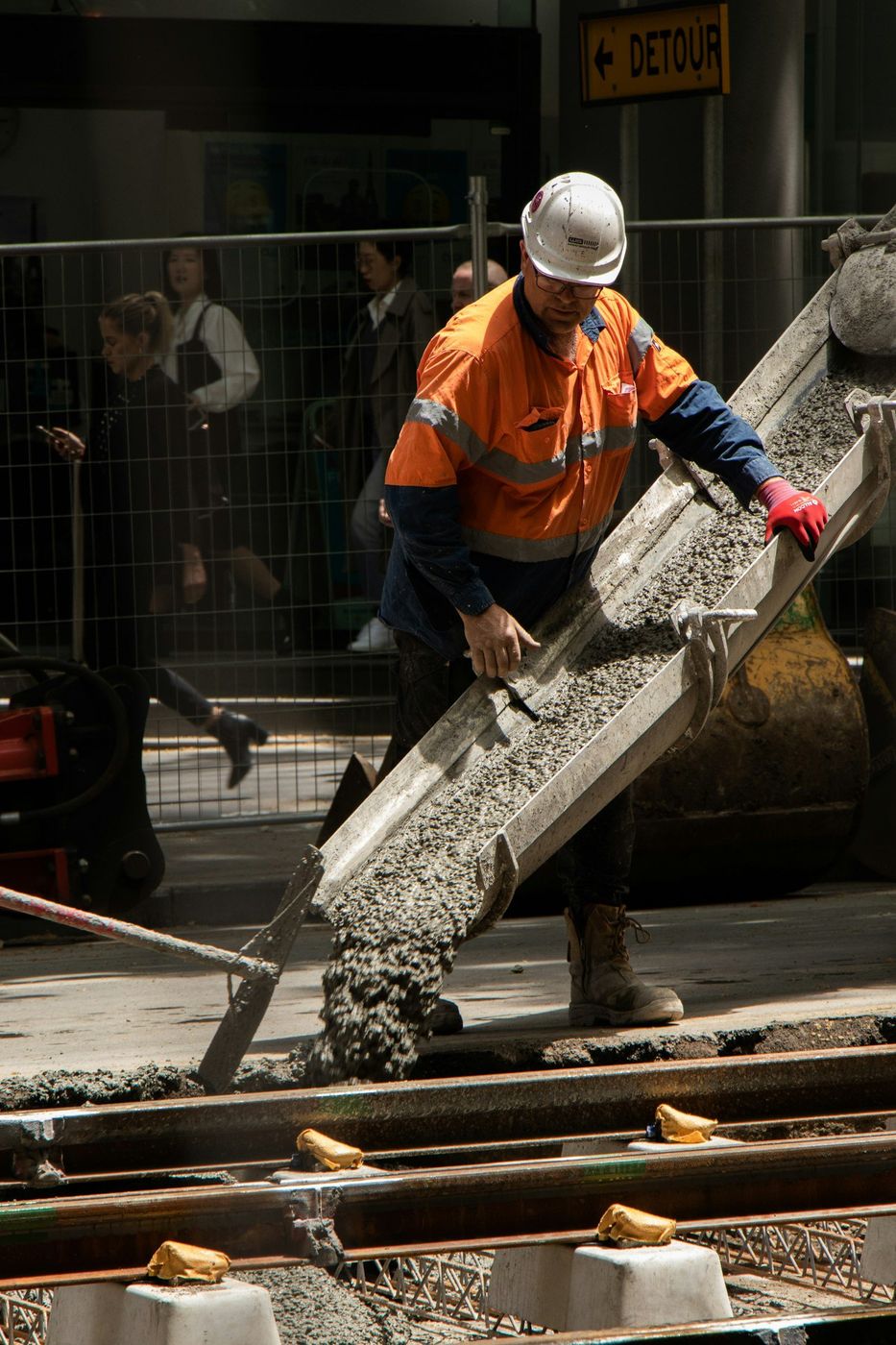
One plane, one direction of fall, and every joint kept out of the places people actually play.
Your lot decides this project, not a catalog page. The wide shallow back yards behind a lot of Lakewood's mid-century homes will take a generous half court without touching the garden, but they rarely have the depth for anything longer. Newer parcels tend to run the other way: deeper, narrower, and often with a grade change somewhere in the middle. Both work. They just produce different courts, and the sooner we measure, the sooner the conversation gets honest.
The other thing that separates a court from a big patio is flatness in one specific sense. A ball has to bounce the same everywhere, which means the surface falls in a single continuous plane rather than crowning in the middle or pitching two directions the way a driveway does. Get that wrong and no amount of coating or striping fixes it, because the problem is the concrete.
Around Applewood and the older streets near Belmar, lots came with real width and mature trees at the edges. Those yards usually take a half court comfortably, and the constraint is shade and leaf drop more than dimensions. We look at where the sun crosses in the afternoon, because a court in full western exposure at this elevation gets uncomfortable in July and a court under a big canopy stays wet and mossy in the shoulder seasons.
The Green Mountain side is a cut-and-fill exercise almost every time. A court has to be a single flat plane, so a sloped yard means excavating into the hill on one side and building up on the other, and the built-up side needs compacted structural fill with a retaining detail rather than dumped dirt. That work is real and it belongs in the plan from the start. Solterra and the newer builds bring tighter setbacks and HOA rules on structures and fencing, so read yours before settling on a layout. Bear Creek properties vary wildly, and some of the best layouts we've drawn are on those larger irregular lots with room to turn the hoop away from the neighbors and the low sun.
| Layout | What you get | What the yard has to give up |
|---|---|---|
| Full-size court | Two hoops, real running game, a genuine sports surface | The largest flat footprint of anything we pour residentially. Rare outside acreage |
| Half court with a full key and arc | Everything a driveway game needs, laid out to real proportions | A rectangle roughly the width of a two-car drive and about twice its depth |
| Compact key and arc | Free throws, shooting, and one-on-one, proportional but scaled down | Fits a lot of ordinary yards without eating the whole thing |
| Shooting strip beside the drive | Practice space and a clean surface, tied into concrete you already have | Almost nothing, though the geometry limits what you can run |
| Multi-use pad | Basketball plus pickleball, striped for both | Nothing extra in size, but the joint layout and striping get more complicated |
We'll measure the yard, shoot the grade, and lay out a court on paper before anybody talks about a hoop.
Control joints are the part people never think about and the part that decides whether the court plays well. Concrete this size has to be jointed or it will crack where it wants to. So the pattern gets planned first and the court laid out around it, with cuts held clear of the key and the free throw line, running in a grid that lines up with the court's own geometry instead of slicing through the top of the arc. A joint nobody notices mid-game is a joint we placed on purpose.
Under it: compacted base at consistent depth, and number 4 bar on chairs rather than mesh lying on the dirt. Mesh is fine for a shed pad. A court is a large uninterrupted slab that has to stay in plane for twenty years, and the steel has to be where it does something. The hoop is its own structure. A fixed pole gets a footing dug below frost with anchor bolts set in a template while the concrete is wet, poured as its own element so it isn't tied to the court. A portable base is the cheap option, and it slides, tips, and marks the surface.
Still unsure about something?
Call the crew at (303) 569-4046 and we will talk it through.
Get a free, no-obligation estimate from a crew that knows Colorado soil, Colorado weather, and how to finish concrete that lasts.
Accessibility
Adjust the site to fit how you read and browse. Your choices are saved on this device.