
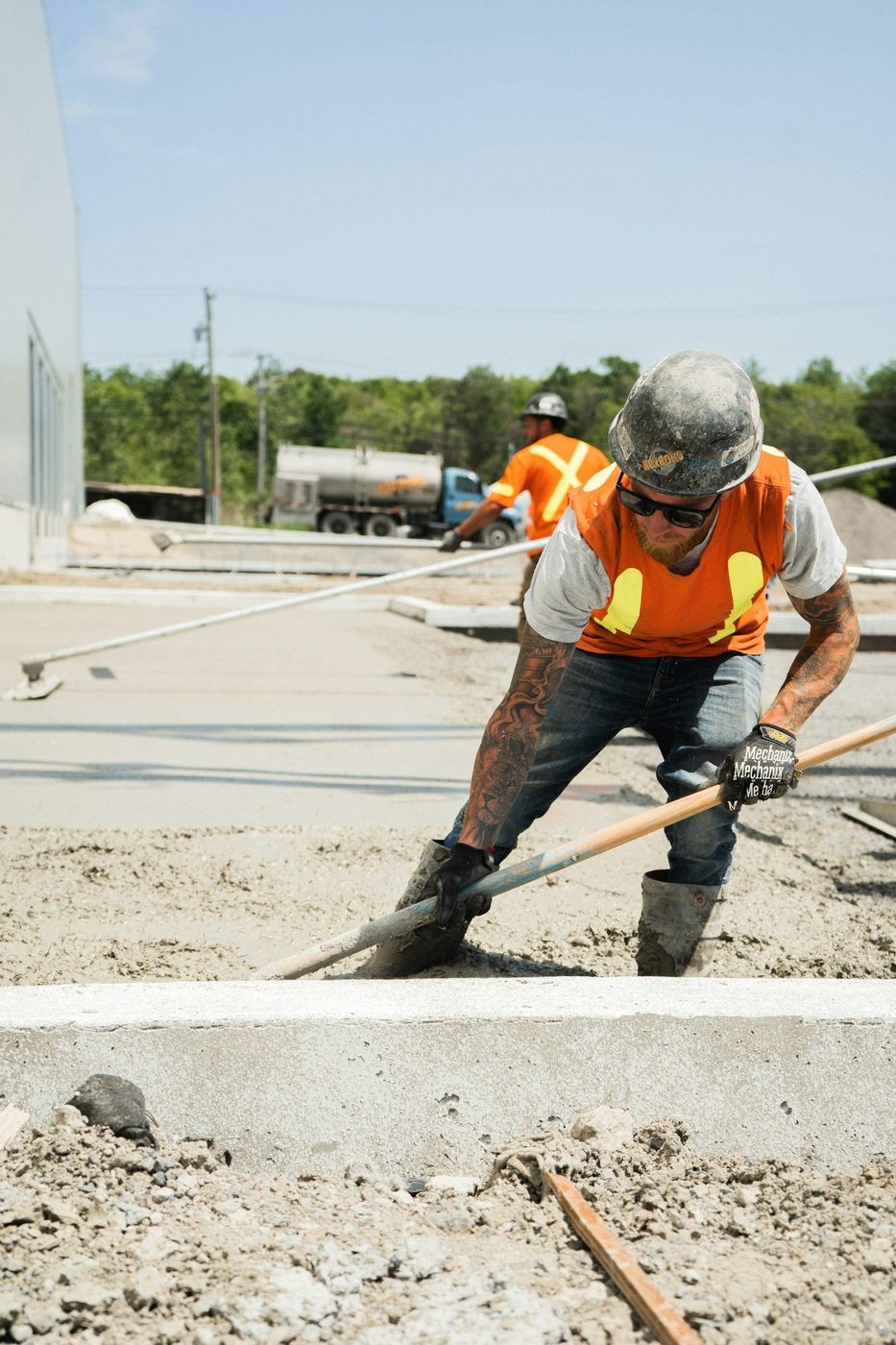
The landing is where you fumble for keys, hold a door, and set the bag down. Build that part right.
Think about what happens on your front steps in a normal week. Somebody comes up with a paper bag on one hip, digging for keys, and needs a flat place to stand while the storm door swings out at them. A kid takes them two at a time. Two trash cans get dragged down on Tuesday night and hauled back up Wednesday. A delivery driver jogs up, drops a box on the landing, and jogs back down without looking.
None of that is graceful and none of it is careful, and a good flight absorbs all of it without anybody noticing. We rebuild entries all over town, from the compact stoops on the mid-century blocks near Belmar to taller flights working down a grade in the Green Mountain area, and the design conversation always starts in the same place. Not the pattern, not the color. The landing.
A landing that is too shallow forces you to back down a step to let the storm door past, usually while holding something. That is the most common mistake we find on older entries, and it is the one that quietly makes people uneasy about their own front door. We build the top landing deep enough to stand square in front of the door, swing it fully open, and still have room behind your heels.
Width matters for the same reason. Two people should pass, or one person should set a box down and still get by it. And the landing gets fall like everything else, pitched away from the threshold so meltwater heads for the yard instead of pooling against the house and working into the joint. Small detail. It decides whether the top tread is dry or glazed on a January morning.
Your legs learn a staircase in about two trips. After that you are running on memory, in the dark, thinking about something else. That is why consistency beats every other spec on a flight. One riser a half inch taller than its neighbors is the reason somebody stumbles carrying groceries, and it is almost always the bottom one, because whoever poured it let the walk elevation dictate the last step instead of dividing the total height evenly.
We measure the full rise from finished landing to finished walk, divide it into equal parts, and build the forms to those numbers. Codes cap riser height and the variation allowed across a flight. We work well inside them. Rails get anchored into the concrete or into footings poured for the purpose, not surface-screwed into a tread and left to work loose. A rail that wobbles is worse than no rail, because people trust it.
We will measure the rise, check the landing, and lay out what it takes. Free estimate. (303) 569-4046.
| Approach | Does it help you stay upright | What it does to the concrete |
|---|---|---|
| Shovel early, before it packs | The most effective thing on this list | Nothing, if you use a plastic blade instead of steel |
| Sand or crushed grit | Yes, immediately, on top of ice | Harmless. Sweep it off in spring so it does not grind the surface |
| Magnesium chloride | Works fast at low temperatures | The hardest thing you can do to concrete. We ask you to keep it off entirely |
| Rock salt | Works down to moderate cold | Drives freeze-thaw damage into the top layer. Never on a first-winter pour |
| Rubber stair treads | Good grip and easy on bare feet | None. Lift them in spring so moisture does not sit trapped underneath |
| Heated mat at the entry | Excellent, and it removes the shoveling question | None. Run the conduit for it while the steps are being built |
Trash cans are harder on a set of steps than people are. Two loaded cans dragged down every week put their weight on the nosings, the thinnest and most exposed part of the flight and the first thing to go. We build a generous radius on that edge, tool it properly, and keep the mix air-entrained so the front lip has a fighting chance.
Texture is the other daily-use decision. A hard steel trowel finish looks sharp and turns treacherous the second it gets wet, and it will get wet, because the roof line above most entries drips right onto the top tread. We broom the treads across their width so the grooves run the direction you walk. It is not a rough finish. It is just not glass.
Steps are hand-formed work, so we like the shoulder seasons: April into June, then September through October, when the crew is not fighting heat during the finish. Cold-weather flights are doable with heated water and blankets over the whole set, and we will not place on frozen footings. Plan on your entry being out of service for the better part of a week.
Ask somebody what is wrong with their front steps and they say the concrete is crumbling. Watch them use the steps for two minutes and you see the real problem: they always pause at the same spot, because one riser is off.From the crew lead on these jobs
Still unsure about something?
Call the crew at (303) 569-4046 and we will talk it through.

Get a free, no-obligation estimate from a crew that knows Colorado soil, Colorado weather, and how to finish concrete that lasts.
Accessibility
Adjust the site to fit how you read and browse. Your choices are saved on this device.