
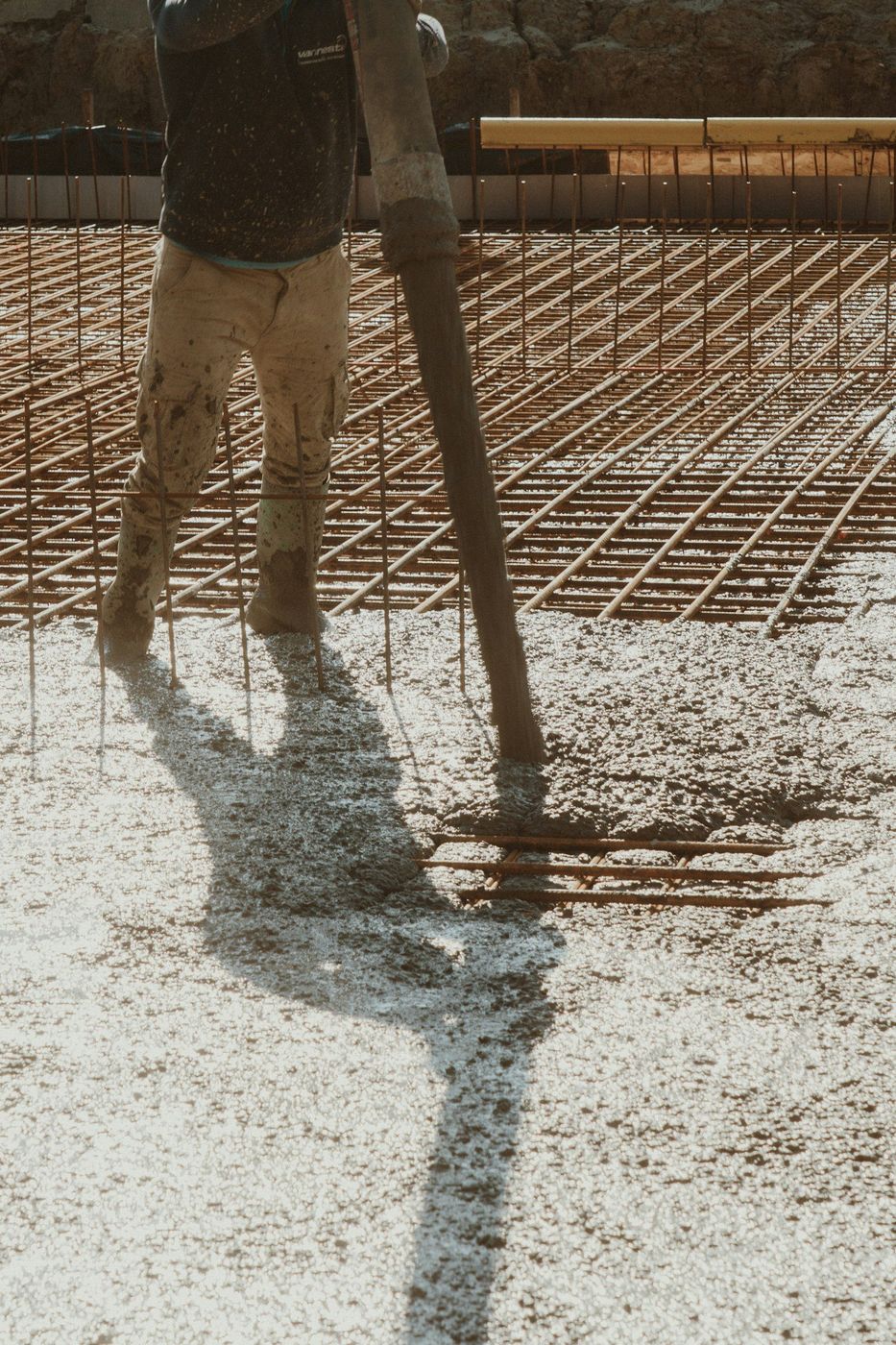
Flat enough that the ball comes back the same way every time, joint layout included.
Every court conversation starts the same way: how much usable flat ground is behind the house. That question sorts our calls faster than budget does. Homes on the bigger lots out toward BackCountry usually have room for a real half court without touching the lawn. Yards in Northridge and Westridge tend to come with mature trees, a slope, and a fence line that decides the footprint for you.
We pour courts in all of those situations, though the honest version of the job usually includes grading and sometimes a small retaining element first. Check your HOA before you fall in love with a layout, since pole height, lighting, and fencing are things communities have opinions about. Then comes the fun part: a slab flat enough and jointed well enough that the ball behaves.
A court is a big rigid rectangle, and big rigid rectangles don't negotiate with a sloped backyard. Most sites need cut and fill first, and the fill side has to be built in compacted lifts, because a slab poured over loose fill cracks right along the line where the two meet. On steeper lots we set a low wall on the downhill side and build the pad off it. Usually looks better than a long grade tapering into the lawn anyway.
Orientation is worth five minutes. Run the long axis roughly north and south and late-afternoon sun stays out of a shooter's eyes, which decides whether the court gets used after work. Drainage is the other one. We fall the whole slab a single direction at about a percent, never crowned, never dished, so a loose ball rolls to a predictable corner.
Trees are the wildcard on older streets. Roots lift a slab eventually, and we'd rather move the court ten feet than take that fight on.
| Layout | Slab footprint | What it gives you |
|---|---|---|
| Key and free throw only | About 20 by 25 feet | Foul shots, layups, one-on-one. Fits alongside a lot of driveways. |
| Compact half court | About 30 by 30 feet | Short corner threes and room to drive. The most common backyard size we pour. |
| Three-point half court | About 40 by 40 feet | The full arc at high school distance with room behind it. |
| Regulation high school half | 50 wide by 42 deep | Real half court dimensions, including the whole lane and arc. |
| Basketball plus pickleball | About 30 by 60 feet | Two sports, two line colors, one slab. Post sleeves set during the pour. |
| Full high school court | 84 by 50 feet | Rare in a backyard. Doable when the lot and the grading allow it. |
Here's the part cheaper court builders skip. Concrete this size has to have control joints, and a joint in the wrong spot turns a dribble into a coin flip. We draw the pattern before the pour, keep panels close to square, run the lines symmetrically about the center, and place joints at the boundaries of play instead of straight through the lane. Then we fill them with a semi-rigid material so the edges stay supported and a ball crossing the line doesn't dive.
Surface texture is the other one. A hard steel trowel finish looks great and turns into an ice rink the moment it's wet, so we use a light float or a fine burnish under an acrylic sport coating. That coating carries the grip and the color. Skip it and you've got gray concrete that plays fine and runs hotter in July.
Pour season runs late April into October, and September is the sweet spot for a slab this large, since cooler afternoons mean the finishers aren't racing the surface. Big pours and summer thunderstorms don't mix, so we start early and keep protection on the truck. Coatings want warm dry weather of their own, so a fall pour often means curing over winter and striping in spring.
We'll tell you which layout fits, what grading it takes, and where the hoop should stand.
Still unsure about something?
Call the crew at (303) 569-4046 and we will talk it through.
Get a free, no-obligation estimate from a crew that knows Colorado soil, Colorado weather, and how to finish concrete that lasts.
Accessibility
Adjust the site to fit how you read and browse. Your choices are saved on this device.