
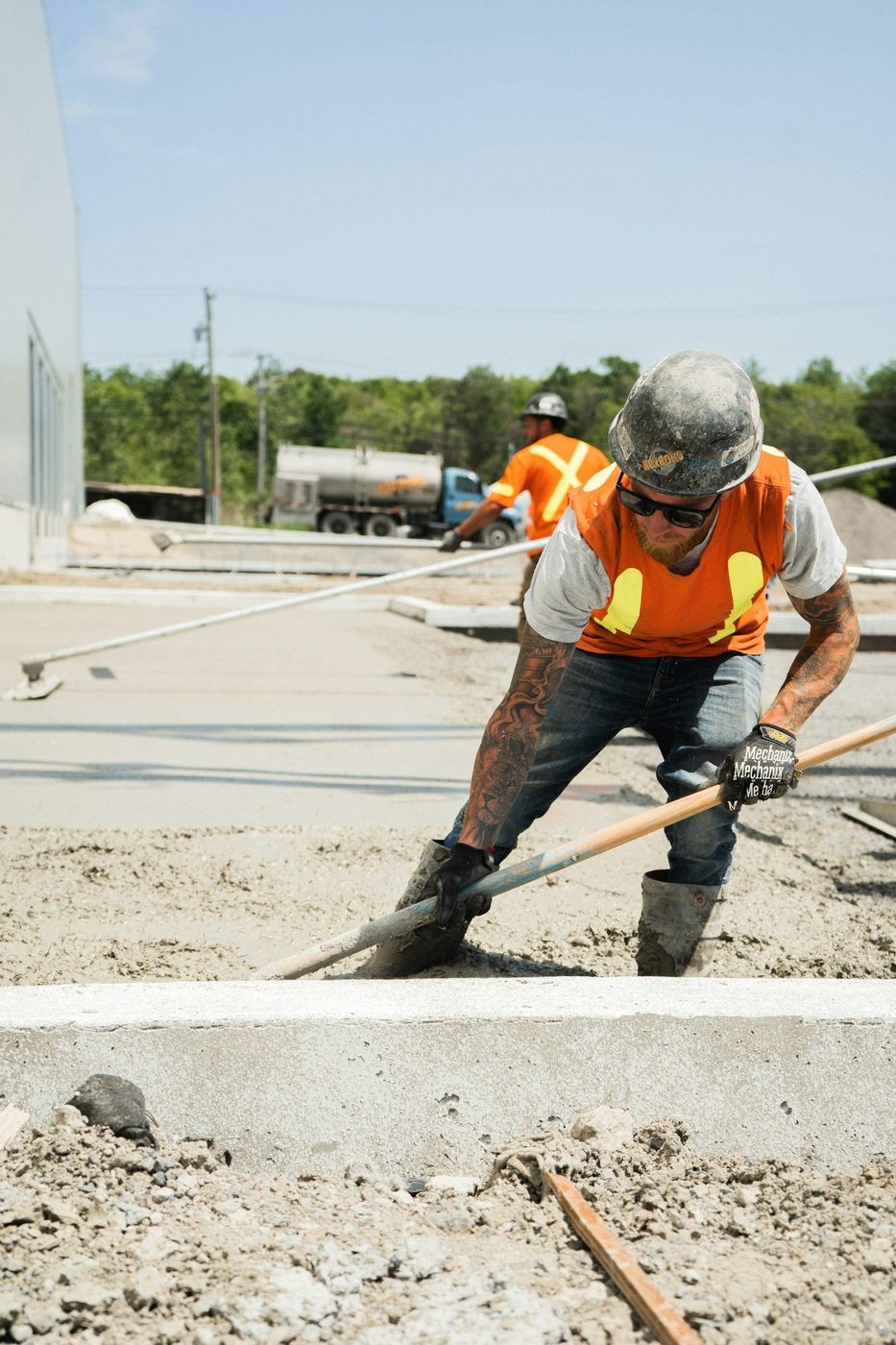
Every trip to the car, the mail, and the trash cans crosses them. They should be boring and identical.
Nobody looks at their front steps, and that's the point. A good flight vanishes into the routine: down to the car in the dark, up with an armload of groceries, out for the mail, back with the trash cans, ninety trips a week without a single conscious thought. The day you start noticing your steps is the day one riser has gone half an inch off and your foot has learned to hesitate on it.
That hesitation is what we build against. Even rise, matching run, treads that shed water and still grip when wet, and a rail anchored into solid concrete rather than screwed into a crumbling edge. Steps carry more traffic per square foot than anything else on the property, and they're the smallest thing we pour. Odd combination, and it's exactly why sloppy step work shows up so fast.
Consistency beats any particular number. Your legs measure the first step and then assume every one after it matches, which is why a flight with one odd riser trips people who have lived in the house for twenty years. Code holds the variation between the tallest and the shortest riser in a run to under half an inch, and honestly your body registers a discrepancy well before that. We form to a single calculated rise and check every one before the truck shows up.
For comfort, a rise somewhere near seven inches with a run near eleven suits most people carrying most things. Deeper treads feel gracious on a wide front entry; shorter runs make sense on a tight side stair where space is short. What doesn't flex is the top landing. It needs to be deep enough that you can stand with the storm door swinging toward you without backing off the edge, and it needs to be pitched away from the threshold so a rainstorm doesn't drive water at your door sweep.
Handrails get planned during forming, not after. Once you're past a couple of risers a graspable rail is required, and the difference between one that lasts and one that wobbles is whether we set sleeves in the wet concrete or drill into an edge later.
Steps take the harshest weather exposure of any concrete on a house. Treads are horizontal, so they hold water. Nosings stick out into the air on two sides, so they freeze faster and thaw faster than anything behind them. Add a shovel scraping that same edge forty times a season and the front lip goes first. Spalled nosings are the top reason we get called about a flight that's otherwise sound.
Orientation decides how bad it gets. A north-facing entry in Northridge stays iced over long after the neighbors' walks have dried, so those flights want a heavier broom texture and a real slope on the treads. Over in The Hearth we do more exterior flights than the front stoop alone would explain, because homes on sloped lots with walk-out basements need a run of steps from the upper grade down to the lower patio, and those get used daily by kids and dogs.
Best season for step work is the same as for everything else we pour, roughly mid-spring through mid-fall, and we lean toward May or September when the days are mild enough to give us finishing time on the treads. Steps are fussier in cold than flatwork is, because there's more formwork and more exposed surface per yard of concrete. Cold pours happen with heated water and careful protection, and we're straight about when a job should wait.
| Method | Holds up here? | Why we pick it or pass on it |
|---|---|---|
| Poured in place on a footing | Yes | One monolithic unit with no joints for water to work into. Our default by a wide margin. |
| Precast units set on a base | Sometimes | Quick to install, but the pieces settle out of level independently and the seams between them collect ice. |
| Block and mortar with a cap | Rarely | Mortar joints are the weak link. Freeze cycles find them, the cap loosens, and repointing becomes an annual chore. |
| Timber with gravel treads | Not at an entry | Fine on a garden path. It rots at grade, moves with frost, and never keeps a consistent rise. |
If one is off, or the front lips are crumbling away, call (303) 569-4046 and we'll tell you whether it's a repair or a rebuild.
Nine out of ten step repairs are the same thing: the front edge of the treads is gone and the rail post is loose. Both come from water sitting where the concrete is thinnest.The crew lead's read on it
Still unsure about something?
Call the crew at (303) 569-4046 and we will talk it through.
Get a free, no-obligation estimate from a crew that knows Colorado soil, Colorado weather, and how to finish concrete that lasts.
Accessibility
Adjust the site to fit how you read and browse. Your choices are saved on this device.