
Landscape edging that holds a line for twenty years instead of buckling out of the bed in three.
You can diagnose most yards from the street. Plastic edging that has popped up out of the bed and now waves along like a black snake. A steel strip with a rusted lip standing an inch proud, waiting on somebody's bare foot. Rock spilling out onto the lawn where a border used to be, and a mow line that has crept a foot and a half into the planting since April.
Every one of those is the same failure in a different costume. The edging had no weight to it, it never went deep enough to matter, and Colorado ground pushed it aside. Poured curbing ends the argument: nothing to unstake, nothing to lift. It's a continuous little beam of concrete with a footing built in, and mowers, freeze cycles, and a ton of river rock all lose to it.
| The symptom | What went wrong | What we do instead |
|---|---|---|
| Plastic edging waving up out of the ground | Stakes lifted by frost, and the strip has no mass to hold itself down | A continuous poured curb with its footing below the bed line |
| Steel edging with a raised, rusted lip | Same heaving, plus corrosion right at the soil line | Concrete doesn't rust and offers nothing sharp to catch a foot |
| Rock or mulch migrating into the turf | The border sits too low to contain what's behind it | A profile with enough height above grade to actually hold material |
| Grass runners marching into the beds | Nothing extends below the surface to stop them | Curb depth that reaches past where those runners travel |
| A curb that broke into loose chunks | Poured thin, nothing in the mix, no joints anywhere | Fiber through the batch and joints tooled on a planned spacing |
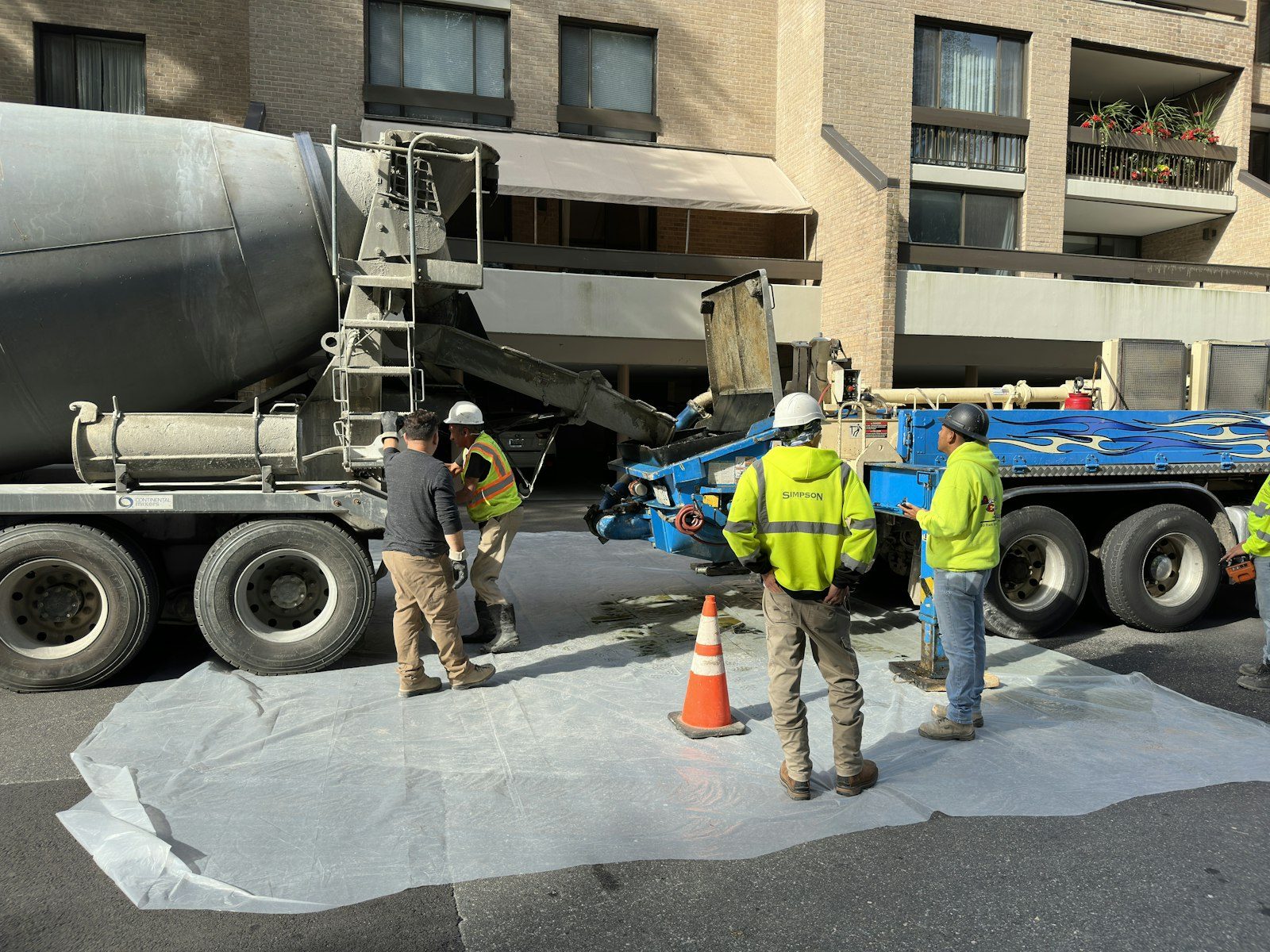
Most residential edging goes in with a curb machine. We feed a stiff, low-slump mix through it and it extrudes a continuous curb right on the bed line, which is why the curves come out smooth instead of faceted the way segmented products do. It's fast, it wastes almost nothing, and radius work is where it separates from the alternatives; a machine curb follows a sweeping arc around an island bed with no visible seam.
Formed curb is the other half of what we do, and it earns its keep where the machine can't help: taller retaining lips, curbs that step down a slope in even increments, straight lines along a walk. Slower, more labor, better result in those spots.
Profile is a real decision, not a catalog page. The slant or rolled top is what we push for anything bordering turf, because the mower wheel rides up on it and you stop hand-trimming the whole yard every week. A square profile looks sharper against modern architecture and holds deeper rock beds, at the cost of taking every shovel and mower hit on the corner. Eastridge yards are usually the first type, redoing beds that have fought sunken edging for decades. In BackCountry the curbing more often goes in with the plantings, and taller square profiles show up more there.
Free on-site layout and a straight price by the linear foot. Call (303) 569-4046 and we'll come measure the beds.
Curbing lives in the wettest microclimate on your property, and that's its main enemy. Irrigation runs three or four times a week straight onto a small section of concrete, so it goes into winter saturated, and a saturated section cycling through freezing and thawing is working against itself every night. Two things counter that: air entrainment in the mix, which we don't skip, and a sealer on colored curb renewed every few years. Adjusting heads so they water plants instead of concrete costs nothing and helps more than either.
The other damage source is the shovel and the plow blade, specifically where curbing runs along a driveway or a walk. Snow gets pushed toward the bed, the blade catches the curb, and you chip a corner. It's another argument for a rolled top, which deflects a blade instead of stopping it.
Installation season runs from the ground thawing in spring through to about the end of October. Curbing is quick, so it drops into a schedule without much lead time even during the busy months. Fall is quietly the best window: beds are getting cut back anyway, digging is easier in cool weather, and the curb cures for months before it faces a full irrigation season. Winter is the one time we'll tell you to wait. The machine needs unfrozen ground, and a thin section is far harder to protect through a cold night than a slab.
Still unsure about something?
Call the crew at (303) 569-4046 and we will talk it through.

Get a free, no-obligation estimate from a crew that knows Colorado soil, Colorado weather, and how to finish concrete that lasts.
Accessibility
Adjust the site to fit how you read and browse. Your choices are saved on this device.