
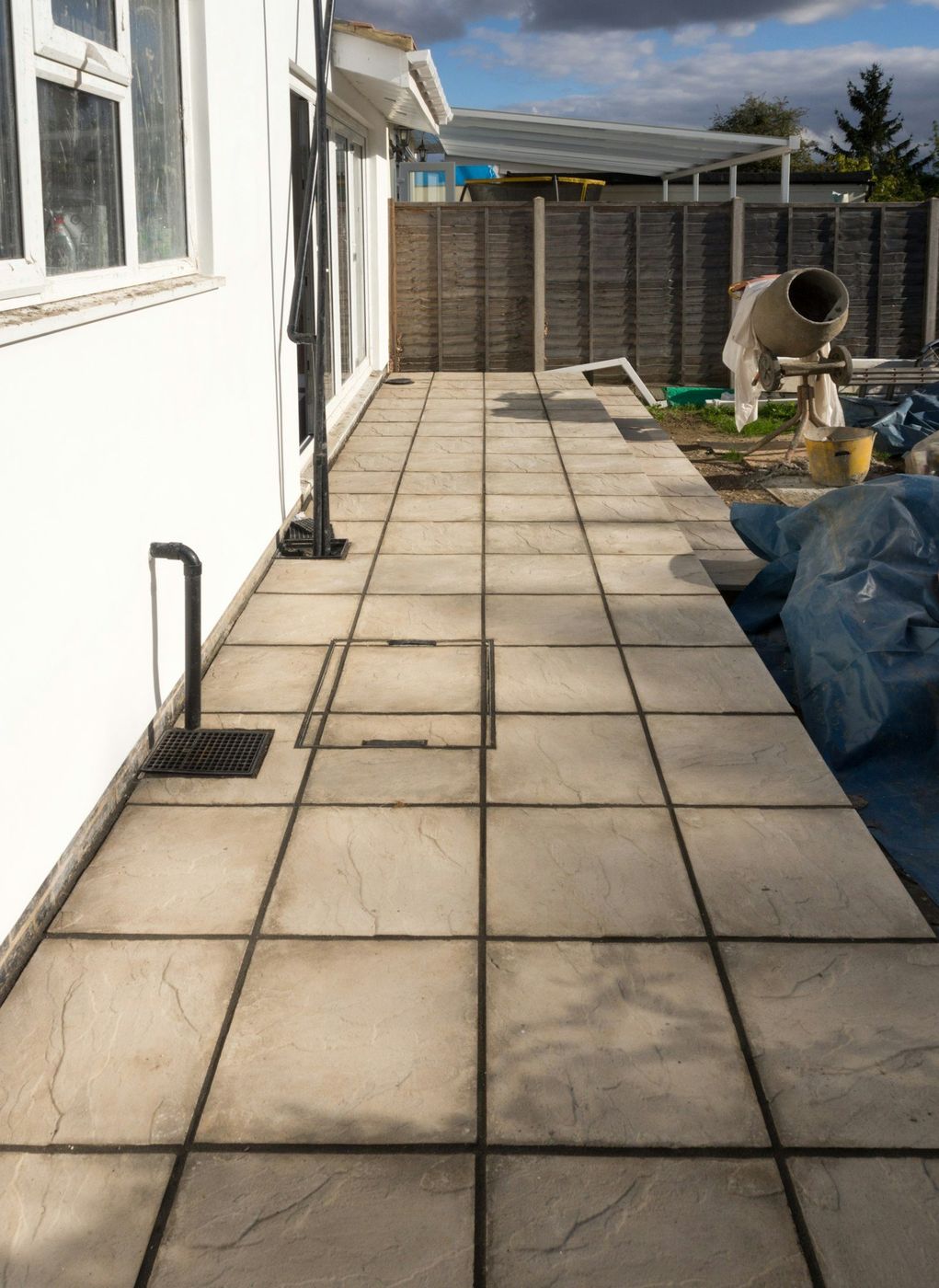
Poured for a February night: dead level under a filled spa, drained at the surface, safe in boots.
Nine degrees, steam rolling off the water, snow stacked along the fence. That's the night a spa pays for itself. It's also the night a bad pad tells on itself. Ice sheeting the path because the slab drains toward the door instead of away from it. A corner that dropped last spring, so the cover no longer seats square. A breaker that trips because somebody ran conduit without a sleeve.
We build spa pads with that night in mind. A filled tub is a heavy, concentrated load that sits in one spot and never moves, in a yard that freezes and thaws dozens of times between November and April. The slab underneath has to stay flat through every bit of it, and flat is not something you can add later.
Splash is the quiet destroyer. Water comes over the side every time somebody climbs out, lands on concrete, and freezes there overnight. Do that a hundred times a season and an unprotected surface starts scaling. Air-entrained mix handles it, because those microscopic bubbles give freezing water somewhere to go instead of pushing the surface apart.
Then there's what people put on the ice. Please, not salt. Deicers chew fresh concrete, magnesium chloride worst of all, and the residue tracks into water you pay to keep balanced. Sand or a rubber mat gives traction without the chemistry. And build a slab that sheds: fall away from the house, no low spot at the door, no birdbath where the cover gets parked.
Homeowners think about the tub. We think about the tub plus the water plus everybody in it, which is a much larger number sitting on a footprint smaller than a parking space. That's a concentrated load, not a patio load, and patio spec doesn't cut it. Five to six inches of concrete, number four bar on a tighter grid than we'd use on flatwork, six inches of compacted road base underneath, and a thickened perimeter so the edges don't break down under the cabinet frame.
Level matters just as much. Spa shells are supported by the pad, and a slab that's out by a quarter inch across the footprint puts the frame in a twist, which shows up as a cover that won't seal and, over time, as stress on the shell itself. We shoot the pour with a laser and hold it inside an eighth of an inch. Where the footprint allows we pour the pad as one panel with no joint through it, because a joint under a spa is a hinge waiting for a reason.
Yards shape this too. On bungalow lots around Wash Park and Berkeley the tub lands tight against a fence or a garage, with no room to fudge the grade. Central Park and Park Hill back yards usually let us put the pad where the walk from the door is shortest, which matters more in February than anybody admits in July.
| Time of year | What the pad is up against | What we build in for it |
|---|---|---|
| Deep winter | Freeze-thaw at the splash line, boots, snow piled on the edge | Air-entrained 4,000 PSI mix and a broom texture that still grips wet. |
| First thaw | Meltwater running under the cabinet and along the slab edge | Positive fall away from the house, over base that drains instead of holding. |
| Spring storms | Soaked ground all around the pad, hail on the cover | Six inches of base and a steel mat, so the pad moves as one piece or not at all. |
| Midsummer | Drain and refill, hot surfaces, bare feet | A drain route that doesn't dump at the foundation, and a finish you can stand on at midday. |
| Fall | Cover swaps, service access, leaves packing the joints | Extra pad on the service side, and joints sealed before the wet season starts. |
Footprint, dry weight, filled weight, and the electrical requirement. That's all we need to size the pad.
Delivery day is where it all shows. If the pad is flat, the crew sets the tub, the electrician terminates, and everybody is home for dinner. If it's out by a half inch, somebody is shimming a spa in the cold and the cover never sits right after that.What our crew lead tells homeowners
Still unsure about something?
Call the crew at (303) 569-4046 and we will talk it through.

Get a free, no-obligation estimate from a crew that knows Colorado soil, Colorado weather, and how to finish concrete that lasts.
Accessibility
Adjust the site to fit how you read and browse. Your choices are saved on this device.