
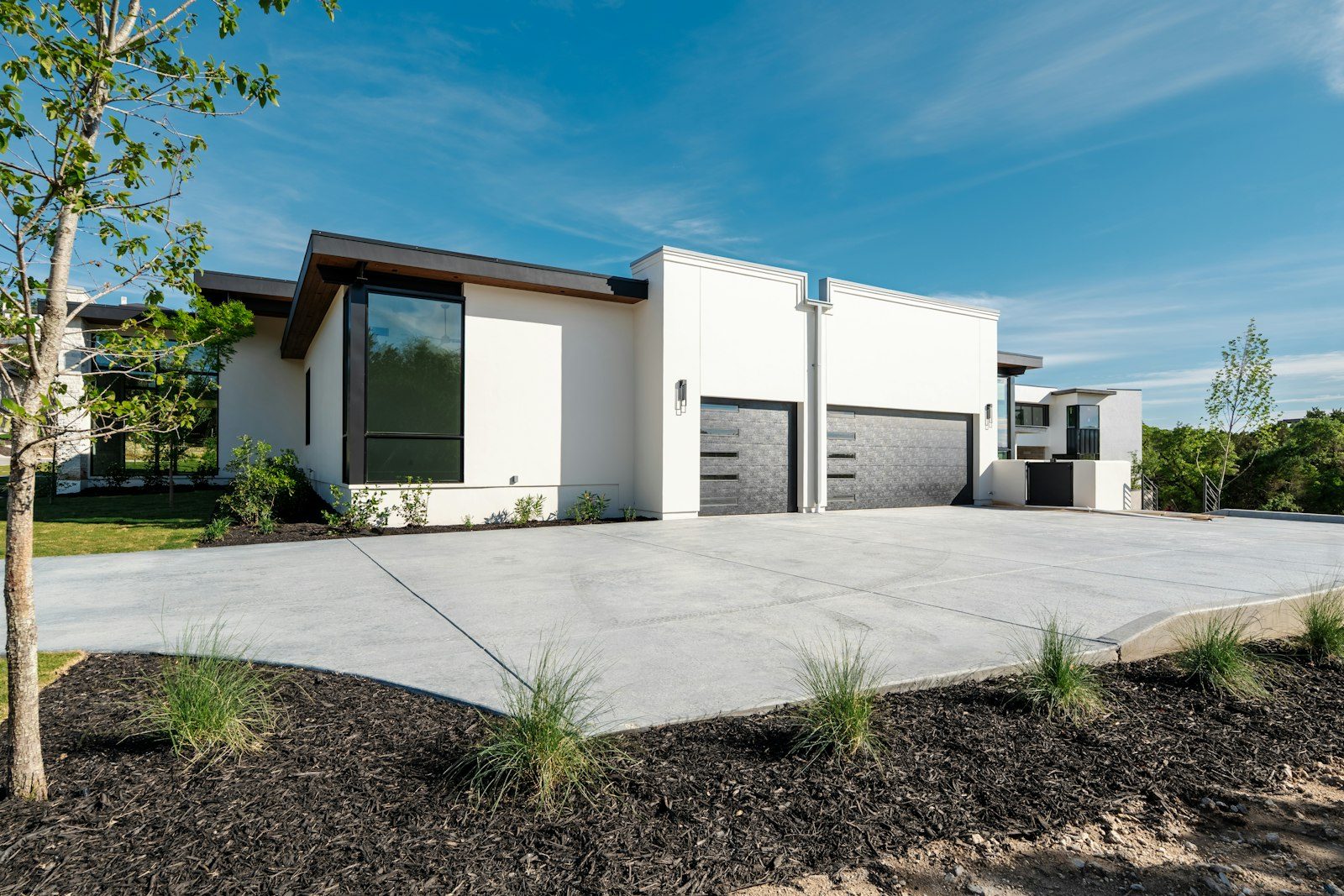
Driveways for hundred-year-old bungalows and brand-new infill, poured a mile above sea level.
You can date a Denver house by its driveway. Washington Park and Berkeley still have ribbon drives, two skinny strips of concrete laid down when nothing wider than a Model A would ever use them. Park Hill and Sloan's Lake got single-car slabs in the decades after, and most of those are now a patchwork of cracked panels shedding gravel every spring. Then there's Central Park, where entire blocks of flatwork went in over a few years, some of it solid, some of it poured fast by builders working down a punch list.
We build driveways for every one of those houses. The address changes; the physics doesn't. Denver sits on clay that moves with every wet spring, and at 5,280 feet a slab surface can freeze at dawn and thaw by noon for weeks on end. A driveway that lasts here gets a real base, real steel, and a mix designed for this climate. That's the job, and it's the whole job.
Under most of Denver is expansive clay. It drinks up a wet April, swells, then shrinks hard through a dry August, and your driveway rides that motion like a raft. Concrete handles the weight of your truck without complaint. What kills it is the ground underneath changing shape twice a year for thirty years.
So we don't pour on native clay. Ever. Every driveway we build gets excavated down, then rebuilt on compacted road base that spreads loads and gives water somewhere to go. Above that goes #4 rebar tied on chairs at a two-foot grid, so the steel sits mid-slab where it can actually hold cracks tight. The concrete itself is a 4,000 PSI exterior mix with entrained air, which gives freezing water in the surface a place to expand without popping the finish off. None of this shows in the final photos. All of it decides whether the driveway makes it to 2060.
| The driveway | How it usually looks now | Our take |
|---|---|---|
| Ribbon drive, two strips | Strips heaved to different heights, center strip gone to weeds | Charming but narrow. Keep it if it's sound and you love it; most owners go full-width when it fails. |
| Original single-car slab | Broken into panels, edges crumbling, pitched toward the garage | Past saving. Tear out, regrade, pour it right once. |
| Widened drive with a cold seam | The added strip and the original separating at the joint | Seams between old and new pours always telegraph. If both halves are failing, replace as one slab. |
| Builder pour from the last decade | Random cracking early, joints cut late or too shallow | Sometimes fixable. We'll tell you straight whether it needs joint work, panel replacement, or a redo. |
Old Denver blocks weren't laid out with concrete trucks in mind. In the Highlands and Berkeley we're often working a narrow lot with the garage off the alley, a fence right on the property line, and a mature tree the homeowner would like kept alive. That changes how we stage a pour. Sometimes the truck chutes from the street. Sometimes we pump over the house. Sometimes it's buggies down the side yard, one load at a time. We figure that out at the estimate, not at 7 a.m. on pour day.
City work can also mean paperwork, especially where a new drive meets the public walk or the curb cut, and we build that step into the schedule instead of treating it as a surprise. University Hills and Park Hill lots usually give us more elbow room; Cherry Creek infill jobs are mostly about pouring flatwork that looks like it belongs next to a brand-new house.
Text photos to (303) 569-4046 or ask for a free written estimate. If it's not ready to replace, we'll say so.
Mid-spring through mid-fall is the season. May and September are our favorite driveway months: warm enough for the mix to behave, cool enough that the surface doesn't dry out ahead of the finishers. Summer works too. We just start early and watch the sky, because a 2 p.m. thunderstorm on wet concrete will scar a finish for good, and we'd rather scrub a pour than gamble on radar.
Winter isn't off the table either. With heated mix water, a non-chloride accelerator, and insulated blankets over the slab, cold-weather driveways cure just fine. One hard rule, though: we never pour over frozen ground. Frost under a slab is a guaranteed callback. And whatever season yours goes in, keep deicer off it for the first winter, magnesium chloride most of all. Fresh concrete plus deicer is how you get a flaky surface by March. Use sand instead.
Half the ribbon drives we pull out around Wash Park have zero base under them. Two strips of concrete sitting on bare dirt since Coolidge was president, and honestly, ninety years isn't a bad run. The replacement gets gravel and steel, so it won't need ninety years of luck.What the crew sees on site
Still unsure about something?
Call the crew at (303) 569-4046 and we will talk it through.

Get a free, no-obligation estimate from a crew that knows Colorado soil, Colorado weather, and how to finish concrete that lasts.
Accessibility
Adjust the site to fit how you read and browse. Your choices are saved on this device.