
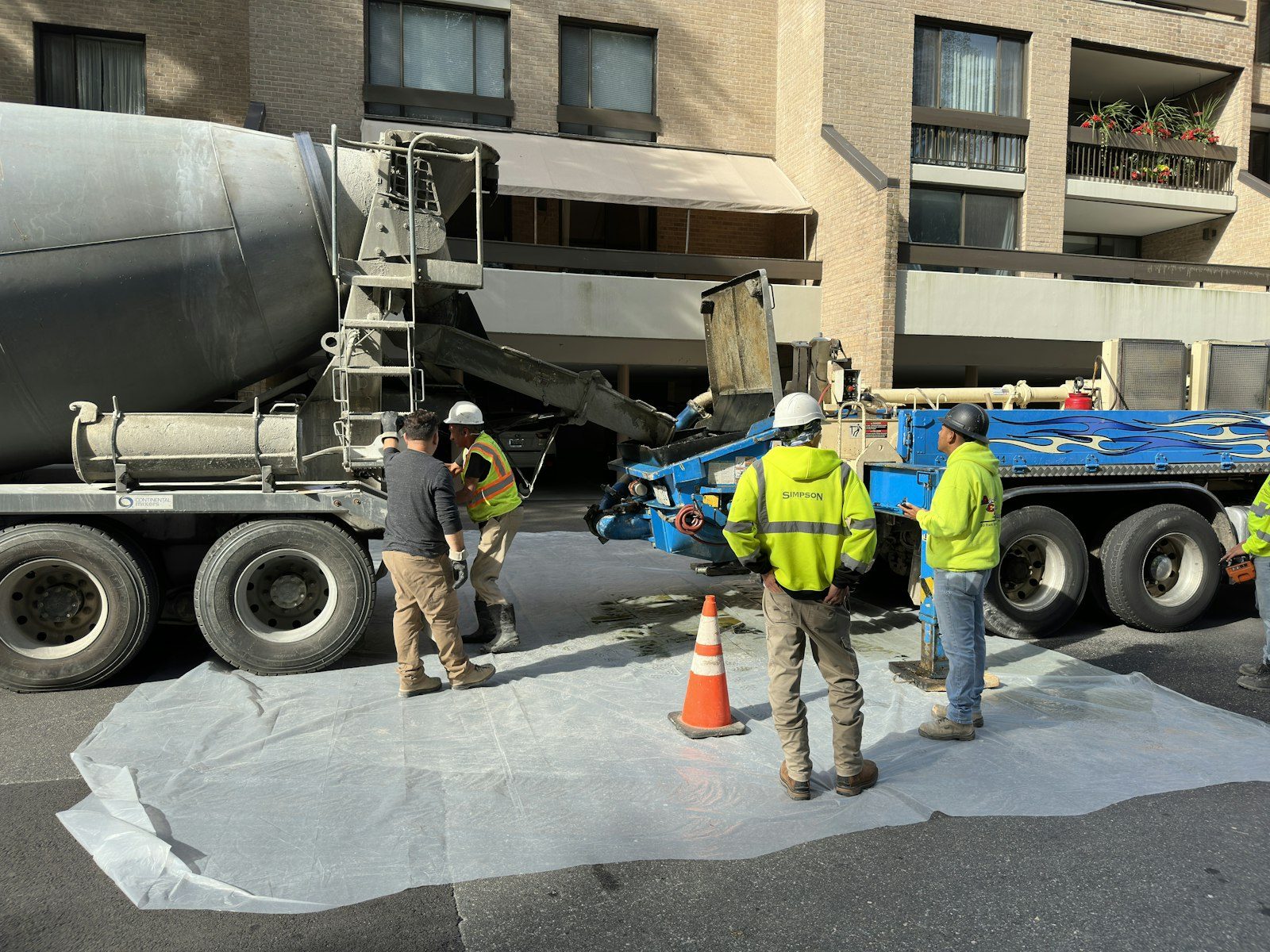
Machines don't sit still. Whatever they're bolted to has to account for that.
The side yard of a Park Hill bungalow is about four feet wide, has a gas meter, a hose bib, and a window well in it already, and somebody wants a new heat pump and a whole house generator to live there too. That's a genuinely different problem from the one we solve at a Central Park build, where the mechanical yard was drawn on the plan and there's room to work.
We pour equipment pads for both, plus the commercial versions: transformer and switchgear pads, compressor pads, and rooftop units that got relocated to grade during a remodel. The property type changes the whole approach, because on an old lot the constraint is space and access, and on a new one the constraint is coordination with three other trades who all want the same six feet.
Old Denver lots hand us the same problems over and over. One narrow path to the back, a thirty inch gate, a neighbor's wall close enough that we're placing by hand, and an existing walk the pad has to meet without stepping. Those jobs get small tools, wheeled concrete when a chute won't reach, and real thought about where the equipment gets serviced from. A condenser jammed against a fence looks fine until a tech needs three feet of clearance.
Newer construction in Central Park and the infill around the Highlands is the opposite. There's access, but there's also a schedule. The electrician wants conduit stubbed exactly where his gear lands, the plumber has a line crossing the same area, and the pad has to be in before either can finish. On the commercial side around Cherry Creek, the utility has its own requirements for what a transformer sits on, and we confirm those before forming anything.
| What's going on the pad | What the pad has to handle | The detail people skip |
|---|---|---|
| Condenser or heat pump | Light load, but it must stay level and stay put through freeze cycles | Service clearance on all sides, and getting it up out of the snow line |
| Whole house generator | Concentrated weight plus running vibration, on a footprint set by the unit | Conduit and gas line sleeves placed before the pour, not cored after |
| Utility transformer or switchgear | Real weight, a specified footprint, and pull boxes underneath | Confirming the utility's own pad requirements before forming anything |
| Shop compressor or fixed machinery | Continuous vibration that will crack a thin slab from below | An isolated pad, thickened and reinforced, not doweled into the shop floor |
| Rooftop unit relocated to grade | Heavier than anything else on this list, plus duct and drain penetrations | A base built for the load rather than a slab poured to match the old pad |
Vibration is the one people underestimate. A generator under load or a compressor cycling all day puts energy into the concrete continuously, and continuous energy finds every weakness. Thin sections crack. Anchor bolts work loose. Base material densifies unevenly and the whole thing takes a tilt. So anything that runs gets a thicker section, steel through it, a compacted base, and isolation from adjacent slabs.
Penetrations are the other failure point, and they're avoidable. Every conduit, gas line, drain, and sleeve should be set in place before concrete arrives. Coring a finished pad afterward cuts steel you can't see, leaves an opening that collects water, and puts a stress riser exactly where the anchor loads are. It costs an hour of coordination beforehand and a lot more than that to correct later. We ask the electrician for his stub locations in writing and we set them.
Send a photo of the space and the spec sheet for the unit. We'll tell you what fits, what the pad needs, and what has to be sleeved before we pour. (303) 569-4046.
Pads sit outside and take everything. Roof runoff sheets onto them, snow gets pushed against them, and meltwater drips in the same line all winter. So we set them slightly proud of the surrounding grade, slope the surface a hair so water leaves instead of ponding, and keep them out from under the drip line where we can. Equipment sitting in a puddle every March corrodes at the base long before the machine wears out.
April through October is the easy stretch. Small pours are the most vulnerable to an afternoon storm, because a little slab reaches finishing stage right as the clouds build, and rain worked into that surface leaves it dusty and soft for good. We watch the sky and carry plastic. Cold weather pads are doable with warm mix, blankets, and no frozen base under them, and we take those calls all winter, because a furnace or generator replacement rarely waits for good weather.
The pad is the cheapest part of the install and the one thing you can't redo without pulling the equipment back off it. Get it right the first time and nobody thinks about it again.The crew lead's read on it
Still unsure about something?
Call the crew at (303) 569-4046 and we will talk it through.

Get a free, no-obligation estimate from a crew that knows Colorado soil, Colorado weather, and how to finish concrete that lasts.
Accessibility
Adjust the site to fit how you read and browse. Your choices are saved on this device.