
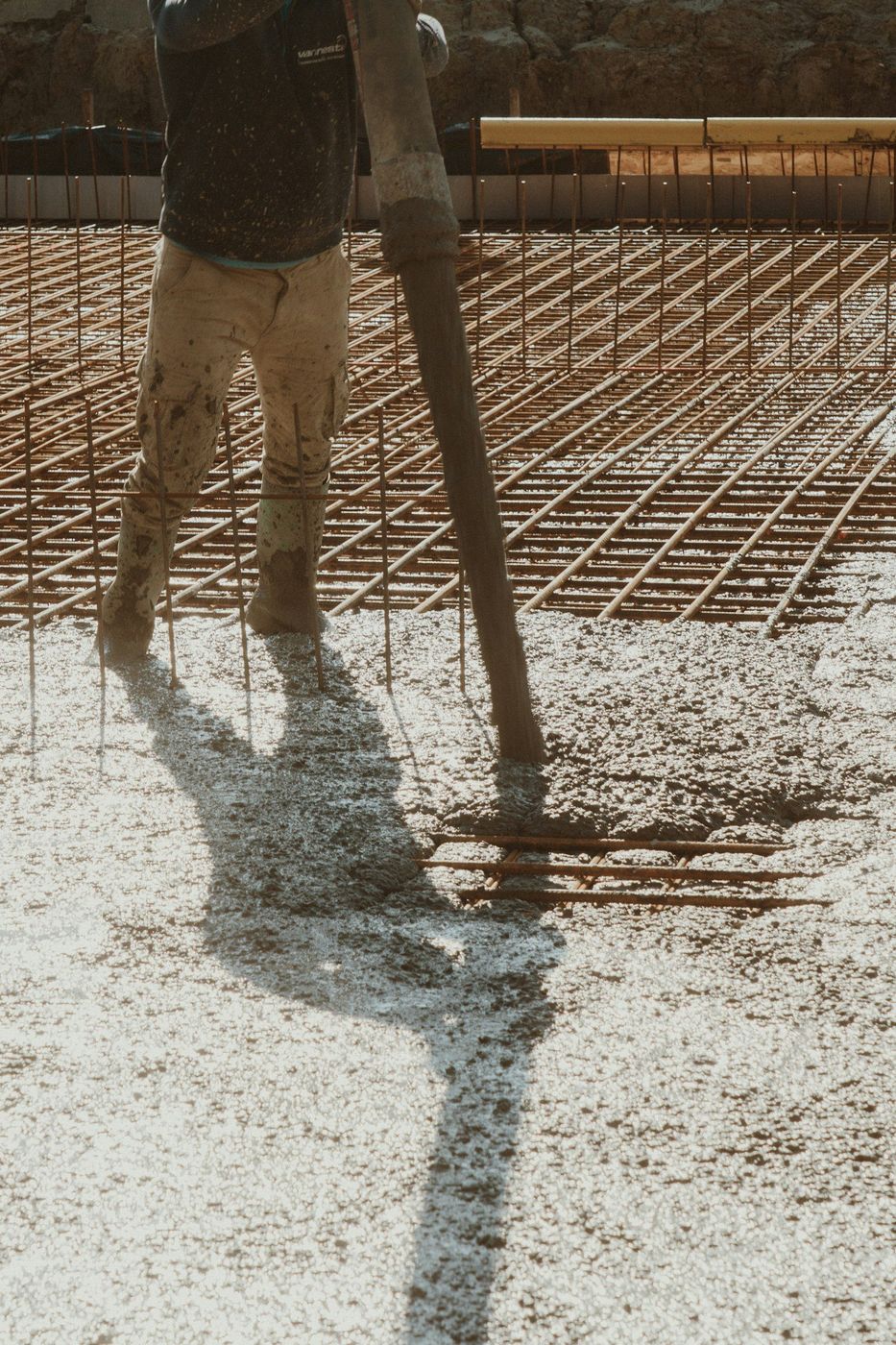
One day, one placement, and a surface that gives you about an hour to get it right.
Pour day on a slab replacement doesn't begin with concrete. It begins with an empty room. Garage cleared to the walls, water heater on blocks, freezer parked at a neighbor's, plastic taped across the doorway. By the time a truck rolls up the street, the day's real decisions are behind us.
So here's one of those days, start to finish. Most slab work we do in Centennial is replacement, and people relax once they know the sequence and can tell normal noise from a problem. Basement floors, garage slabs, shop pads. Different rooms, same rhythm.
We saw the perimeter first so the old concrete breaks where we want and your foundation wall doesn't take the hit. Then the hammer goes to work, pieces come out in loads small enough to carry, and the old concrete leaves to get crushed and reused. Loud, dusty, and the most satisfying part of the week.
The interesting moment comes when the floor is gone and we're standing on whatever the original crew left. Sometimes it's clean base and the day gets easy. Often it's the story behind why the slab failed: loose backfill that settled into a void, a plumbing trench nobody compacted, black dirt where road base belonged, a sewer line higher than anyone expected. We stop, photograph it, and call you before fixing any of it. Nobody should learn about a change from an invoice.
New base goes in as road base in shallow lifts, each run with a plate compactor and moisture conditioned so it knits instead of shifting. You can feel a good base underfoot. Your heel doesn't sink.
Then the vapor retarder, lapped, taped at the seams, turned up at the walls and around every penetration, directly under the slab. Skip it under a garage floor and you get a floor that sweats and a coating that peels a year after somebody rolls it on. Steel next: bar on chairs at a real grid under anything carrying vehicles, mesh only for light duty, thickened sections under bearing walls or where a post lands. Then we chalk the joint plan on the base while the whole floor is still visible, because deciding where cracks are allowed to go is easier before the room fills up.
| What we see | What it means | What happens next |
|---|---|---|
| Water sheening across the slab | Bleed water is still coming up | Nothing. Work it now and you trap water at the top, which means dusting later |
| Sheen gone, a boot sinks about a quarter inch | The set has started | Bull float work ends, edging and the first float pass begin |
| A thumb leaves a shallow print | Ready to finish | Close it with a trowel indoors, or pull a broom across it outside |
| One end stiffening ahead of the other | Sun, wind, or two loads that weren't the same | Split the crew and chase the fast end first |
| The saw ravels the edge of a test cut | Too early | Wait, then try again in a corner where a bad cut won't show |
| The cut runs clean, the dust is fine | The window is open | Cut every joint on the plan now, not tomorrow morning |
Call (303) 569-4046 and we'll look at what's under it. Estimates are free, and we'll say so if a repair beats a replacement.
Hardest thing to teach a new finisher is how to stand still. Every slab has a stretch where the right move is setting the trowel down and watching the water come up. Get impatient there and the floor tells on you later.Straight from the crew
Summer afternoons here are a real constraint. Cells build over the mountains and arrive fast, so we start early and try to be finishing before the sky gets interesting. A hot, dry, windy day is worse than people think: the surface loses water faster than the slab can bleed, which is how you get short random cracks in the first hours. We answer with an evaporation retarder, wind breaks, and an early start.
Rain during finishing is the real emergency, because water landing on a soft surface leaves scaling and dusting for the life of the floor. Plastic rides on every truck we run. Rain a day later is just a nuisance. Winter pours happen constantly, especially indoors with temporary heat, and outdoors we run heated water, accelerators, and blankets. Never on frozen ground. Then 24 to 48 hours before you walk it, a week before a car, and 28 days to the number on the ticket.
Still unsure about something?
Call the crew at (303) 569-4046 and we will talk it through.

Get a free, no-obligation estimate from a crew that knows Colorado soil, Colorado weather, and how to finish concrete that lasts.
Accessibility
Adjust the site to fit how you read and browse. Your choices are saved on this device.