
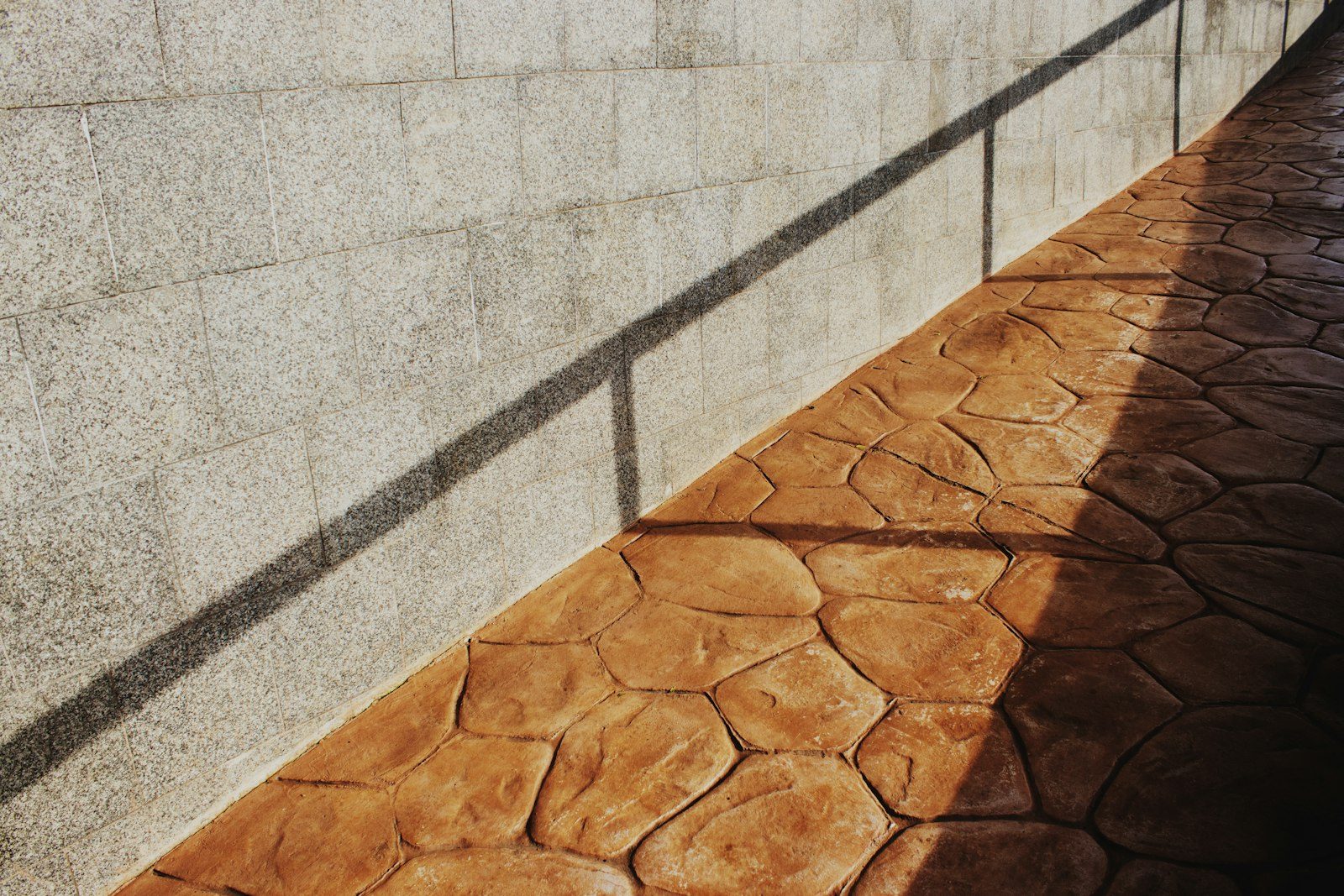
Saw lines that look like design because they were drawn around where the slab wants to move.
Everybody shopping for a scored patio wants to talk about the pattern. Diamonds, ashlar, a running grid, a border with a field inside it. Fine, we'll get there. But the pattern is the last thing we settle, because the lines that hold your slab together get located first, and they're located by what's buried under it: the soil, the base we compacted, and where water goes when it leaves your roof.
Get that order backwards and you end up with a pretty grid and a random crack running diagonally through it. We've seen plenty of those, in newer Crystal Valley builds and older Plum Creek yards alike. Scoring done right hides nothing and fixes nothing. It just puts the cuts where the concrete was already going to break, and then makes them look deliberate.
Douglas County dirt does not hold still. Moisture moves through it, the ground lifts and drops through the year, and any slab sitting on top rides that motion. Our answer isn't to fight it. It's to build a base that spreads the load, six inches of compacted road base with the fines washed and the grade sloped to drain, and then to decide in advance where the concrete is allowed to relieve stress.
Those relief points are control joints, and they have real rules. Spacing tied to slab thickness. Cut depth at roughly a quarter of the slab. Panels kept close to square, because a long skinny rectangle will crack across its middle no matter what you drew. Re-entrant corners, meaning the inside corner where a patio wraps around a bump-out, need a joint running off them or a crack will start there within two seasons.
Once those lines are set, the decorative scoring fills in around them. Shallower cuts, purely visual, laid so the structural joints read as part of the same family instead of scars crossing your pattern. That's the craft. Anyone can run a saw. Knowing which line has a job and which line is jewelry is what separates a patio that ages well from one that looks broken at year four.
A score line is a groove, and a groove holds water. On a flat or badly graded slab those cuts turn into little reservoirs, and up here at 6,224 feet water sitting in a groove freezes hard, expands, and works on the edges of the cut until they crumble. You'll see it first as rounded, dirty-looking lines that never wash clean.
So we set the fall before we set the pattern. A quarter inch per foot away from the house, cuts running with the slope rather than damming across it wherever the design allows, and no dead-end grooves in a low spot. On a walkout patio in Castlewood Ranch that might mean rotating the whole pattern fifteen degrees off the wall. Nobody notices the rotation. Everybody would notice a row of iced-over trenches in January.
You walk the slab, look at the lines from the kitchen window, and tell us to move them. Then the saw comes out.
| Layout | What it looks like | Where we use it |
|---|---|---|
| Square grid | Even panels, cuts meeting at right angles | Straight runs and rectangular pads. Simplest to keep square with the joints. |
| Diagonal grid | The same panels rotated forty-five degrees to the house | Small patios. The long sight line across a diamond makes a space read bigger. |
| Ashlar | Staggered rectangles of varied size, like cut stone | Large patios and entries where a repeating grid would look mechanical. |
| Border and field | A banded perimeter with a simpler pattern inside | Front walks and pool surrounds. The border hides the edge and frames the slab. |
| Radial or curved | Arcs struck from a center point, cut freehand off a guide | Round patios, fire pit surrounds, and anywhere a curve already exists. |
Still unsure about something?
Call the crew at (303) 569-4046 and we will talk it through.

Get a free, no-obligation estimate from a crew that knows Colorado soil, Colorado weather, and how to finish concrete that lasts.
Accessibility
Adjust the site to fit how you read and browse. Your choices are saved on this device.