
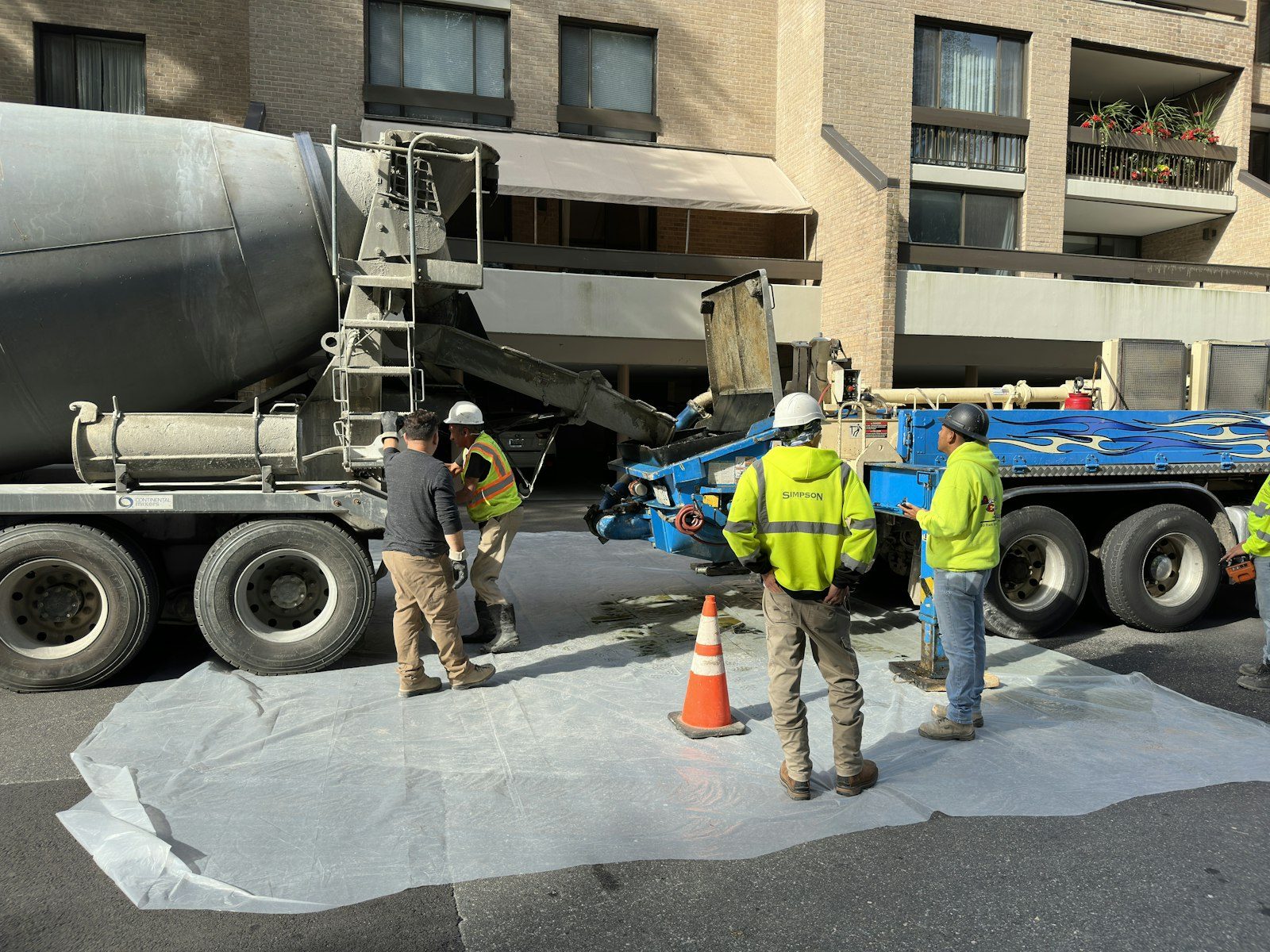
Four ways to set a machine on the ground, and only one of them is worth pouring concrete for.
Not every piece of equipment needs a poured pad, and we'll say so before we take the job. A light condenser on stable ground can live on a composite pad for years. A standby generator with a gas line, a transfer switch, and a service tech who has to kneel beside it twice a year is a different animal. So the useful question isn't what a pad costs. It's which of the available answers actually matches the machine, the load, and the ground it's sitting on.
We pour these all over Aurora, residential units tucked along side yards in Sterling Hills and Tollgate Crossing, and light commercial pads for generators, chillers, and compressors. The equipment changes. The decision framework doesn't.
| The option | When it's genuinely the right answer | Where it lets you down |
|---|---|---|
| Composite or precast pad on compacted gravel | Light residential condensers on ground that drains and doesn't move | Point loads dent it, and it follows whatever the soil beneath decides to do |
| Poured pad on prepared base | Anything heavy, anything vibrating, anything with conduit or gas coming up through it | Costs more up front and can't be relocated on a whim |
| Extending or tying into an existing slab | The equipment sits right at a sound slab edge and the loads are modest | Two slabs poured years apart move differently, so the joint between them has to be detailed, not ignored |
| Pad on piers or helical supports | Large generators and transformers on fill or on questionable bearing | The most expensive option, and the only one that works when the soil won't carry the load |
Equipment that runs shakes, and shaking is not what concrete enjoys. A compressor, a generator under load, or a large condenser pushes energy into whatever it's bolted to, and a thin unreinforced pad answers with cracks radiating from the anchor points. Mass helps. So does steel: bar on chairs rather than mesh flopping in the bottom, with thickness matched to the machine instead of to a default. Isolation mounts handle the rest, and where a pad sits close to the house we keep it separate from the foundation so movement isn't shared.
The other half is what passes through the slab. Electrical conduit, gas penetrations, condensate and drain lines, control wiring, grounding. All cheap to sleeve before the pour and genuinely painful afterward. Coring a finished pad beside a live gas line is nobody's favorite afternoon.
So we want the equipment submittal and the installer's rough-in locations before ordering concrete. Stub-ups land where the cabinet knockouts are, not where they seem reasonable, and anchor patterns come off the manufacturer's drawing. A few emails with your electrician beats watching a tech improvise a conduit bend around a stub that missed by four inches.
Send the submittal sheet and a photo of the location. We'll tell you what the pad needs and whether you even need one.
Almost every pad we pour is racing something: a generator delivery, an HVAC changeout in the first hot week, a compressor arriving with the installer already booked. Concrete is unimpressed by all of it. It needs a few days before a heavy machine lands on it and longer before it has real strength. We work backward from your install date and pour early rather than fast.
Season shapes the plan more than the product. April through October is straightforward. Winter pads get heated water, chloride-free accelerator, and blankets, and we won't place on frozen ground, because that ground pulls back as it thaws and leaves the pad unsupported exactly where you can't see it. For a January install, a temporary enclosure with heat is often the cheaper answer.
Once it's in, the care list is short. Keep deicing chemicals off entirely the first winter and go easy after that, since magnesium chloride is hard on any exterior concrete. Shovel around it instead of chipping ice against the edge. Keep roof runoff from dumping beside it, because water undermining the base is what actually tilts these pads.
Nine times out of ten a tilted AC pad isn't a concrete failure. Somebody's downspout has been washing the base out from under one corner since the house was new.What our crew lead tells homeowners
Still unsure about something?
Call the crew at (303) 569-4046 and we will talk it through.

Get a free, no-obligation estimate from a crew that knows Colorado soil, Colorado weather, and how to finish concrete that lasts.
Accessibility
Adjust the site to fit how you read and browse. Your choices are saved on this device.