
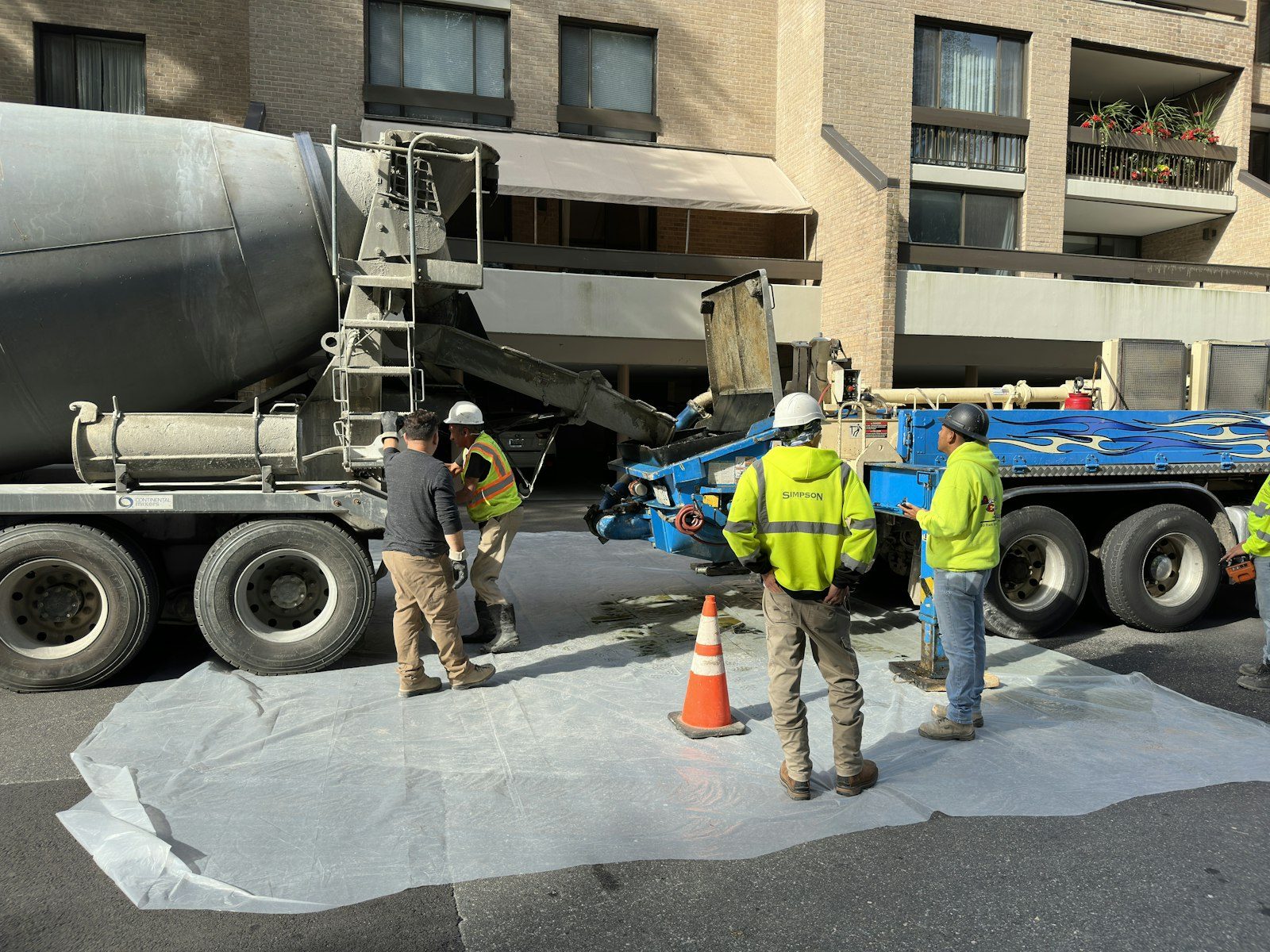
The concrete that ends up in your building gets tested four times before anybody signs for it.
A commercial placement looks chaotic from the sidewalk and it isn't. Every person on that site is running a short list, in order, on a clock set by the batch plant. The pump operator has one job. The vibrator hand has one job. Somebody's kneeling at the chute with a slump cone, and somebody else is filling cylinders that nobody will look at for four weeks.
This page walks through that morning the way we actually run it in Arvada, from the Olde Town side where a mixer has to thread past parked cars and an occupied building, to the newer west-side pads where the site is open, the ground was graded last season, and the only real constraint is how fast the plant can load.
We set the mix design and the delivery rate days ahead, and both matter more than most owners realize. Rate first. A footing pour that stalls because trucks arrive twenty minutes apart gives you cold joints where you wanted continuous concrete, so we order a spacing the plant can actually hold and we tell them what happens if they can't. Mix second. Exterior work here goes in air-entrained at the strength the drawings call for, and the air is not negotiable, because that's what carries the concrete through its first hundred freeze cycles.
By the time the first truck backs in, steel has been inspected, embeds are laid out and double-checked against the anchor bolt plan, and the forms have been walked with a hammer. Anything loose gets found before there's forty thousand pounds of pressure behind it.
Concrete goes in lifts, not in one deep dump, and each lift gets vibrated into the one below it so the two become a single piece. Too little vibration leaves rock pockets and honeycomb at the form face. Too much drives the paste to the surface and the aggregate to the bottom, which is worse and harder to see. The hand running the vibrator is the most skilled person on a footing pour and rarely the one anybody watches.
The last hour is where jobs get lost. Top of wall struck to grade, bolts checked again because a vibrator will move one and nobody notices until the steel shows up, finish worked as the bleed water leaves, and curing started before the surface dries out. On a windy Arvada afternoon the surface can dry faster than the concrete can bleed, and that costs you strength right where the anchors live.
| The check | When it happens | What it catches |
|---|---|---|
| Slump | At the chute, on the loads the spec calls out | Concrete watered down in transit, which trades strength for easy placement |
| Air content | Same sample as the slump, on exterior and cold-weather work | Low air, meaning the concrete has no freeze-thaw protection at all |
| Concrete temperature | Every load in summer and winter, logged with the ticket | Hot loads that flash set, cold loads that will not gain strength overnight |
| Cylinders cast for break tests | Filled during placement, cured, broken on a set schedule | Concrete that never reaches design strength, before you load the structure |
| Delivery ticket review | As each truck arrives, before it discharges | Wrong mix, wrong admixtures, or a load that has been riding too long |
Send drawings and the geotech report. We price the placement, the testing, and the inspection sequence together. (303) 569-4046.
Winter placement is routine and it is not free. Heated mix water, non-chloride accelerator, insulated blankets on everything, and ground that has to be thawed and kept thawed until the concrete is down. We monitor the concrete as it cures rather than guessing off air temperature, and forms stay in place longer, which pushes the whole trade sequence behind us.
Summer flips the problem. Placements start early, cylinders get shaded, and we watch the western sky from noon on. A hard cell during finishing beats water into the surface, and that damage shows up months later as a floor that dusts under traffic. Fall is the easiest stretch of the year here, which is exactly why the plants are busiest then. Book early or take a winter date knowingly.
Still unsure about something?
Call the crew at (303) 569-4046 and we will talk it through.

Get a free, no-obligation estimate from a crew that knows Colorado soil, Colorado weather, and how to finish concrete that lasts.
Accessibility
Adjust the site to fit how you read and browse. Your choices are saved on this device.