
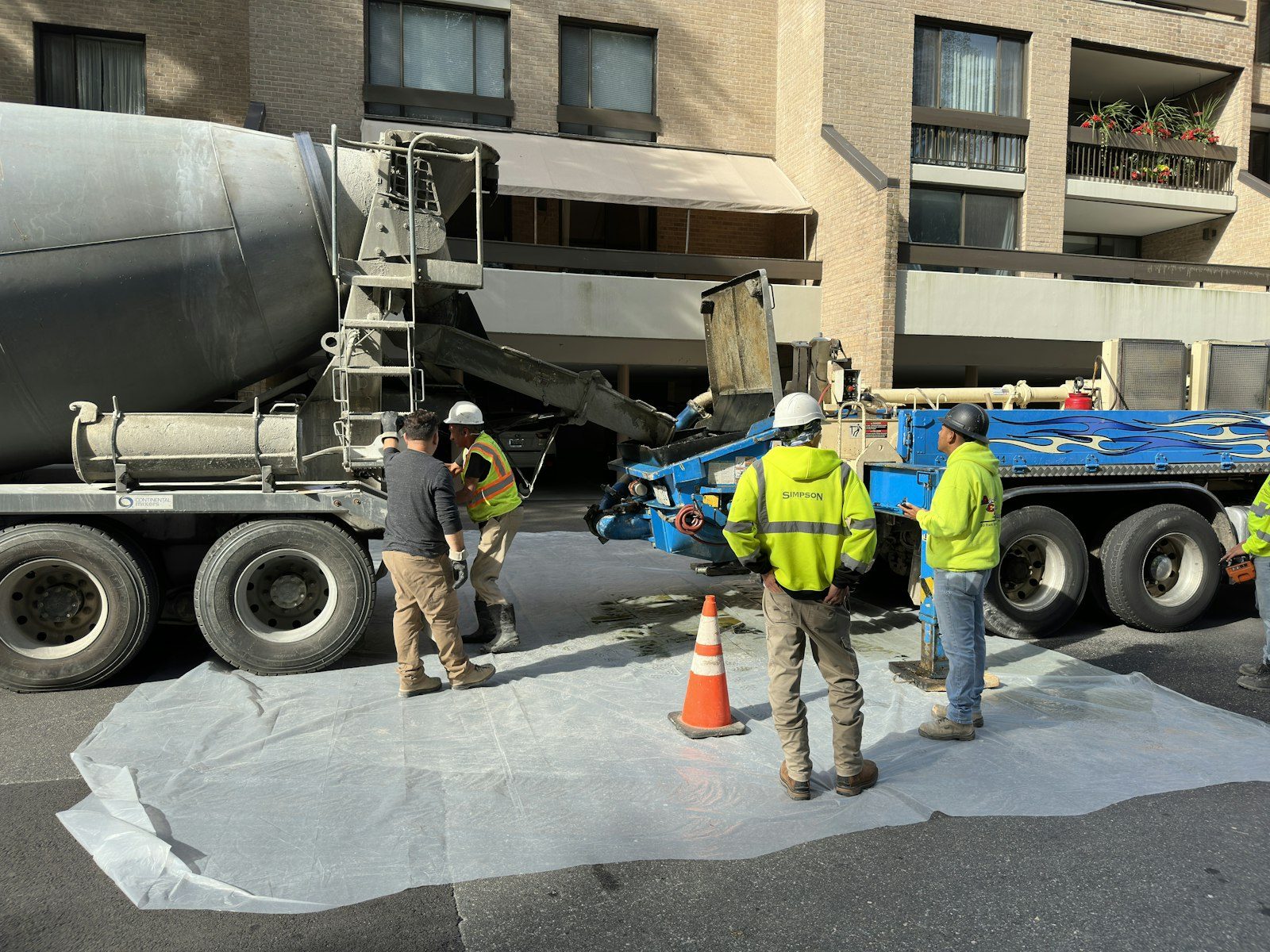
Every private drive in the county gets graded by the same two weeks of thaw, and only some of them pass.
There is a stretch of late February and March when the ground here does something specific and destructive. The top few inches thaw during the day. Underneath it is still frozen solid. Meltwater has nowhere to go, the surface turns to soup sitting on a hard shelf, and any truck crossing it kneads the road like dough. That is how a gravel service drive looks fine on Halloween and is unusable the first warm Tuesday in March.
We build concrete access roads and service drives for commercial and industrial property around Arvada. Most of the calls land in those two weeks, from somebody standing next to a truck with mud past the hubs.
Gravel is not a surface. It is a pile of stone borrowing all its strength from the ground under it. When that ground is dry and dense the road feels like pavement. When it goes to slurry, the stone has nothing to bear on and presses down into the mud, which is where your rock goes every year. You are not losing gravel to erosion. You are burying it.
Concrete works differently because it spans. A properly reinforced section does not need every square foot beneath it to be strong at the same moment. It distributes a wheel load out over a wide area, so a soft patch during thaw is bridged instead of punched through. That is the entire argument for concrete on a private road here, and it is a seasonal argument more than a durability one.
The other factor nobody plans for is the refreeze. A rutted road holds water in every rut, that water turns to ice overnight, and by morning the drive is a set of frozen troughs a delivery truck has to crawl through.
A service drive gets designed around the heaviest thing that uses it and the tightest turn it has to make, in that order. Straight runs get the section the loads call for. Turning areas, the entry throat, and anywhere a truck stops and pivots get thicker, because a wheel grinding through a turn puts far more into a slab than the same wheel rolling straight. Edges get thickened or confined, since an unsupported edge is the first thing to break.
Around Olde Town the version we see is short: a back service lane behind older commercial buildings, tight against a property line, with drainage nobody ever formalized. Those are surgical jobs, poured in pieces, often at night so a receiving door stays usable by day. West of there it gets longer. The newer construction and association infrastructure serving Candelas, Leyden Rock, and Whisper Creek generates maintenance drives and equipment approaches on graded ground where the fill is young and still settling. Properties around West Woods land in between, usually needing a long approach rebuilt in segments.
| Ground condition | Gravel or thin asphalt under the load | A properly built concrete section |
|---|---|---|
| Frozen solid in January | Best it ever performs, hard and quiet, which is why people think the road is fine | No change. It was never depending on the frost |
| Thawed top over frozen subgrade in March | Ruts on the first pass, deeper on every pass after | Bridges the soft layer. This is the week it pays for itself |
| Saturated ground after spring runoff | Stone presses into mud, road loses section, and the regrade bill starts | Spreads the load wide enough that saturated subgrade is not carrying a point load |
| Dry and dense in July | Fine, but dusty, and it washboards on the braking approaches | Fine, and clean, which matters if the route feeds a dock |
| Mid-storm on an August afternoon | Surface fines wash to the ditch and the crown flattens a little more | Sheds and keeps its shape. Nothing to carry away |
Tell us what the heaviest vehicle on that road is and how many times a week it runs. We will tell you what section it needs and where to start.
The customers who call us in March all say the same thing about the gravel: it was fine in the fall. It was. That is the problem with judging a road in October. October never asked it a hard question.Our crew lead, after the walkthrough
Still unsure about something?
Call the crew at (303) 569-4046 and we will talk it through.
Get a free, no-obligation estimate from a crew that knows Colorado soil, Colorado weather, and how to finish concrete that lasts.
Accessibility
Adjust the site to fit how you read and browse. Your choices are saved on this device.