
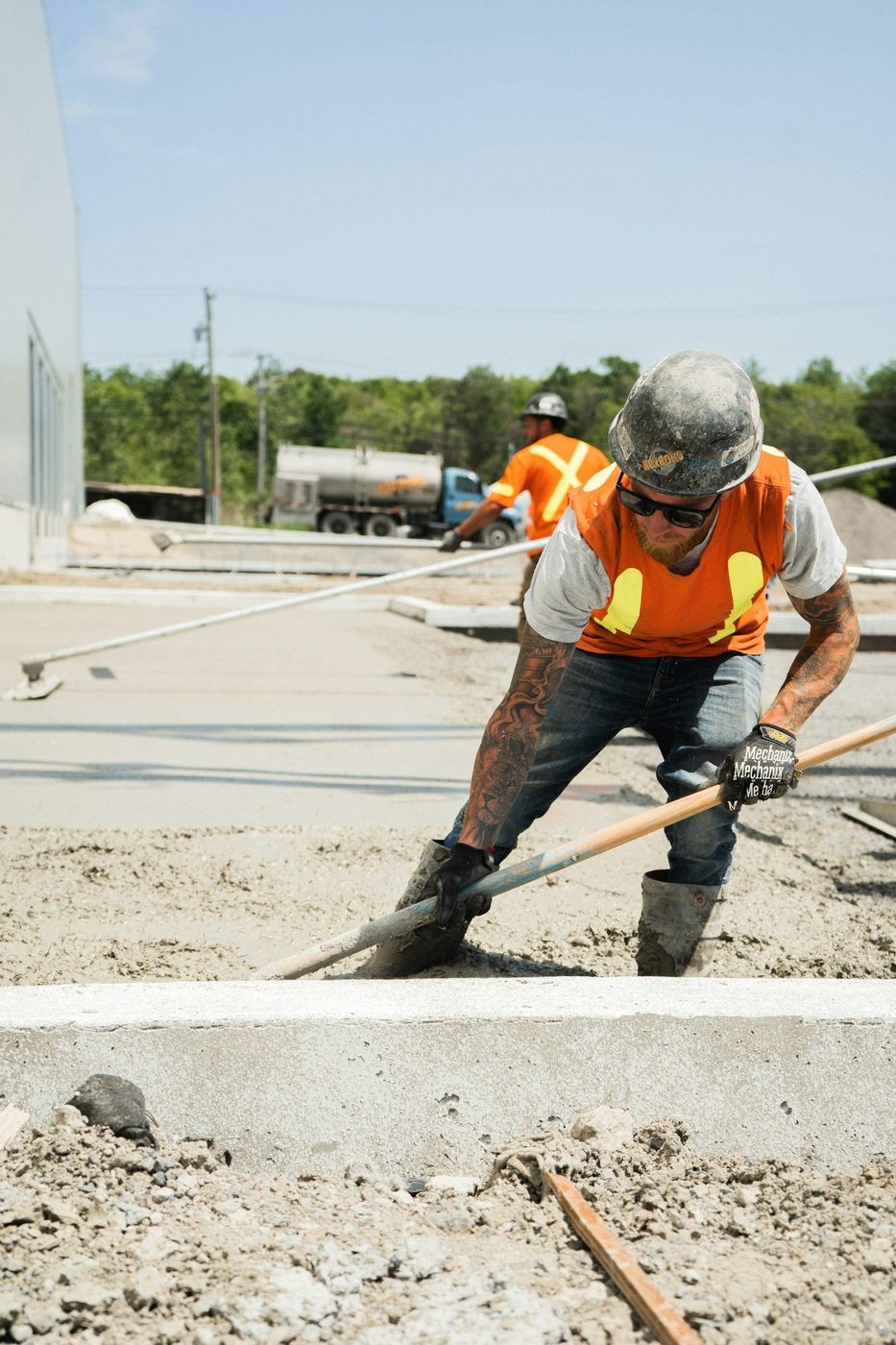
There is a two hour window on ramp day where every number on the drawing is still fixable, and then there is not.
Ramp day is short and unforgiving. An entrance ramp is not much concrete, so the whole thing goes in before lunch, and the tolerances are tighter than anything else we pour on a commercial site. Two percent across the width. One in twelve down the run. A landing flat enough that a wheelchair does not drift while somebody works a door handle.
Miss any of that and the fix is a saw and a jackhammer, because nobody grinds their way out of a slope problem on a finished ramp. So this walks through pour day on an Arvada accessible entrance, in order. Most of it gets decided before the truck shows up.
We start early. Saw cutting and demo come first, and on a retrofit that means removing more than the old ramp: the transition panel, part of the walk behind it, and whatever asphalt wedge somebody built at the gutter years ago. Then we dig. Base for a ramp gets the same attention as base for a driveway, because a settled landing is a compliance failure even when it measured perfectly the day it cured.
Forms go up next, and this is where the job is won. We set the top of form to the finished elevation of the concrete, so the forms carry the slope rather than the finisher. Eyeballing a grade down a short run is how you end up two and a half percent across a landing. Once forms are pinned we shoot every corner again and adjust before anyone calls for concrete.
Steel gets tied and chaired. The truck shows up. A sloped pour has a different feel than flat work, so we run a stiffer mix and place from the low end up. Cast-in warning panels go in wet, square with the direction of travel rather than square with the building. Broom finish across the run so grip works with the slope. Joints get cut the same day, the whole thing gets covered, and nobody walks it until we say so.
| Check | When it happens | What it costs if we skip it |
|---|---|---|
| Threshold elevation confirmed against the door | Before forms are pinned | A lip at the door no finishing can make legal |
| Running slope measured on the forms | Before concrete is ordered | A run that measures over, found by an inspector, not by us |
| Cross slope read at three points across the width | Immediately after screeding | A ramp that drifts a wheelchair sideways toward the drop edge |
| Landing flatness both directions | While the surface is open | A landing that ponds and glazes over the first cold night |
| Warning panel alignment and setting depth | Within minutes of placement | Panels proud of the surface, a trip hazard and a callback |
| Edge of the gutter transition | As the concrete takes first set | A gap or bump where the ramp meets the pan, the defect we get called about most |
| Broom direction and texture depth | Just before final set | A smooth sloped surface that is dangerous the first time it ices |
Send the report and a photo of the entrance. We will tell you whether the geometry can be corrected in place or whether the run has to come out.
The best ramp weather is a cool overcast morning, and Arvada gives us plenty of those in May and September. High sun and afternoon wind at this elevation pull water off a sloped surface faster than a finisher can chase it, which is how sloped pours end up with a crusted top over a soft body. We start ramps early in summer, tent them when we have to, and cure hard.
Cold weather ramps get built too, mostly for tenants who cannot lose an entrance in their busy season. Warm batch water, a chloride-free accelerator, insulation over the whole ramp including the edges, which shed heat fastest. We will not place on frozen base or let anyone walk it early because the store wants the door open.
The work splits by property age. Older storefront entries around Olde Town are almost all retrofits, threading a ramp between an existing door, a narrow walk, and a gutter line nobody can move. Newer commercial pads and association amenity buildings out toward Candelas, Leyden Rock, and Whisper Creek usually have workable geometry but landings that settled a fraction of an inch on graded fill, which is enough to fail a measurement. Properties near West Woods more often need the route fixed rather than the ramp: the walk feeding it is what heaved.
Still unsure about something?
Call the crew at (303) 569-4046 and we will talk it through.
Get a free, no-obligation estimate from a crew that knows Colorado soil, Colorado weather, and how to finish concrete that lasts.
Accessibility
Adjust the site to fit how you read and browse. Your choices are saved on this device.