
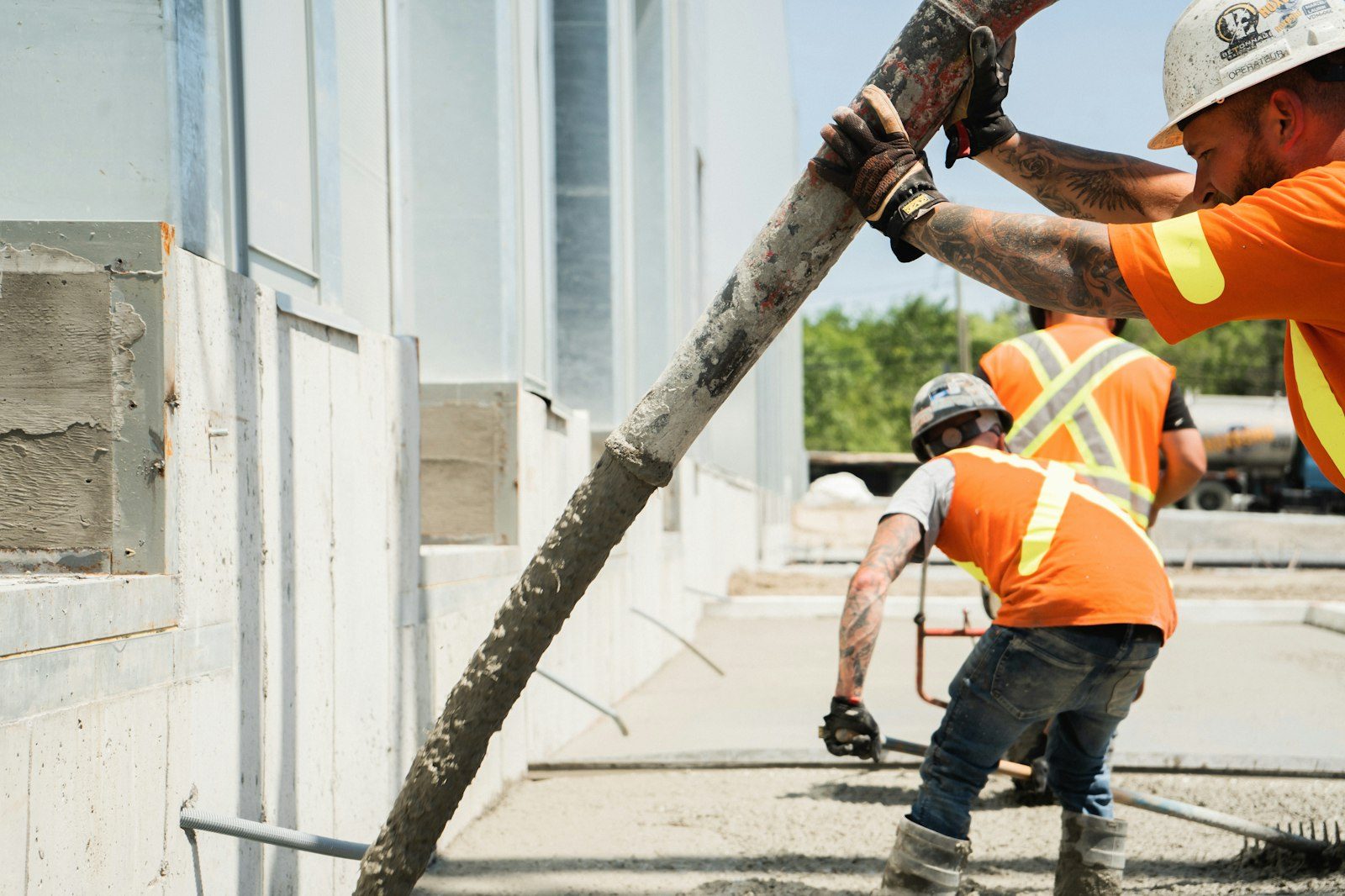
The two hours after the old curb comes out decide whether the new one lasts twenty years or seven.
The interesting part of a curb job is not the pour. It is the trench. Once the broken run is loaded out and you are looking at bare ground, you find out what you bought: dry base that rings under a boot, dark saturated fines that squelch, or a soft channel where water has been running under the curb for years, quietly carrying material away.
We build and replace curb and gutter for commercial, industrial, and association property across Arvada, and we bid the dirt as seriously as the concrete. A curb is a shallow structure on a narrow strip of ground with water pouring down it. Everything that goes wrong with one goes wrong from underneath.
A gutter pan is a few inches thick and a curb face is a thin vertical fin. Neither has the mass to bridge anything. So when a section drops, tips, or cracks in a straight line, the concrete did not fail. The ground under it moved and the concrete followed.
Three things move that ground. Water is the biggest: it comes down the pan by design, and any gap in a joint sends some of it into the base instead of to the inlet. Second is the back side, which nobody thinks about. Irrigation, roof drainage, and landscape grading push moisture into the fill behind the curb, and saturated fill stops holding the back of your gutter up. Third is what the site was built on. Newer commercial pads and association infrastructure out by Candelas, Leyden Rock, and Whisper Creek sit on engineered fill, but the last few feet at the edge of a pad get the least attention during grading, and curb lives exactly there.
Older frontage tells a different story. Around Olde Town and the established parcels near West Woods, curb often predates the pavement in front of it and sits on whatever was there at the time. Cinder, sand, buried asphalt, old trench spoil. Those runs get rebuilt from the ground up or they come back.
| What we find in the trench | What caused it | What we build differently |
|---|---|---|
| Dry, dense base that rings under a boot | The original crew did it right and the drainage worked | Trim, recompact, and pour. This is the cheap version of the job |
| Soft, dark, saturated fines under the pan | Water entering through joints or cracks and staying | Over-excavate, replace with clean compacted road base, and fix the entry point before backfill |
| A washed channel running lengthwise under the curb | Flow following the run instead of leaving at an inlet | Correct the flow line grade first, then rebuild. Pouring over the channel rebuilds the problem |
| Buried trench spoil, old asphalt, or debris | A utility cut or a demolition that got backfilled with whatever was handy | Dig it out entirely. Mixed fill never compacts evenly and the run will telegraph every soft spot |
Send a photo of the run plus one of the same spot after a storm. We will tell you whether it is a curb problem or a drainage problem before we quote a foot of it.
The window we like runs from full thaw through the middle of fall, and that is about the trench rather than the concrete. Frozen subgrade cannot be compacted or evaluated, and saturated spring ground reads soft everywhere, so you either over-dig for no reason or get fooled by ground that firms up in June. Late spring and early fall give us honest dirt.
Winter curb happens, usually because a plow took out a run in February and somebody is looking at exposed steel in a drive aisle. We can form and place small sections cold with heated mix water, a non-chloride accelerator, and blankets left on longer than anyone wants. What we will not do is compact frozen material and call it base. If the frost is deep, we make the area safe, get you through the season, and rebuild it properly in the spring.
Two other notes. Keep the first winter chemical free, since a thin curb section has more exposed surface per unit of concrete than any flatwork you own. And schedule curb ahead of paving and striping, never after, because the curb sets the grade the pavement ties into.
Still unsure about something?
Call the crew at (303) 569-4046 and we will talk it through.
Get a free, no-obligation estimate from a crew that knows Colorado soil, Colorado weather, and how to finish concrete that lasts.
Accessibility
Adjust the site to fit how you read and browse. Your choices are saved on this device.