
Half of what we get called about first got noticed from the sidewalk, by somebody walking a dog.
Stand at the end of your own driveway and look back at the house. Most settlement announces itself from there long before it announces itself underfoot. A dark line of shadow along one joint. A garage door that no longer reads as one straight line where it meets the concrete. A front walk whose panels have stopped agreeing with each other about level.
Those are the calls we get most often in Westminster, and they suit polyurethane. We drill ports the size of a dime, inject foam that expands under the slab, fill the void, and float the concrete back where it belongs. It cures in minutes and weighs almost nothing, which matters when the ground below is the reason things moved.
You stop seeing your own house. That's not a character flaw, it's how attention works. The apron drops a quarter inch a year and your eye adjusts right along with it, until a photo or a visitor makes it obvious.
The short list of things that read from the curb: a shadow gap under the closed garage door, sometimes with a leaf caught in it. A joint at the apron that used to be a thin line and now casts a stripe. Walk panels stepping up and down along the run like piano keys. A stoop separated from the siding by a visible seam. Water sitting in one spot three hours after the rain quit, which from the street looks like a permanent dark patch.
None of that is cosmetic. Each one is a void doing its work below, and each gets worse on its own schedule, because the tipped panel is now steering water toward the low corner that created it.
Foam goes in through a hole about five eighths of an inch across. On a stamped patio or a colored walk, that's the difference between a repair you notice and one you don't. The material expands to fill whatever cavity it finds, sets within minutes, and carries load almost immediately.
Weight is the real argument, though. Cured polyurethane comes in at a few pounds per cubic foot. A cement slurry runs past a hundred. When a slab sank because the ground under it couldn't hold what was already there, adding another hundred pounds per cubic foot of new material is a strange way to solve it. Foam fills the same space without loading the soil, and it doesn't wash out with the next wet spring.
It also seals. As the foam expands it pushes into the gaps and voids around the edges of the cavity, which cuts off the little channels water was using to keep excavating. That's part of why a foam lift tends to hold in yards where drainage isn't perfect and never will be.
Send us the same photo you'd send a neighbor. We can usually name the cause before we pull up.
| What settled | Realistic correction | What sets the limit |
|---|---|---|
| Apron dropped below the garage slab | Usually back to the door line | The old joint. Push past it and the door seal stops meeting concrete. |
| Walk panel tipped toward the street | Full correction, in most cases | Its neighbors. We match the run, not one lonely square. |
| Stoop pulled away from the house | Partial, and taken slowly | Anything anchored to the wall: railings, siding trim, the door threshold |
| Patio pitched back at the foundation | Enough to restore fall away from the wall | The house edge is fixed, so every bit of movement comes from the outside |
| Panel already cracked across the middle | Lift, then seal the crack | Broken concrete rises in pieces, so both halves need their own ports |
| Slab sitting on deep loose fill | Lifting it is the easy part | Not the foam. The ground below decides whether it stays up. |
Cement-based lifting shuts down for winter. Foam doesn't, and that's a real advantage on the north metro calendar. Polyurethane cures chemically rather than waiting on warmth, so a cold, dry day is workable as long as the subgrade isn't frozen solid. We check that first, because frozen ground reads high and would have us leveling to a number that vanishes in March.
That opens a window most contractors won't touch. A trip hazard on the walk in December doesn't have to sit until spring, and established blocks near Legacy Ridge call us about exactly that every winter. An apron letting snowmelt run under the garage door can get corrected before you spend another winter squeegeeing the floor.
Our preference is still the shoulder seasons. October and early November give dry ground, mild temperatures, and soil moisture that's stopped swinging, so the slab tells the truth about where it wants to sit. Spring works too, though after a wet stretch we wait a few days for the ground to give back what the storms left.
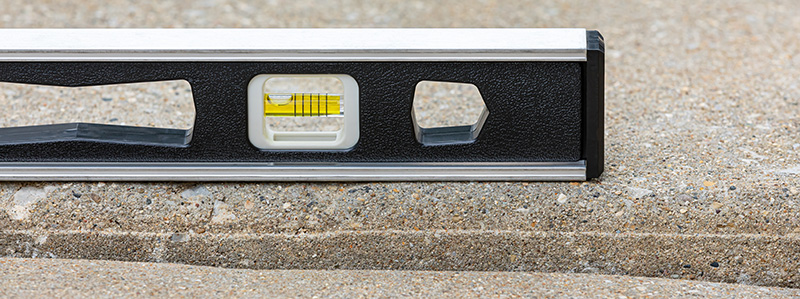
People apologize for calling about something small, then we get there and put a level on it. A quarter inch at the door is inches of water in the wrong place over a whole driveway. Small at the curb rarely means small underneath.What the crew sees on site
Still unsure about something?
Call the crew at (303) 569-4046 and we will talk it through.

Get a free, no-obligation estimate from a crew that knows Colorado soil, Colorado weather, and how to finish concrete that lasts.
Accessibility
Adjust the site to fit how you read and browse. Your choices are saved on this device.