
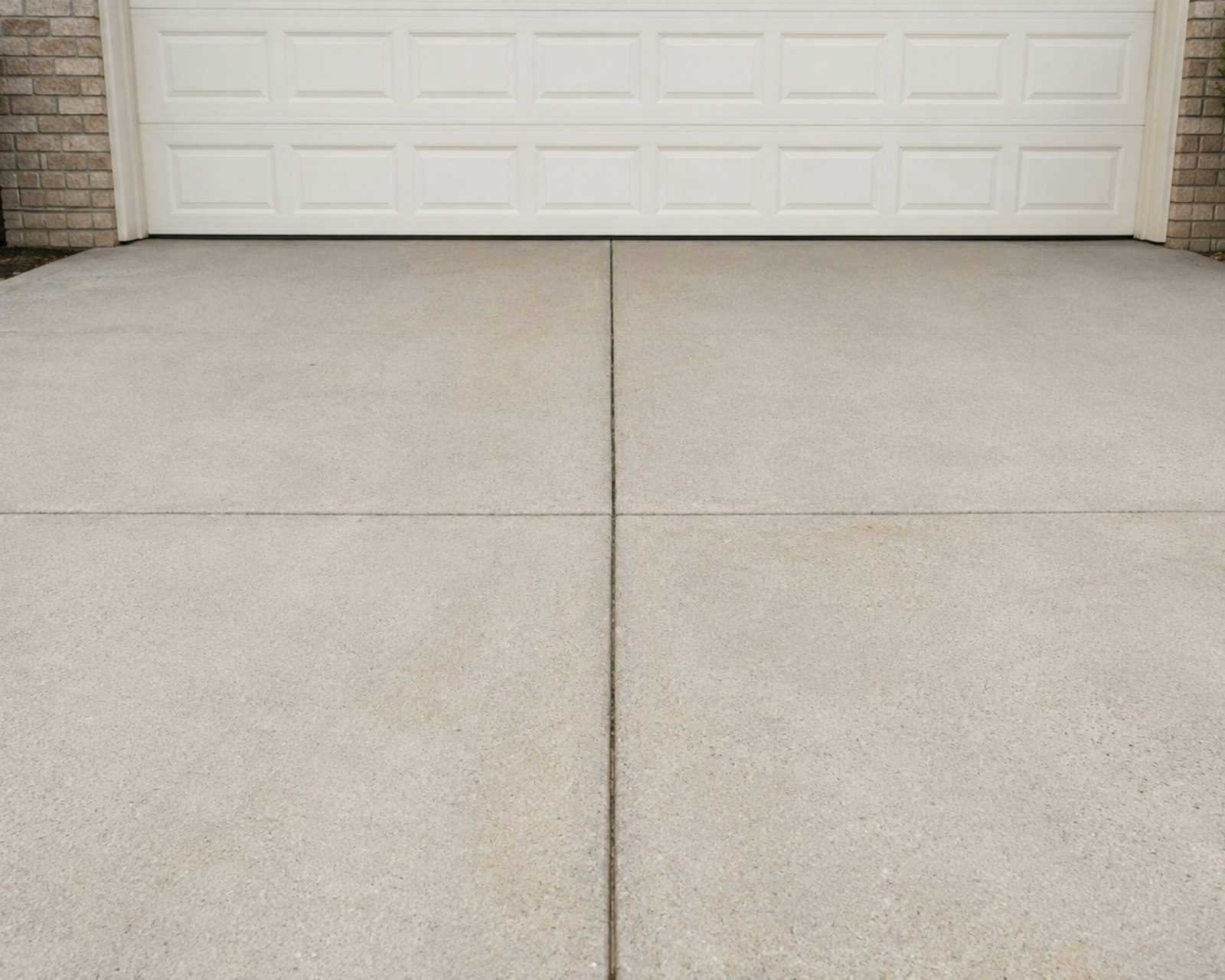
Sealer fails from underneath far more often than it fails from the sky.
Almost every failed sealer we get called to look at had water working on it from the wrong side. Not rain. Not sun. Water that came through the base, up through the slab, or in from a saturated edge, pushing on a coating built to keep water out and given no plan for water headed the other way.
Which makes sealing a drainage job with a chemistry step at the end. The first visit goes to downspouts, sprinkler heads, and where the grade really falls. Only then do we talk about product. Skip that order and you'll have a white haze or a peeling film inside two seasons.
A slab sits on a base, and that base is either shedding water or holding it. On the clay across the north metro, a base that wasn't built to drain turns into a shallow reservoir every time snow melts. Water down there doesn't just sit. Concrete wicks it, and it travels toward the dry face, which is the top, which is the surface somebody just coated.
Push a film onto that and the water reaches the underside of the coating and stops. It can't leave. You get a milky haze, or blisters, or sheets lifting the first time it freezes with water trapped beneath. Penetrating products handle it better since they build no barrier, but even they can't soak into pores that are already full. Sealing a wet slab is the most common way to waste a Saturday in this trade.
Two entirely different products get sold under one word, and moisture is the cleanest way to choose between them. Penetrating sealers react inside the pores and leave nothing on top. Concrete still looks like concrete, water beads and rolls off, and the slab keeps breathing, which is why these go on driveways, walks, and any exterior slab where we aren't certain the base is dry. No gloss, no darkening, and nothing there to peel.
Film-forming sealers sit on the surface and give you the wet look, deeper color, and real protection for decorative work. Stamped and stained surfaces need one. But a film is a door, and if water is knocking from underneath, the door is the problem. Where there's a drainage question we fix the drainage first or go breathable and skip the shine.
| What we check | How we check it | What stops the job |
|---|---|---|
| Surface moisture | A square of plastic taped down tight overnight | Condensation under it, or concrete reading darker than the slab around it |
| Deep moisture in a floor | A calcium chloride kit or a probe set into the slab | A reading past what the data sheet allows. That number isn't ours to argue with |
| The shaded half | The same checks, run separately on the north side | One side passing while the other fails. Everything waits for both |
| Joints and edges | Open a joint and look at the grit inside it | Damp material after a dry week means water is arriving from somewhere |
| A garage slab with nothing under it | White rings near the drain or where the vehicle parks | Salts coming up from below. Breathable product, never a film |
| A slab just pressure washed | A finger drawn across it two dry days later | Cold, dark concrete. Washing puts days back on the clock |
September into early October is the best stretch we get, and it fills. Free estimates. Call (303) 569-4046.
There are two good stretches on the Front Range. Late spring, once the ground has drained and overnight lows quit dipping. Then early fall, which is better, because the slab has been drying since June and afternoons are warm without being hot enough to flash a coating off the roller before it levels.
New concrete runs on its own rules. A curing product goes on right away, and a real sealer waits about a month while the slab gains strength and gives up water. Through that first winter you use sand and nothing else. High summer works from a daylight start, though a hot slab sets a film before it spreads and those lap marks never come out.
After that it's a rhythm. Plain flatwork around Legacy Ridge and Bradburn goes several years between penetrating coats. Decorative work wants attention every two to three years, and an October water test tells you more than any calendar.
Still unsure about something?
Call the crew at (303) 569-4046 and we will talk it through.
Get a free, no-obligation estimate from a crew that knows Colorado soil, Colorado weather, and how to finish concrete that lasts.
Accessibility
Adjust the site to fit how you read and browse. Your choices are saved on this device.