
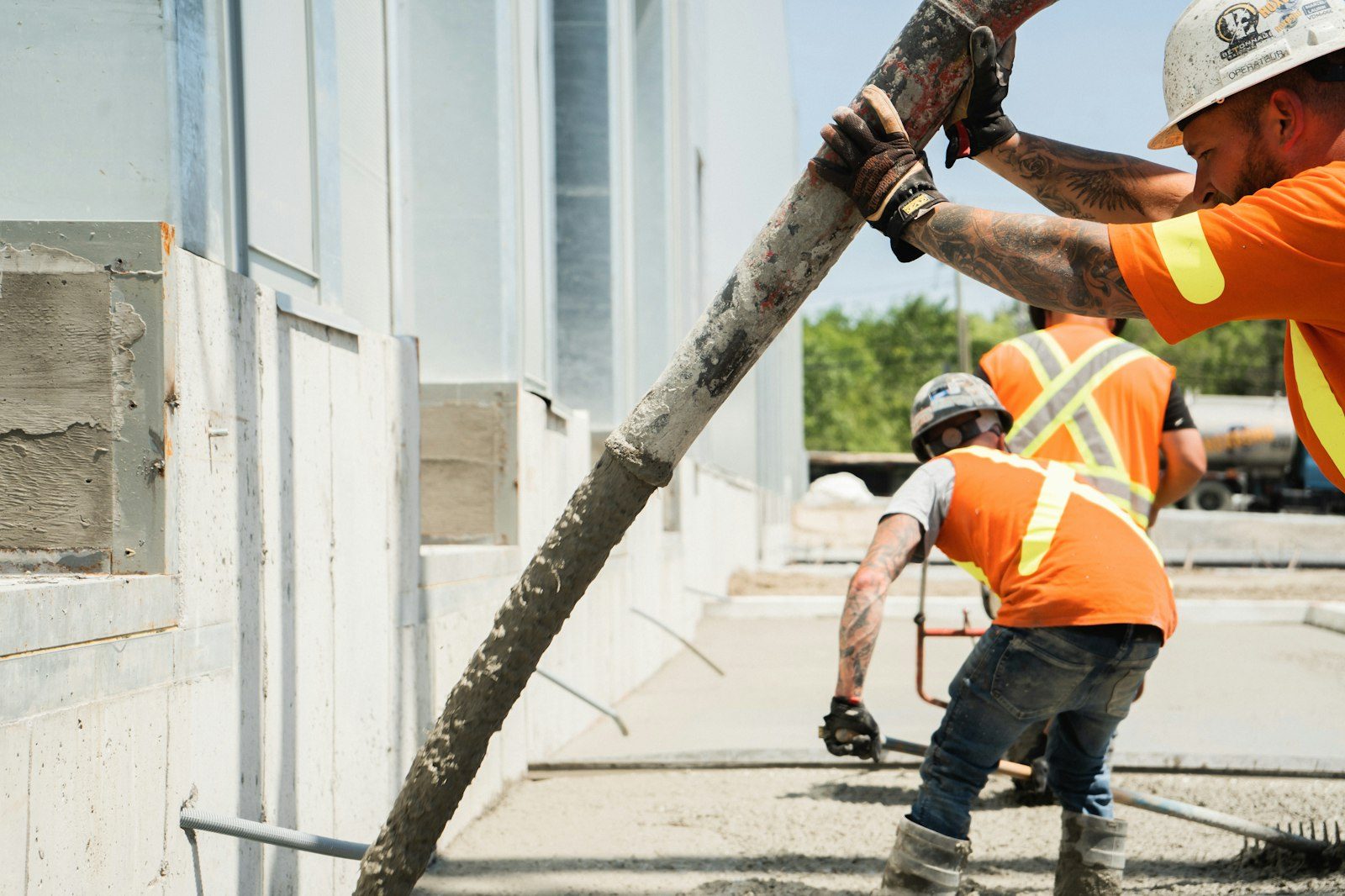
A curb line tells you what decade a property went in, and roughly when its drainage quit working.
Four completely different clients call us about curb in this city and the calls sound nothing alike. A retail property manager wants the entrance to stop looking beat up. An association board has residents complaining about the loop. A light industrial owner has curb the trucks flattened. A GC on a newer pad needs a run tied into work somebody else poured.
Underneath, all four are the same job. Curb isn't trim. It's a drainage structure shaped like trim, and it's the only concrete on your property that has to hand off cleanly to five other things: the pavement, the drive approach, the inlet, the ramp corner, and whatever landscaping presses against the back of it. Blow one handoff and the whole run gets blamed.
Retail corridor lots wear out at the entrances and at the trash enclosure. Drivers cut the corner, front tires ride up on the face, and the top edge chips until the run looks chewed. The concrete two feet away is fine. Geometry failed, not material.
Mature associations are a different animal. Hunters Glen and Quail Valley went in when rolled curb was standard, and rolled curb invites exactly what you'd expect. Residents park across it, guests drive over it, and decades of that leave a run pushed slowly outward. Failures cluster at the mailbox pull-off and wherever the loop tightens.
Light industrial fails at the entrance and nowhere else, because a tandem axle turning in from the street tracks its rear wheels well inside the front ones. Newer pads toward North Creek Farms have the shortest complaint list, though we still find shallow base and flowlines shot to the drawing rather than to where water goes. Older property near Eastlake is the opposite: curb repaired four times, grade never corrected once.
| Where the curb hands off | What the transition has to do | How it goes wrong |
|---|---|---|
| Into a drive approach | Drop the face to nothing over a short run while the flowline holds its grade all the way through | Crews flatten the flowline through the approach because it's easier. Water stops there, and every January you get ice across your entrance. |
| Gutter pan into a storm inlet | Deliver water to the throat with the pan sitting slightly low at the opening | A pan built a hair high at the casting holds a permanent puddle. Sediment settles, freeze cycles work on it, the pan breaks up around the frame. |
| Into a ramp corner | Meet the ramp flush with no lip and hold cross slope through the landing | The lip. A quarter inch at the bottom of a ramp catches a caster wheel and gets written up. |
| Against the asphalt edge | Give the pavement a clean vertical face to butt to, with base running continuously under both | Old asphalt gets left thin and ragged at the joint. Water gets in, the edge crumbles, and the curb takes the blame. |
| Along a landscape bed | Hold soil and irrigation water back on the planted side | Bed grade creeps above the back of the curb. Every irrigation cycle soaks the base from behind and the run tips outward. |
| Into the run you're keeping | Match line, profile, and flowline elevation at the seam | The last contractor matched the top of the curb and ignored the flowline. Water hits the joint and quits moving. |
Send us a couple of photos and we'll tell you what we'd measure first. No charge for the walk or the written scope.
Curb sits in a narrow trench with soil pressing one side and pavement the other, which makes it the most drainage-sensitive concrete on a property. The clay under it moves with moisture, and that moisture almost always comes from something you control: a bed graded toward the curb, a sprinkler head aimed at the back of it, an inlet that stopped taking water two years ago. So we rebuild the base and the drainage, not just the concrete somebody already replaced once.
Winter finishes the job. Plows catch the face, steel edges chip the lip, and whatever the snow vendor spreads settles in the pan and sits through every thaw. A curb line takes more freeze cycles per season than anything else you own, because it holds water by design.
Best window is late spring through October. Curb takes a stiff mix that doesn't like cold, and machine-extruded runs especially want decent temperatures to hold their shape. We'll pour cold-weather curb with heated water, accelerator, and blankets when a property has a live hazard, and we'll tell you plainly when a run should just wait for April.
People point at the broken part and ask us to replace the broken part. We shoot the grade first, because nine times in ten that section is just the low spot in somebody else's mistake, and new concrete in the same hole gets the same result.From the crew lead on these jobs
Still unsure about something?
Call the crew at (303) 569-4046 and we will talk it through.

Get a free, no-obligation estimate from a crew that knows Colorado soil, Colorado weather, and how to finish concrete that lasts.
Accessibility
Adjust the site to fit how you read and browse. Your choices are saved on this device.