
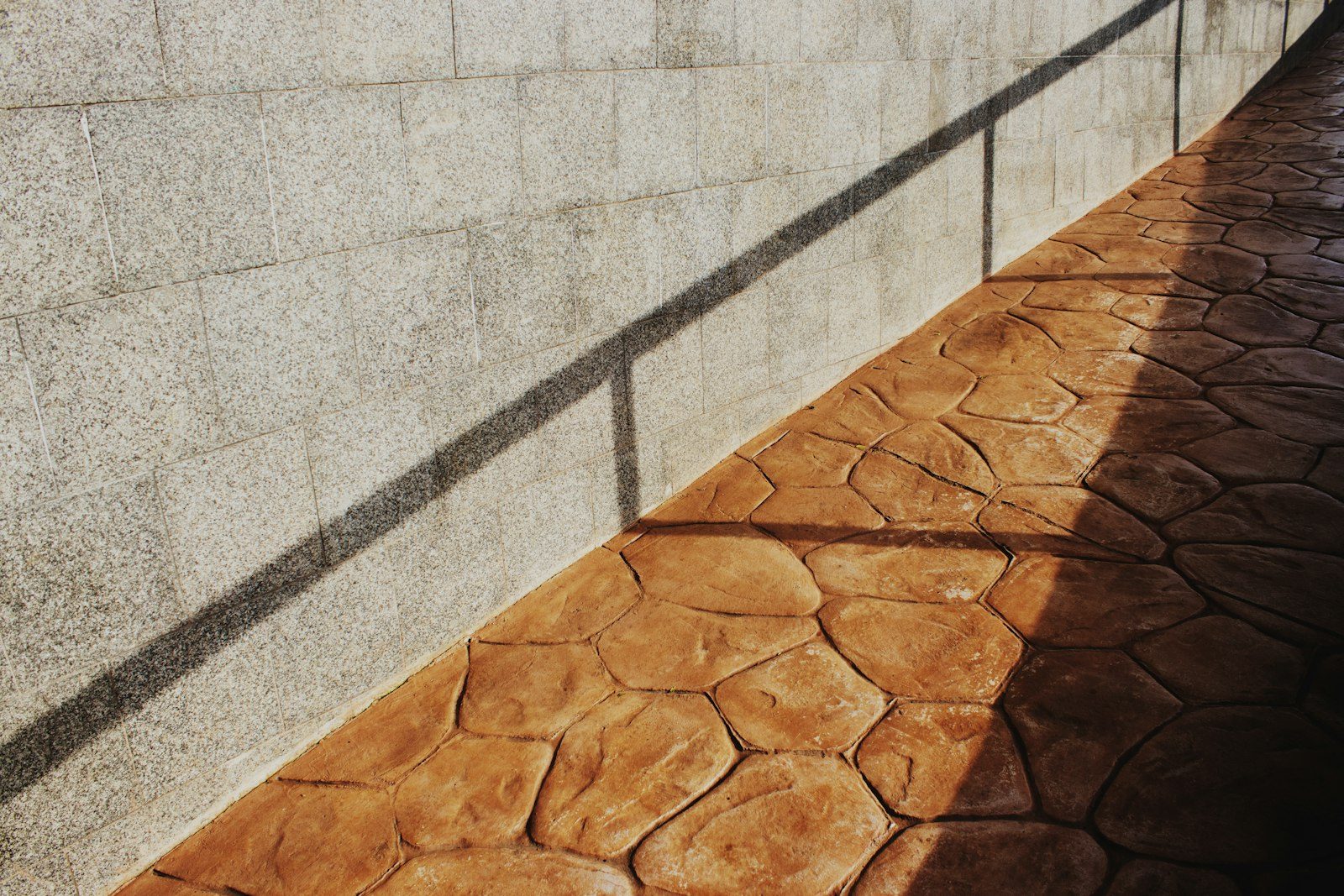
The quietest way to make a slab stop looking like a slab, and an honest read on when it beats stamping.
Most people who call about scoring are really asking a different question: how much do we need to spend to make this concrete stop looking like a parking pad? Scoring is one answer among five or six, and it isn't automatically the right one. Sometimes it's exactly right. Sometimes we'll tell you to put the same money into color instead, or to skip decoration altogether and fix the drainage first.
So this page is a decision page. What scoring actually does, what it costs you in maintenance, and which situations make it the smarter pick over stamping, staining, or a full overlay. We cut these lines on new pours and on slabs that have been sitting behind houses in Clarke Farms and Idyllwilde for years, and the honest answer about which slabs benefit is not every slab.
Scoring adds scale and rhythm. That's the whole product. A big uninterrupted gray field reads as industrial no matter how well it was finished, and cutting it into sized shapes changes how your eye handles the space. Twelve-inch squares make a walk feel like a path. Large ashlar rectangles make a patio feel like a room. A cut border around the perimeter frames everything inside it.
What scoring does not do is change the color, the texture, or the condition of the concrete. It's shape only. Which is why the pairing that gets used most is scoring plus stain: the lines create the pattern, the color gives the surface depth, and the two together get you within shouting distance of a stamped look for considerably less work. If your slab is worn, dusting, or spalled, though, cutting lines into it just gives you a patterned bad surface. Fix the surface first.
| Option | What it changes | When we'd pick it |
|---|---|---|
| Leave the broom finish | Nothing, and there's no shame in that | Utility areas, side yards, anywhere nobody stands around looking |
| Saw-cut scoring | Shape and scale only | A sound slab that just reads too plain, and a budget with limits |
| Scoring plus stain | Shape and color together | The best value we offer on an existing patio, by a comfortable margin |
| Stamped concrete | Shape, color, and real surface texture | New pours where you want depth you can feel underfoot |
| Patterned overlay | A whole new wearing surface with pattern in it | Slabs that are structurally fine but cosmetically finished |
| Pavers | Everything, including the slab | When you want individual units and accept the weeds and resetting |
Send us a photo of the slab and tell us how you use the space. We'll say which one we'd actually recommend, even when it's the cheaper one.
Two kinds of cuts end up in a slab and they are not the same thing. A control joint is structural housekeeping: cut roughly a quarter of the way through the slab so that when the concrete shrinks, it cracks down in the groove where nobody sees it. A decorative score is shallow, just deep enough to catch a shadow and hold a line of color. Cut a decorative pattern deep enough to act like a joint and you've created weak paths the slab never asked for.
The layout has to respect both. We draw the pattern around the joints the slab needs, not the other way around, so the functional cuts hide inside the design. On a curved patio we bend the layout to follow the edge, because a square grid running off a curved perimeter leaves slivers along the outside and slivers always look like a mistake. Every pattern gets chalked on the slab and looked at before a saw comes out of the trailer.
On a fresh pour we can cut early with a soft-cut saw while the concrete is still green, which keeps the edges tight and lets us get joints in on the same day the slab goes down. On an existing slab it's dry cutting with diamond blades and vacuum shrouds, which is dustier and slower but perfectly clean when it's done right. Old slabs also need a scrub first, because a saw following a chalk line over a dirty patio wanders.
Timing follows the weather in one specific way: whatever goes on after the cutting, sealer or stain, needs a dry slab and mild temperatures. So we book this work from late spring through early fall, with September and early October the easiest stretch to get right. Winter cutting is possible on a dry, clear day if the pattern is all we're doing, but nothing gets colored or sealed until spring. And through the first winter after a new pour, keep deicers off entirely. Salt collects in the grooves and works on the concrete right where the water sits longest.
Still unsure about something?
Call the crew at (303) 569-4046 and we will talk it through.

Get a free, no-obligation estimate from a crew that knows Colorado soil, Colorado weather, and how to finish concrete that lasts.
Accessibility
Adjust the site to fit how you read and browse. Your choices are saved on this device.