
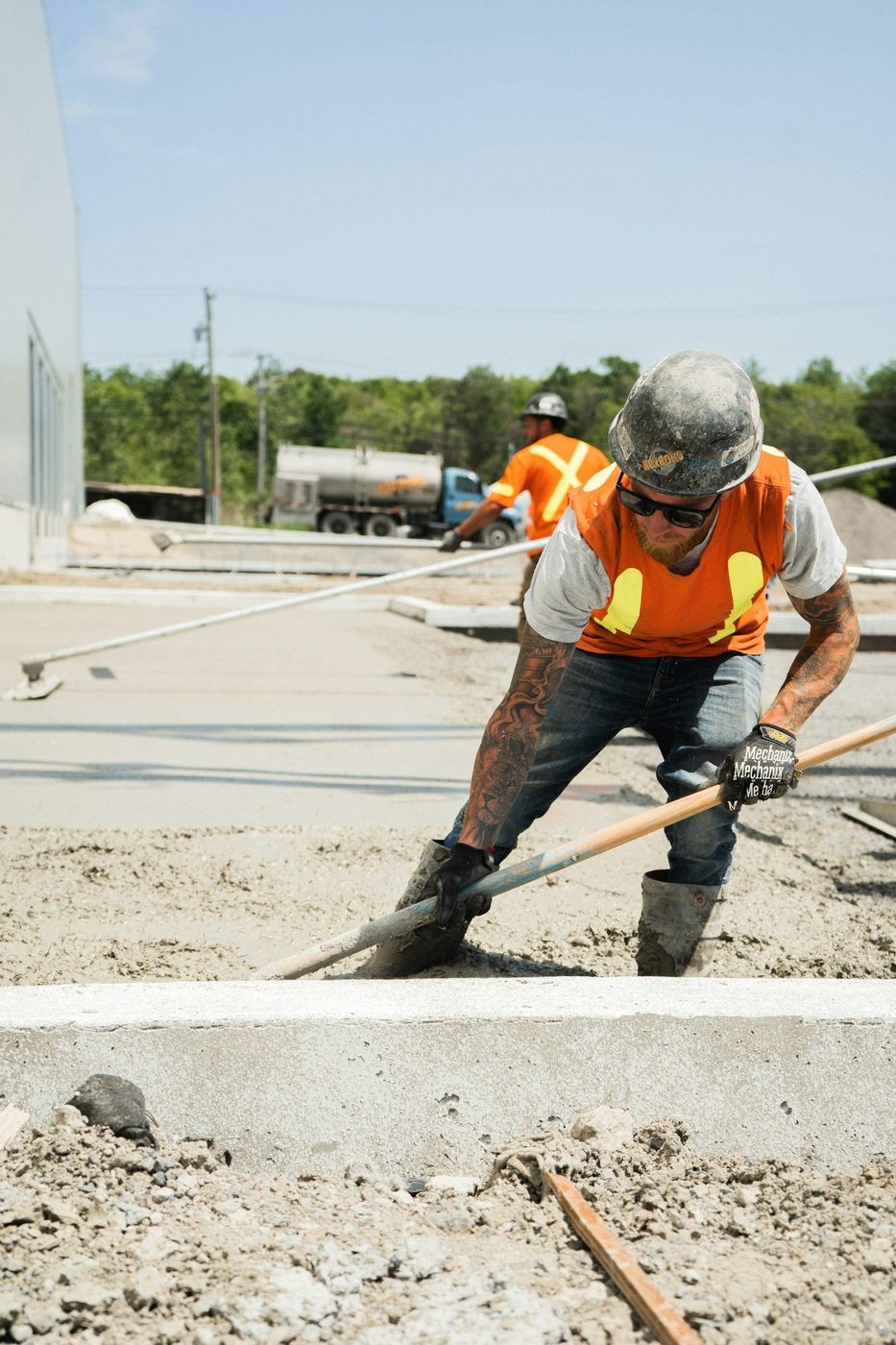
A bonded topping goes down on a clock nobody gets to negotiate with, so the whole day is built around that clock.
Overlay work runs on a clock you can't argue with. Polymer-modified toppings start setting the moment water hits the powder, and once they skin over there's no going back for a second pass. That single fact shapes everything: how many people show up, how the batching station gets set, which end of the patio we start from, and why we won't take on more square footage in a day than the crew can finish clean.
Here's how one of these days actually goes at a house in Canterberry Crossing or Idyllwilde. The short version: mornings belong to prep, midday belongs to placement, and the afternoon belongs to texture and protection. The long version is below, because most homeowners have never watched this work happen and the process is genuinely more interesting than the brochure version.
Nothing else on the job matters if the topping doesn't stick. A cured slab has a closed, slick surface plus whatever it's collected over the years: sealer, tire rubber, fertilizer residue, sunscreen, barbecue grease. All of that has to come off, and the concrete underneath has to be opened into a texture with some tooth to it. We're after a profile you can feel with your palm, roughly like coarse sandpaper.
Cracks get handled before anything goes over them. Static shrinkage cracks get routed out and filled. Working cracks, the ones tied to real movement below, get honored instead: we carry them up through the topping as a joint rather than pretending they're gone, because a moving crack always finds its way back to daylight. Existing control joints get the same treatment. And if the slab underneath is heaved, hollow, or crumbling, we say so on the estimate and talk about replacement instead of dressing up a failure.
| Method | Where it fits | What it leaves behind |
|---|---|---|
| Diamond grinding | Small areas, edges, and slabs with glue or thick sealer on them | Flat and clean, with fine dust that has to be vacuumed at the source |
| Shot blasting | Whole driveways and big patios that need a uniform profile fast | The most even tooth of any method, and almost no slurry to deal with |
| High-pressure water | Slabs near landscaping or windows where dust is the bigger problem | A great profile, plus a wet slab that has to dry before anything is placed |
| Chemical etch | Small residential patches only, and only when nothing mechanical fits | An uneven bite. We use it rarely and never on a slab that saw heavy deicer |
| Scarifying | Thick coatings and stubborn buildup that grinding just polishes | An aggressive gouged texture that needs a follow-up pass before placement |
We'll sound it, check the cracks, and tell you honestly whether a topping is money well spent or a delay on a tear-out.
Once mixing starts, the crew splits into roles and stays in them. One person batches, and batching is exact work: the same water every time, timed mixing, no eyeballing. Others place and screed, then a finisher follows behind pulling the surface to the texture you picked. Spray-down knockdown, broom, trowel, stamped, or a smooth microtopping. Whatever it is, it happens once, on the whole surface, in one continuous run so there's no cold joint sitting in the middle of your patio.
Parker's air is the real opponent. Low humidity at 5,869 feet, plus wind coming across open ground, pulls water out of a thin topping faster than most people believe. So we shade the working area when the sun is high, dampen the substrate ahead of placement without leaving standing water, and we'll start at six in the morning in July to stay ahead of the heat. On a breezy day we may set a wind screen just to keep the surface from skinning early.
Season matters. Late April into October is the window, and September into early October is the best of it: mild days, cool nights, and steady curing before the freeze. Winter placement is off the table for us. These materials need surface temperatures that hold above freezing for days, not hours, and a January patio simply can't offer that. What winter is good for is planning: we measure, sample colors, and get the spring calendar sorted while nobody is in a hurry.
Still unsure about something?
Call the crew at (303) 569-4046 and we will talk it through.
Get a free, no-obligation estimate from a crew that knows Colorado soil, Colorado weather, and how to finish concrete that lasts.
Accessibility
Adjust the site to fit how you read and browse. Your choices are saved on this device.