
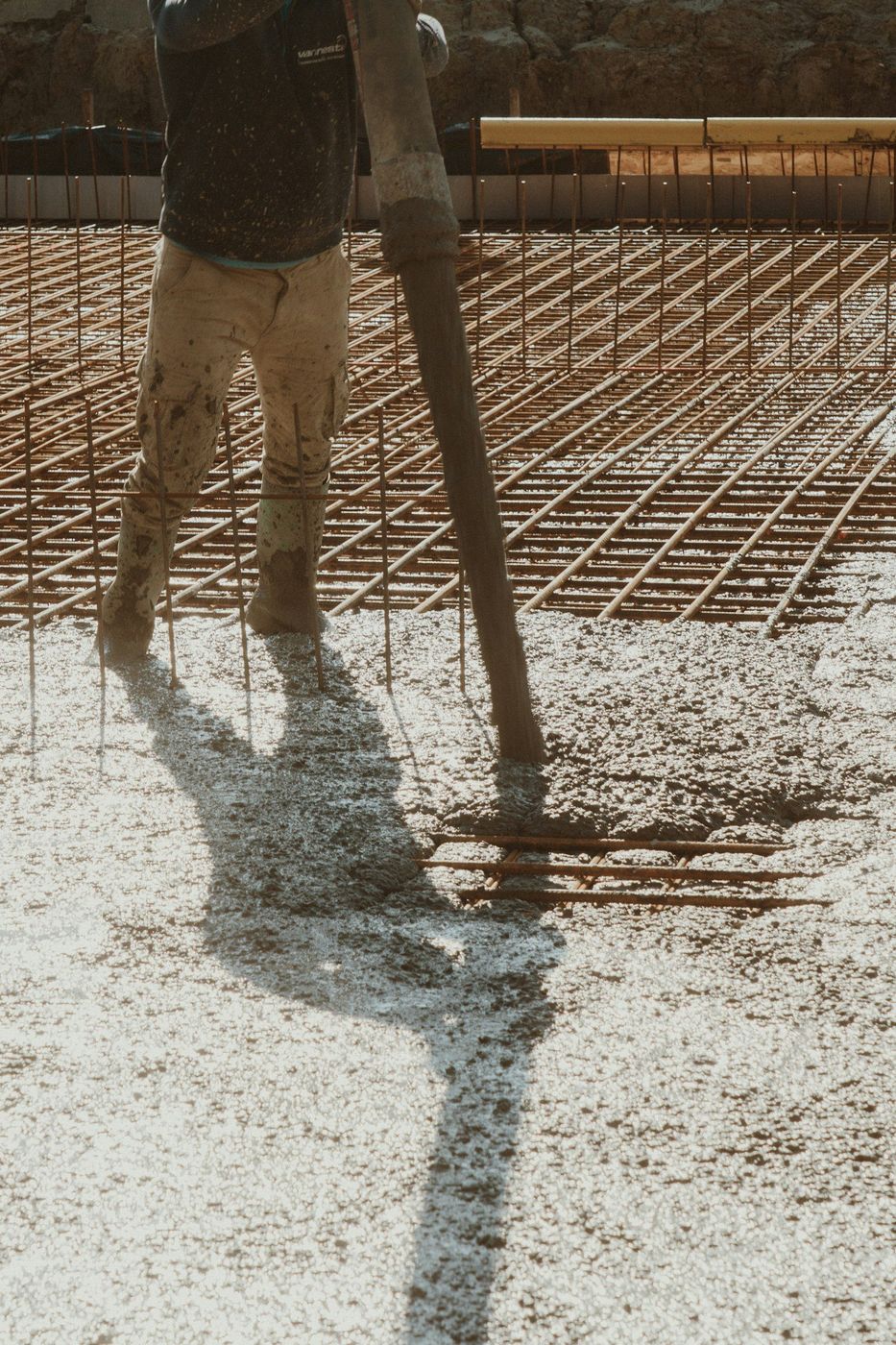
Ask an operator where the floor is bad. They will point at the same joint every single time.
Ask a forklift operator where the floor is bad and they point without thinking about it. Same joint every time. The one that rattles the mast, shifts a load, and knocks a top box off once a month. That joint is the real cost of a warehouse floor, and it arrives years after anybody signed the contract, in maintenance tickets, damaged freight, and an operator lifting off the pedal at the same spot forty times a shift.
We place and repair industrial floor slabs for warehouse, flex, and service buildings around Lone Tree and the RidgeGate corridor. A floor bid is easy to compare and nearly meaningless on its own, because what you are buying is flatness, joint behavior, and a slab that holds its shape under the racking you intend to load. Those three items are where the money actually goes, and they are the three a thin bid leaves out without saying so.
Start below grade, because that is where a surprising share of the number lives. Subgrade has to be proof-rolled, corrected, and compacted across the entire footprint, not just where the trucks drove during construction. Then a granular layer, then a vapor barrier on floors that will ever be coated or polished, placed directly under the slab rather than buried under a sand layer that traps water.
Next is thickness and reinforcement, and that is a function of your racking, not your square footage. Post loads from a rack upright concentrate weight into a base plate the size of a dinner plate. Where those uprights land matters more than the aisle beside them, so we want the rack layout before we design the slab.
Then flatness, which is mostly labor and equipment. A laser screed, a properly staffed finishing crew, and a placement sequence that keeps every strip inside its window cost more than a wet screed and three finishers. That difference is the single biggest legitimate gap between two floor bids.
Curing and joint treatment close the list. Both are cheap next to the slab. Both decide how it performs in year five.
Joint spalling is the classic one. Small wheels hammering an unfilled or badly filled joint break the edges down, the gap widens, and repairs start eating a maintenance line item every year. Filling joints with the right semi-rigid material after the slab has done most of its shrinking is the fix, and doing it too early is the reason so many floors get filled twice.
Curling is the second. Slab edges lift when the top dries faster than the bottom, which at 5,817 feet with our humidity is a real risk on any floor cured carelessly. To a forklift a curled edge feels exactly like a settled slab, and it is far harder to correct later than to prevent now.
Moisture failures under coatings are the third and the most expensive. A coating goes down over a slab that is still releasing water and it blisters, delaminates, and comes back off. That is a floor paid for twice plus a shutdown. Vapor barrier under the slab and real moisture testing before the coating are the whole prevention.
| How the floor gets used | What we build to | What it takes to get there |
|---|---|---|
| Storage bays, foot traffic, hand pallet jacks | Standard flatness verified with a straightedge | Wet screed placement and a capable finishing crew |
| Sit-down forklifts, moderate racking | Higher overall flatness measured across the whole placement | Laser screed, planned strip layout, riding trowels on a tight schedule |
| Narrow-aisle turret trucks, high racking | Defined-traffic numbers measured down each aisle | Aisle layout locked before the pour, then straightedging and grinding the wheel paths |
| Coated or polished floor | The same flatness plus a moisture-controlled substrate | Vapor barrier directly under the slab, moisture testing, cure chosen with the coating |
| Service bays and shop floors | Flatness secondary, fall to the drains primary | Slope built into the screed and drains set dead-on before placement |
| Cold storage | Flatness plus insulation and armored joint edges | Under-slab insulation, tighter joint spacing, steel-protected joints at wheel crossings |
Send us both scopes and your rack layout. We will mark what one priced and the other skipped, at no charge and with nothing to sign.
Still unsure about something?
Call the crew at (303) 569-4046 and we will talk it through.

Get a free, no-obligation estimate from a crew that knows Colorado soil, Colorado weather, and how to finish concrete that lasts.
Accessibility
Adjust the site to fit how you read and browse. Your choices are saved on this device.