
Cut out a failed curb and the answer is in the trench, not in the concrete.
Saw out a failed curb section and look at what comes with it. Under a run that lasted, there is compacted base carried well past the back of the gutter, backfill that drains, and a flowline shot with an instrument rather than judged by eye. Under a run that failed, there is native ground, a scoop of gravel thrown toward the flowline, and trench spoil somebody boot-tamped at four thirty on a Friday.
We build and replace curb and gutter for commercial properties, community associations, and site work across Lone Tree. Owners tend to file curb under trim. It is not trim. It is the drainage structure that decides where every gallon on your property ends up, and it is the edge restraint holding the pavement beside it together. When a curb line gives out, the lot next to it starts going with it.
| Layer | What we build | How it shows up when it is missing |
|---|---|---|
| Subgrade | Proof-rolled native ground with wet or soft pockets dug out and replaced | The run breaks into short pieces as the ground below it moves through the year |
| Structural fill | Imported material placed in lifts, each one compacted and tested | One dipped section in an otherwise straight, healthy run |
| Aggregate base | Graded road base carried at least a foot past the back of the gutter | Edges break away, the curb rotates outward, and the pavement follows it over |
| Backfill behind the curb | Compacted in lifts to finish grade and sloped so water leaves | Ponding behind the structure, a saturated subgrade, and heave the first hard winter |
| Flowline grade | Elevations shot along the whole run and fall verified into every inlet | Water standing in the gutter, ice through February, early surface loss |
| Joint layout | Contraction joints on set spacing, isolation at inlets and structures | Random cracking wherever the run is weakest, usually at the tightest radius |
A curb occupies the worst real estate on any site. Half of it is buried in soil that changes volume as moisture comes and goes; the other half is out in the sun, in front of a plow blade, and downhill of whatever gets scattered on the pavement in January. At 5,817 feet the daily swing does the heavy lifting. A curb face can sit at 15 degrees at sunrise and 50 by early afternoon, day after day from December into March, with water in the flowline riding the same cycle.
Then consider where snow goes. Plow crews push to the curb by design, so every pile on the property lands on the one structure with dirt against one face and open air against the other. That pile melts into the backfill, refreezes overnight, and pushes. Runs at the newer commercial pads near RidgeGate usually show it as tipped curb leaning away from the pavement. Older amenity and residential work around Heritage Hills and Montecito shows it as vertical offsets, where one section lifted and the next one held still.
The cure is unglamorous and it works. Drain the backfill. Compact it in real lifts. Get water into an inlet instead of letting it stand against a structure all winter.
Send a photo and roughly how long the run is. We will say whether you are looking at a grade problem or a settlement problem, free.
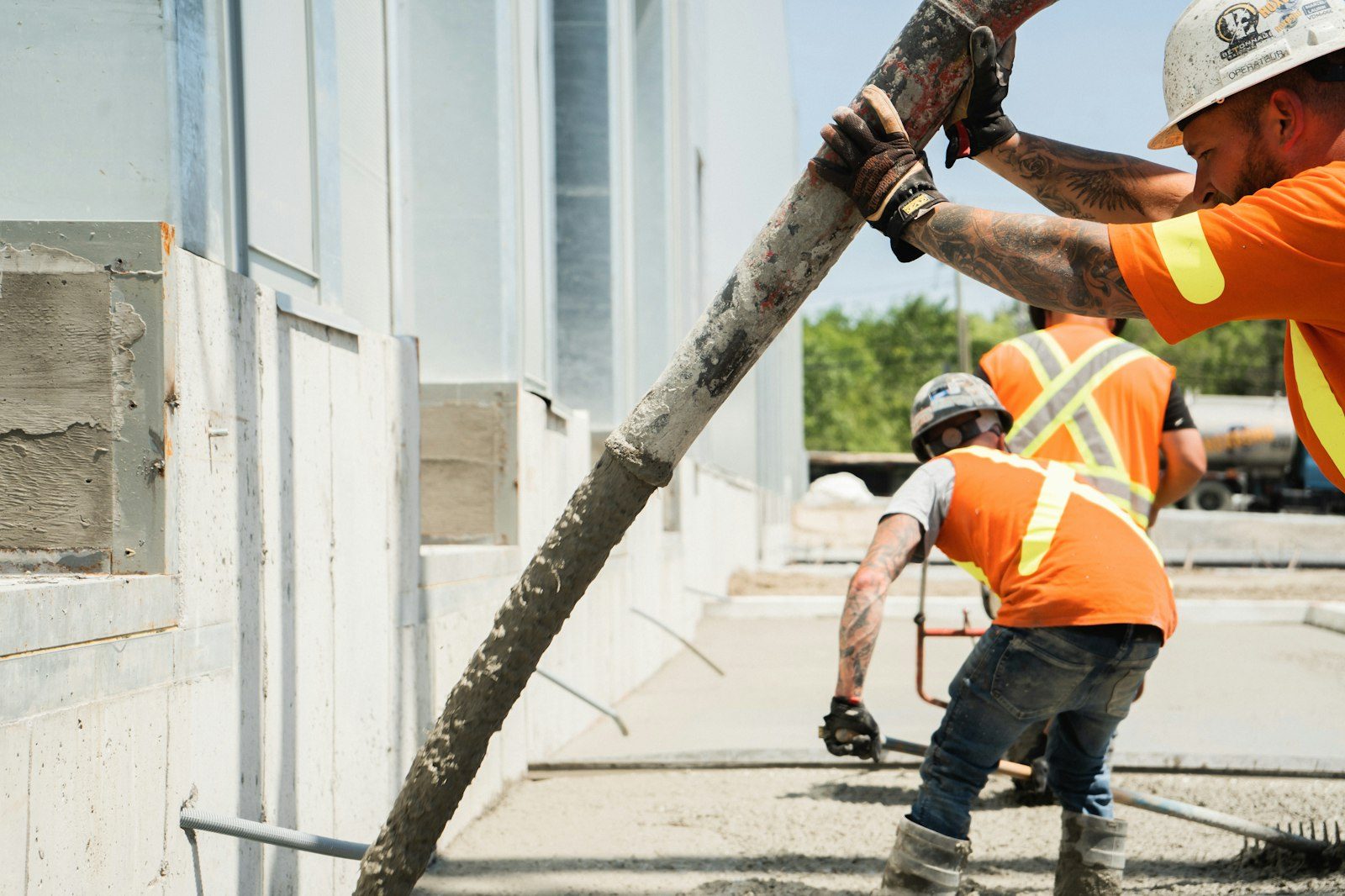
We replace curb in segments, not in one long ribbon, because a property needs its aisles. A crew can take out, form, pour, and strip a manageable run inside a few days, and we stage those segments so the entrances and the fire lane never close at the same time.
Late April through October is the comfortable season for curb work on the Front Range, and the shoulder weeks are the best of it. Cool nights let a crew finish a long run without racing a crust down the flowline. Summer means placing early and keeping an eye west, because a storm cell hitting fresh concrete washes paste out of the gutter surface, and that is precisely the surface that will spend all winter under water.
Winter placement is possible: hot water at the plant, an accelerator carrying no chloride, blankets over each section overnight. We do that when a property has no other window. What we will not do is set curb on frozen subgrade.
Still unsure about something?
Call the crew at (303) 569-4046 and we will talk it through.

Get a free, no-obligation estimate from a crew that knows Colorado soil, Colorado weather, and how to finish concrete that lasts.
Accessibility
Adjust the site to fit how you read and browse. Your choices are saved on this device.