
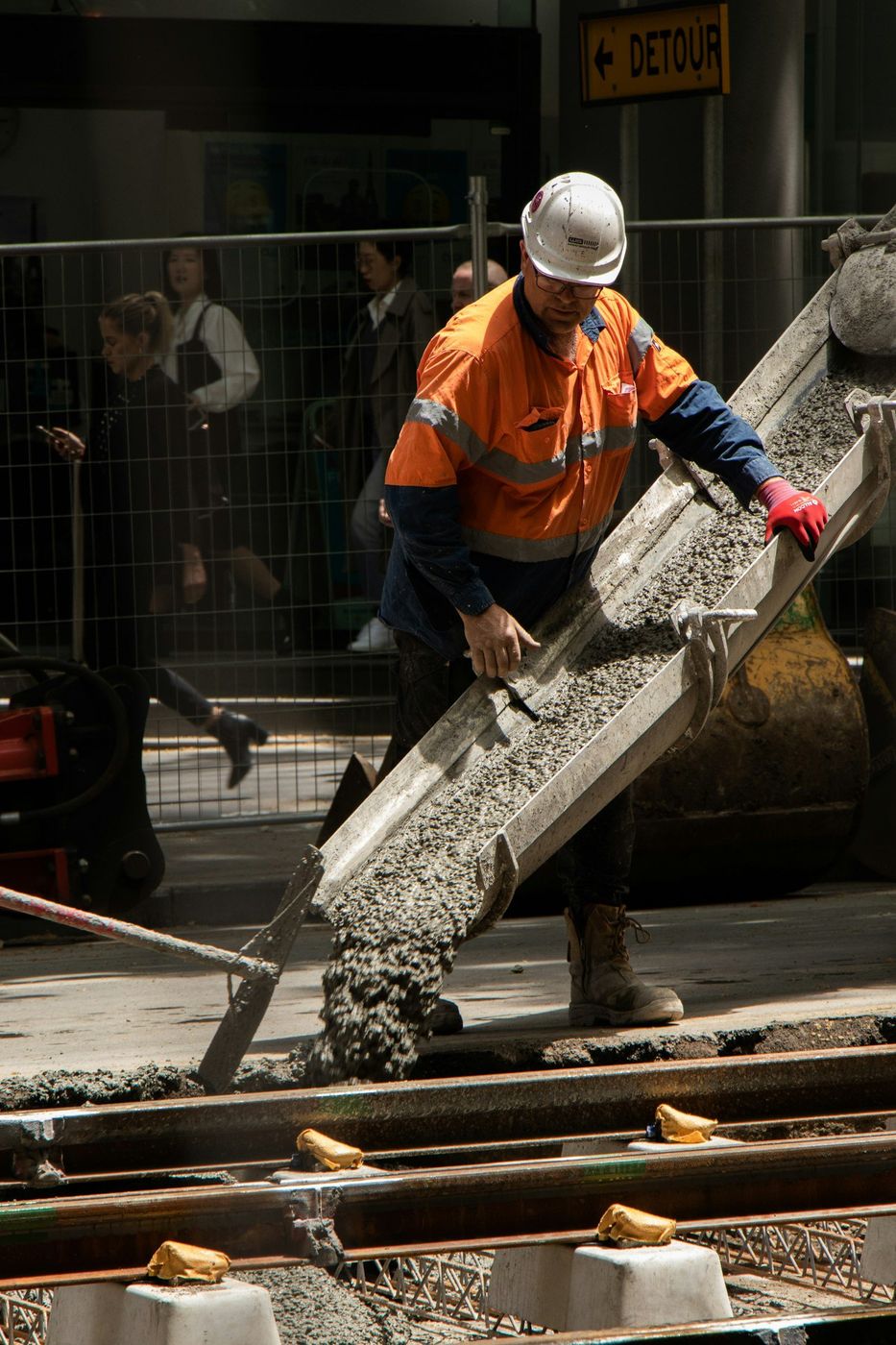
Patch it, replace it, or move it. Three questions decide which one you are actually buying.
Trash enclosure pads start a specific argument. Maintenance wants to patch it. The hauler says the container rocks every time they set it down. The owner or the board looks at a bid and wonders why a slab under a dumpster costs what it costs. All of that is fair, and the answer comes down to three questions: did the ground under it fail, how many years does the enclosure itself have left, and is the pad even in the right corner of the property.
We build and replace enclosure pads for retail centers, restaurants, office buildings, and community properties around Lone Tree. The engineering is not exotic. A front-load truck sets two steel forks down on a few square inches each, hoists several tons over the cab, and repeats that in the exact same footprint twice a week for ten years. Nearly every failed pad we look at got built like a parking stall.
First: is the damage in the concrete or under it. Stand on the slab while a loaded container gets rolled across it. If nothing moves and the trouble is surface flaking, you have a repair. If the panel rocks, if there is grit pumping out of the cracks, or if one side has dropped below the other, the base failed and the concrete is just the messenger.
Second: how much life is left in everything attached to it. Enclosure posts, gates, and screen walls share footings and a footprint with the pad. Replacing the slab now and the walls in two years means paying for mobilization, demo access, and traffic control twice.
Third: is the location still right. Enclosures on older properties often sit where the site plan put them years ago, and the truck route has changed since. If the hauler crosses half a lot and swings through a landscape island to reach it, that pad is quietly damaging your parking every week. We have moved enclosures at properties near RidgeGate for exactly that reason, and the lot repairs it prevented paid for the move.
| What you are looking at | The call | The reasoning |
|---|---|---|
| Surface flaking, slab solid underfoot | Grind or bond an overlay | Damage lives in the top layer and the structure is still doing its job |
| Cracks at the fork contact points, nothing settled | Full-depth replacement of the pad | It was poured too thin or without steel. The ground below is fine |
| Pad has dropped and the container sits crooked | Replace the pad and rebuild the base under it | Something moved down there. New concrete on the same soft spot fails identically |
| Approach rutted, pad itself intact | Extend concrete out to where the truck stops | The front axle is chewing asphalt the pad never reached |
| Walls leaning, gates dragging on the slab | Do the pad and the enclosure in one trip | Posts and pad are one system, and two mobilizations cost more than one |
| Hauler crosses the whole lot to reach it | Relocate to a spot off the drive aisle | You are buying lot repairs every year to serve a pad in the wrong corner |
Have the container pulled on service day and send us photos of the bare slab. We will tell you which one you are dealing with, free.
The cheapest time to replace an enclosure pad is while a crew is already on your property for something else. Bundle it with lot panel work, a curb run, or a walkway package and you split mobilization, traffic control, and haul-off across the whole scope. Call us for one pad on its own and you buy a full setup to place a few yards of concrete.
Late April into October is comfortable, and September is the sweet spot at 5,817 feet, with warm ground and cool nights giving the crew a clean finishing window. Summer placement happens early in the day because an afternoon cell landing on fresh concrete washes paste out of the surface, and the surface of a trash pad already lives a hard life. Winter work is doable with heated water, an accelerator, and blankets, and we simply will not place on frozen ground.
Then comes winter one, which is where new pads get ruined. Snow gets plowed against the enclosure, meltwater runs across the slab, and somebody reaches for a bag of ice melt. Sand only for that first season, and no magnesium chloride ever. A trash area collects whatever gets spread everywhere else on the property, because it all arrives on tires.
Still unsure about something?
Call the crew at (303) 569-4046 and we will talk it through.

Get a free, no-obligation estimate from a crew that knows Colorado soil, Colorado weather, and how to finish concrete that lasts.
Accessibility
Adjust the site to fit how you read and browse. Your choices are saved on this device.