
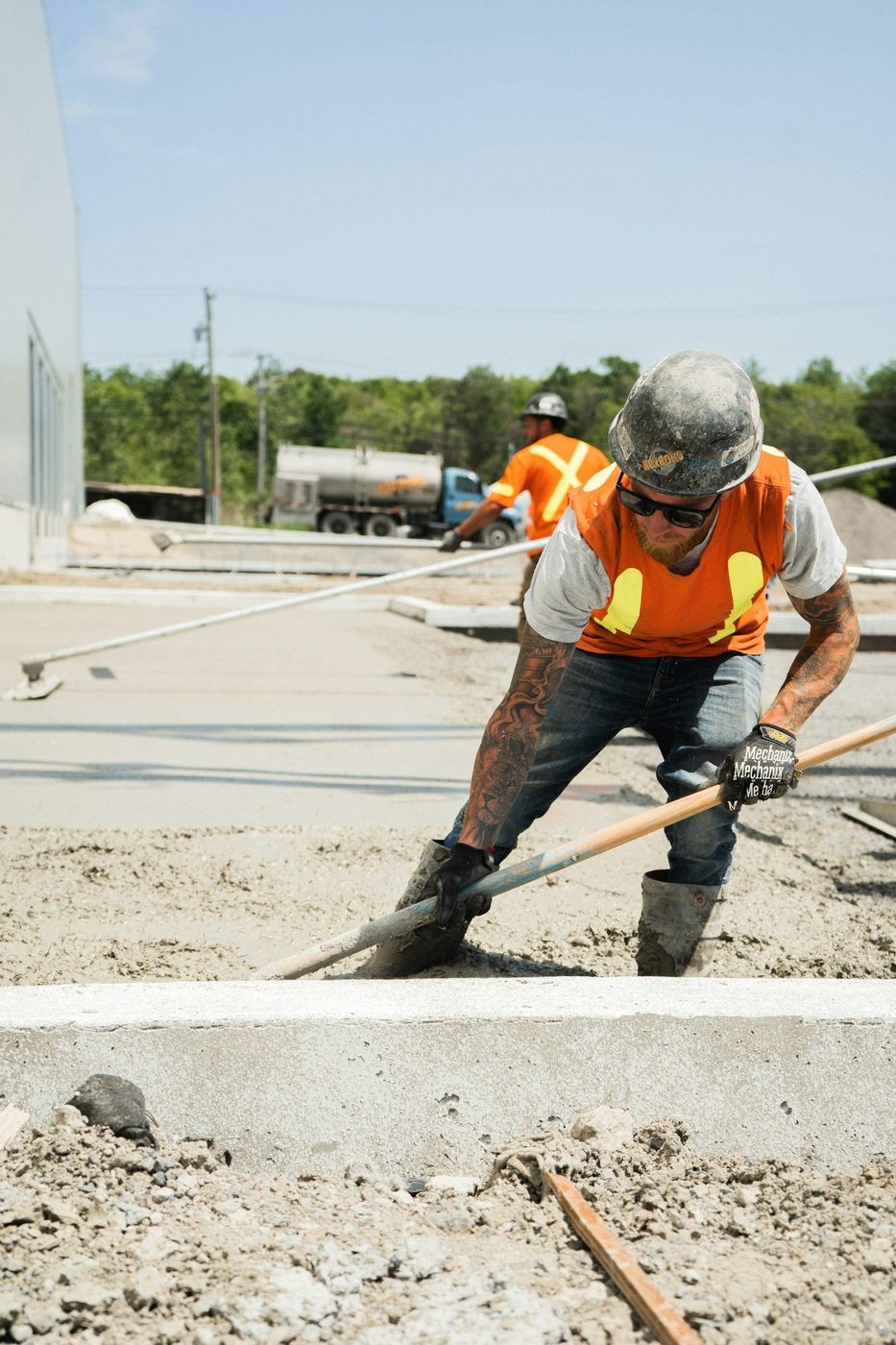
Walks, aprons, and service pads scoped around how your tenants and drivers actually move through a day.
Count what crosses your walks between six in the morning and eight at night. First shift on foot. A vendor pushing a loaded hand truck. Strollers, a wheelchair, a landscape trailer ramp dropped over the curb, and a front-load truck that swings the same arc every Tuesday. One panel at a busy Lone Tree property absorbs more contact in a week than a backyard patio sees in a year.
That is the load we build for, and it is rarely the load somebody priced the first time. We pour and replace commercial flatwork across the RidgeGate corridor and the office, medical, and retail sites that grew up around it. Sidewalks, entry aprons, trash routes, equipment pads, the service walk behind the building nobody looks at until a vendor catches a toe on it. Every one of those surfaces has a different job. Pouring them all to one spec is how a property ends up replacing a third of its concrete years ahead of schedule.
Every property has a wear map and it never matches the site plan. Traffic concentrates into three narrow ribbons: the line from the closest stalls to the front door, the path from the receiving area into the back corridor, and whatever route the waste hauler takes on pickup morning. Those ribbons take most of the abuse across a small slice of the total square footage.
So we walk a site before we price it. Where do the carts turn. Where does the plow pile snow, and what drains out of that pile in March onto the panel underneath it. Newer commercial ground near RidgeGate went in fast and mostly got poured to one uniform thickness, which is fine on the quiet edges of a site and gives out early in the ribbons. Amenity and clubhouse concrete serving Heritage Hills, Carriage Club, Fairways, and Montecito wears in a different pattern again, with everything funneled through a handful of doors and gates.
Get the ribbons right and the rest of the flatwork can stay ordinary. That is where the savings hide.
| Surface | The daily load | How we build it |
|---|---|---|
| Main entry apron | Door swings, carts, rolling luggage, every visitor you get | Five inches, tight joint spacing, broom texture pulled across the direction people walk |
| Building perimeter walks | Foot traffic, shovels, string trimmers, a mower wheel now and then | Four inches over compacted base, joints spaced to the walk width |
| Trash and delivery route | Loaded box trucks plus a hauler setting its forks down hard | Six inches, number four bar tied on chairs, thickened through the turn |
| Service walk behind the building | Vendors, hoses, condensate lines, water that sits where nobody looks | Four inches with fall away from the wall and a joint at every penetration |
| Rooftop unit and generator pads | Static weight, vibration, conduit stubs, annual service calls | Isolated pad, reinforced, sleeves set before anybody calls for concrete |
| Accessible route and landings | Wheelchairs, walkers, strollers, and an inspector carrying a level | Slope held under the ceiling, no lip at any joint, flat landing at each door |
We will walk the site, mark what has failed and what has plenty of life left, and hand you both in writing. Free, and nobody follows up with a pitch.
Nobody wants barricades across their front door on a Friday. So most of our flatwork here goes in overnight, on weekends, or in strips short enough that every entrance stays reachable the whole time.
Season matters more than people expect at 5,817 feet. Late April through October is the open window and September is the best of it, with warm ground, cool evenings, and finishers who are not chasing a crust across a wide placement. July and August we watch the sky hard. A cell rolling off the foothills onto fresh concrete drives water down into the surface paste, and what you get four months later is a walk that dusts under a broom and scales along the joints.
Winter work happens too, and for retail tenants the dead weeks after the holidays are sometimes the only quiet stretch all year. Heated mix water, a non-chloride accelerator, blankets down before the sun drops, and no placement on frozen ground. That last one we do not bend on. Concrete set over frost drops when the frost leaves.
Still unsure about something?
Call the crew at (303) 569-4046 and we will talk it through.

Get a free, no-obligation estimate from a crew that knows Colorado soil, Colorado weather, and how to finish concrete that lasts.
Accessibility
Adjust the site to fit how you read and browse. Your choices are saved on this device.