
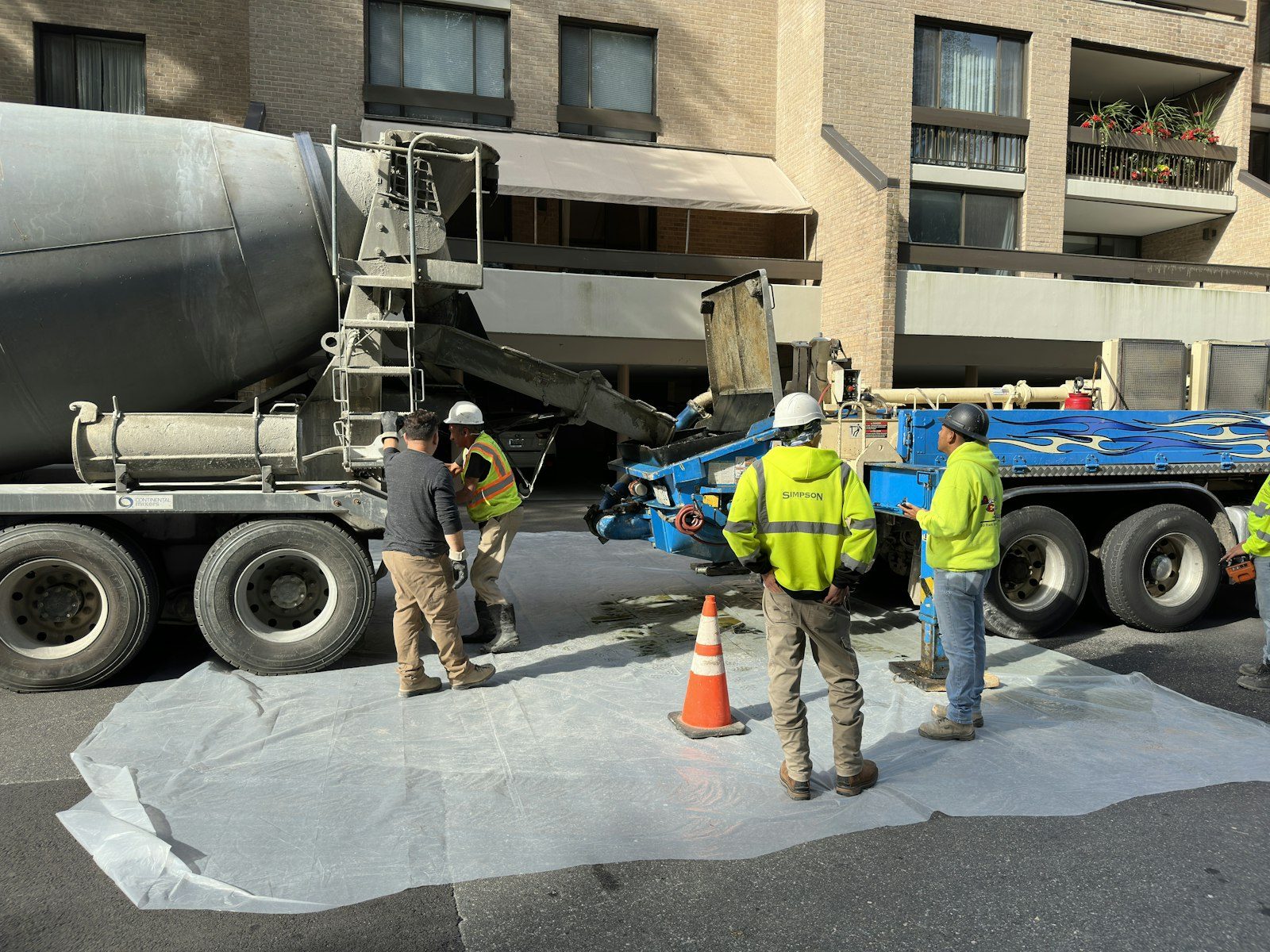
Most docks around here failed because the use outgrew the design, not because they got old.
Lone Tree has no old warehouse district, and that changes what dock work looks like here. What we find instead is receiving built into buildings designed around something else. One dock-high door behind a retail suite. A recessed pit tucked at the back of a medical building. A drive-in ramp at a flex tenant. A grade-level door somebody sized for a cargo van that now takes a straight truck three mornings a week.
Docks like that do not fail the way a distribution center fails. They fail because the use outgrew the design. The apron got poured at car-slab thickness. The pit never got a drain because the first tenant never washed anything down. The ramp works fine until the trailer that shows up has a different kingpin setting. We rebuild all of it, and we start by asking what actually backs in on a Tuesday rather than what the original plan sheet assumed.
The pattern repeats. A building goes up along the RidgeGate corridor or in one of the retail and medical clusters serving the neighborhoods around Heritage Hills and Fairways. The first tenant takes small deliveries. Five years later a different tenant is running pallets, and the concrete in front of that door never got the memo.
The first thing to crack is the strip right at the building. A trailer parked at a dock is not sitting still. It rocks every time a forklift crosses the plate, and the landing gear drops point loads through two small pads onto a slab that was designed for spread-out wheel loads. Add a slab poured tight against the building without an isolation joint and you get a crack running parallel to the wall within a couple of seasons.
The second thing is drainage. Depressed docks are holes in the ground with a building on one side. Snow blows in, melts against the warm wall, refreezes overnight, and by February a driver is stepping onto ice at the bottom of a pit. Every pit we touch gets checked for a working drain and a slope that reaches it before we quote anything else.
| Setup | Where it shows up | What the concrete has to handle |
|---|---|---|
| Single dock-high door | Retail and flex suites built for one trailer at a time | Thickened approach at one trailer position, dowelled to the building slab |
| Recessed pit with a leveler | Grocery, food service, and medical receiving | Square, level pit walls, anchors set to the fabricator template, a drain that drains |
| Grade-level drive-in door | Contractor and light industrial suites | Interior slab carried through the opening, ramp graded so a straight truck clears |
| Depressed dock cut into the lot | Buildings retrofitted for receiving after the fact | Retaining walls, a real low-point structure, and a plan for snowmelt |
| Two or more doors in a row | Larger tenants and distribution space | Continuous approach with dowelled joints so panels move together under load |
| Van and courier apron | Office and medical buildings | Lighter section, still thickened at the threshold and sloped away from it |
Tell us the door count and your receiving schedule. We will build the pour around your calendar and tell you honestly whether the timeline works.
Receiving does not get to pause, so we plan the shutdown before we plan the pour. On a multi-door dock we work one position at a time and leave the others live, with plating and barricades between the crew and your traffic. On a single-door property we go Friday night, place by Saturday morning, and hand the concrete a full weekend before anything touches it.
Timing on the calendar matters too. Late April through October is the easy window here, with September the pick of it. Summer means placing at first light and watching the western sky, since a storm cell landing on a fresh approach slab drives water into the surface and leaves you a layer that dusts under forklift traffic within a year. Winter work happens, and for retail receiving the weeks after the holidays are often the only quiet stretch. Warm water, accelerator, blankets over every panel, and nothing placed on frozen ground.
Trades matter more at a dock than almost anywhere else on a property. Leveler and bumper fabricators, the electrician running conduit, plumbing for the pit drain, and your striping crew all have to land in the right order, and we sequence that once instead of cutting new concrete open a month later.
Still unsure about something?
Call the crew at (303) 569-4046 and we will talk it through.

Get a free, no-obligation estimate from a crew that knows Colorado soil, Colorado weather, and how to finish concrete that lasts.
Accessibility
Adjust the site to fit how you read and browse. Your choices are saved on this device.