
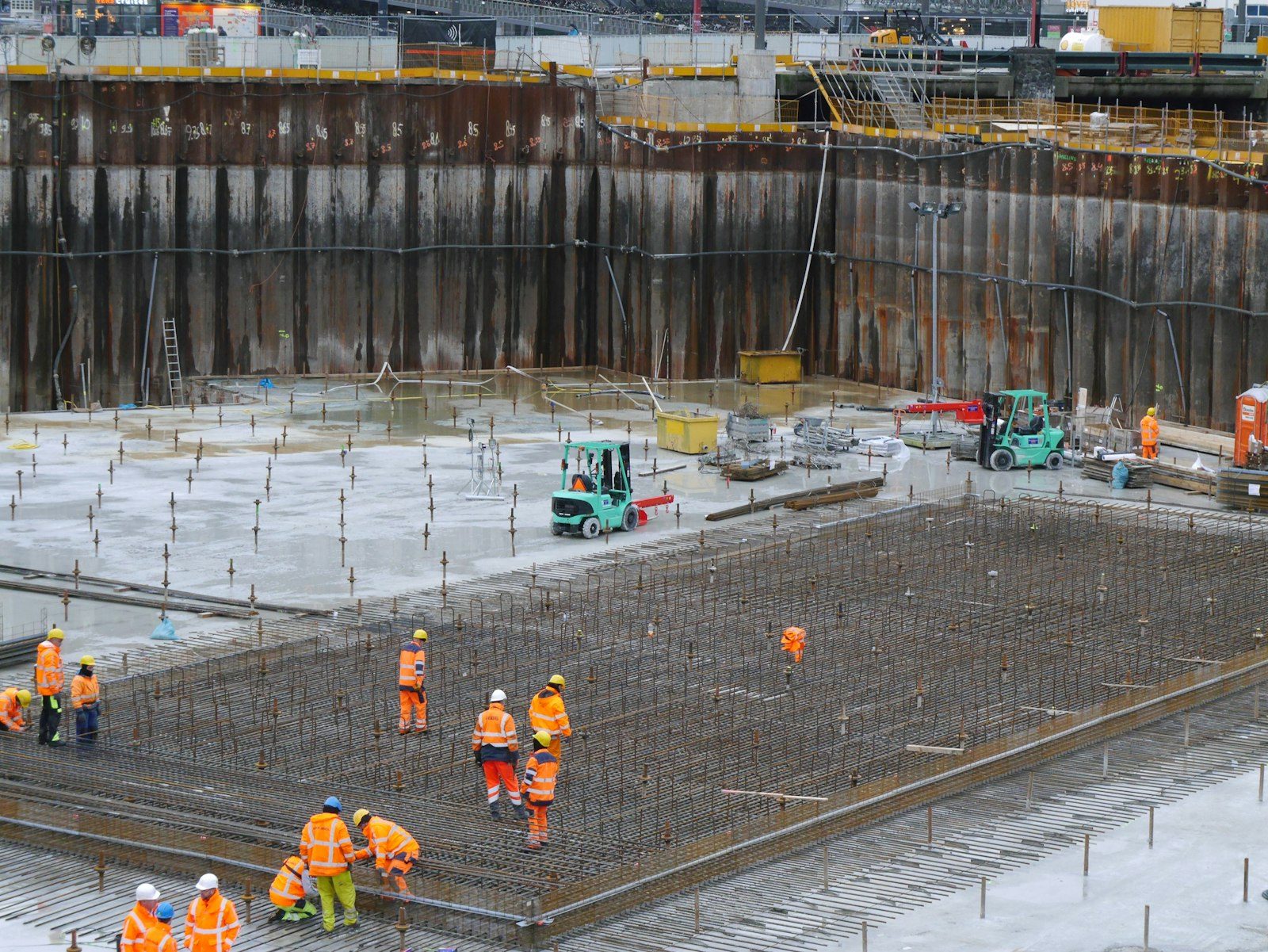
Most of a foundation budget disappears into things that get buried before the framer ever shows up.
Ask what a foundation costs and the honest answer is shaped by dirt, not by concrete. Trucks are a line item anybody can price. The open hole is where the money actually goes: how far down we dig before we find soil that will hold, how much of what came out is going back in, whether the lot sheds water or collects it. We've dug on lots all over this town and no two holes handed us the same answer.
So we work bottom up. Bearing, then base, then drainage, then steel and forms. Our structural engineer settles the support scheme before anybody calls a batch plant, which is exactly why we keep one on staff instead of renting a stamp when a plan reviewer asks for one.
An excavator bucket is a free soil test if you watch it. Material that crumbles off the teeth in dry granules reads one way. Gray clay that peels away in slick ribbons and keeps the shape of the bucket reads another, and it tells us the design has to plan for ground that changes volume when it gets wet.
None of that replaces a soils report, and on new construction we want one in hand. Around Douglas County the recommendations in that report usually pick the support scheme for us: over-excavate and replace with engineered fill, drill piers and hang a grade beam over void space, or set conventional spread footings when the numbers allow it. Our engineer reads the report, lines it up against what the hole is showing, and decides which of the three we're building, well before any forms go up.
| Layer | Its job | Skip it and you get |
|---|---|---|
| Bearing soil or engineered fill | Carries the whole building | A corner that drops a little more every year |
| Drilled piers with void form | Moves load past soil that moves | Heave pushing the structure up from underneath |
| Compacted road base | Even support and a clean working surface | Soft pockets that telegraph straight into the slab |
| Perimeter drain in washed rock | Pulls groundwater away from the footing | A wall that weeps through every spring melt |
| Vapor retarder under interior slabs | Stops moisture rising through the floor | Musty lower level and flooring adhesive that lets go |
| Reinforcing steel on chairs | Keeps concrete tied together when it flexes | Cracks that open wide instead of staying hairline |
Send the drawings and the soils report if you have one. Estimates are free, and our engineer reviews the support scheme before we put a number on paper.
Foundations here rarely fail because of the concrete. They fail because water reached somewhere it shouldn't and the soil beside the footing answered. That's true in the older sections of Heritage Hills and Carriage Club, where thirty years of irrigation and mature landscaping have been quietly training the ground next to the house. It's just as true on a bare lot where the backfill hasn't finished settling.
Which is why the water plan belongs to the foundation, not to whoever shows up later with sod. Footing drain in washed rock, sleeved in filter fabric, running to daylight when the lot cooperates and to a sump when it doesn't. Damproofing on the outside face of every wall with living space behind it. Backfill that drains rather than holds. Final grade falling away from the wall on all four sides. Get those right and your foundation turns boring. Boring is the goal.
Foundation work runs most of the calendar here. The easy digging window opens in April and holds through October, when trenches cut clean and backfill compacts the way it's supposed to. Fall is quietly the smartest time to break ground, because the concrete cures through cool weather and your framers inherit a dry deck come spring.
Winter doesn't shut us down. It just costs attention. Frozen ground gets thawed or hauled off, because nobody pours on ice. We warm the mix water, run a non-chloride accelerator, and blanket walls so the concrete holds its own heat while it gains strength. What we won't do in January is backfill against a wall that hasn't earned it, or compact frozen chunks in a trench. That shortcut buys you a sunken sidewalk and a damp wall by April, and you'll pay for it twice.
Still unsure about something?
Call the crew at (303) 569-4046 and we will talk it through.

Get a free, no-obligation estimate from a crew that knows Colorado soil, Colorado weather, and how to finish concrete that lasts.
Accessibility
Adjust the site to fit how you read and browse. Your choices are saved on this device.