
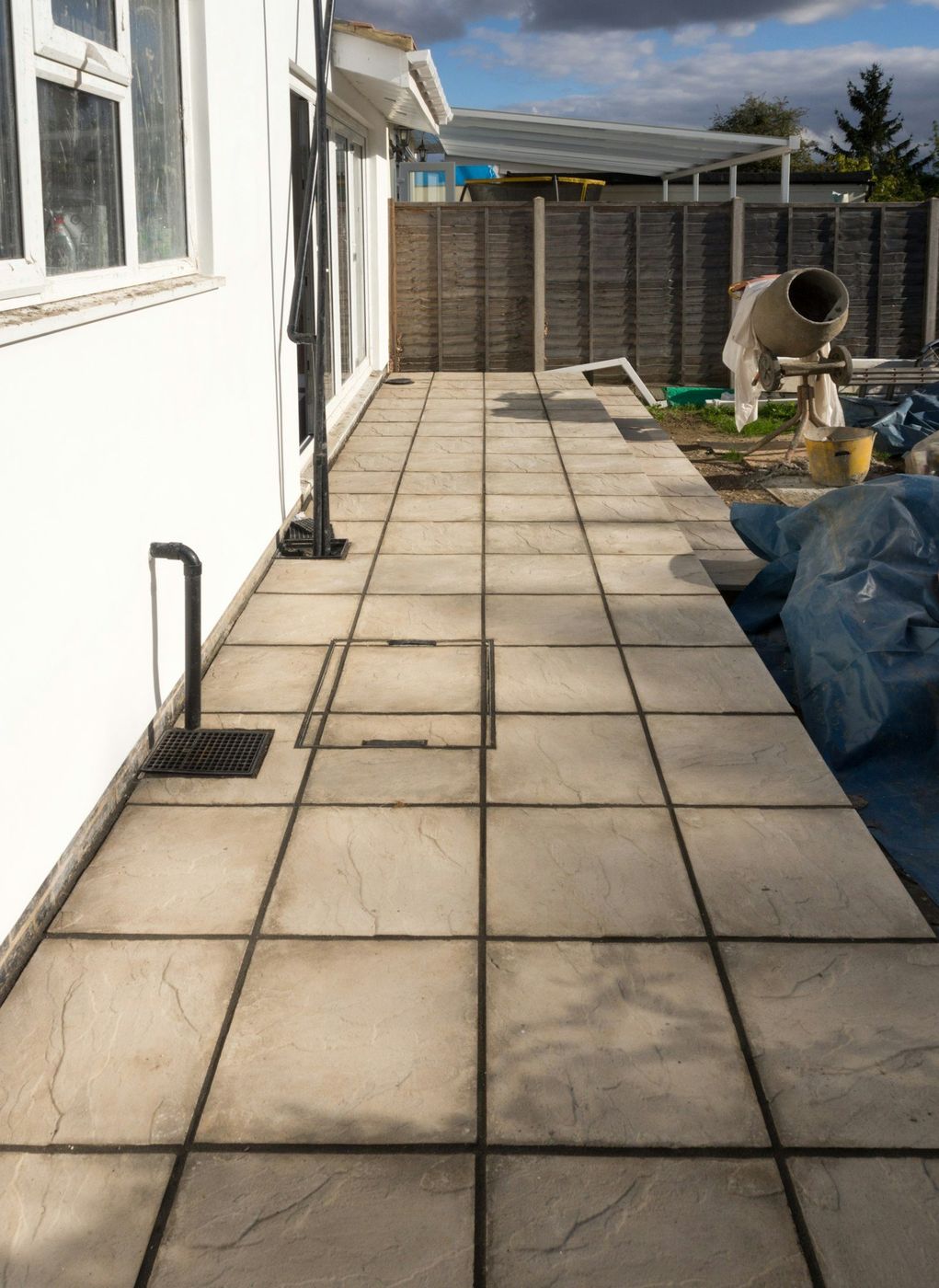
Your pool is the most accurate level you own, and the deck around it cannot hide anything from that straight line of water.
Go stand at the shallow end and sight across the water to the far coping. That line is dead level and always will be, which makes it the cruelest measuring tool in your backyard. Any deck that has sagged, tipped, or lifted announces itself against it, and once you've noticed you cannot stop noticing.
Most of what goes wrong with a pool deck is visible long before anybody trips on it. The tile line stops running parallel to the water. A dark seam opens at the coping. The wet footprints all run the wrong way. Homeowners in Columbine and Highland Walk usually call us six months to three years after the deck started telling them, so here's how to read it early.
| What you see | What has actually moved | What the fix takes |
|---|---|---|
| Coping no longer parallel to the water | The deck has tipped, usually settling on the backfilled side | Lifting the affected panels, or removing and repouring that section |
| An open seam at the pool edge | The joint between deck and coping has torn or was never flexible | Cleaning the joint out and rebuilding it with a compressible backer and sealant |
| Puddles that outlast everybody's swim | The deck falls the wrong way or has gone flat | Regrading that section, adding a drain line, or repouring to a real slope |
| A chalky, pitted band near the edge | Splash-out chemistry and freeze-thaw working on unsealed paste | Surface repair and a proper sealer, if the damage is still shallow |
| A panel stepped down at a joint | Base washed out under one side of the joint | Filling the void and bringing the low panel back to plane |
| Rust-colored weeping from a crack | Steel too close to the surface and now corroding | Opening the crack, treating the bar, and patching it properly |
Everything hard about a pool deck happens in the band closest to the water. That's where splash-out lands, and in this dry air it evaporates fast and leaves whatever was dissolved in it sitting right there on the paste. Chlorine, salt, calcium, concentrating in one strip thousands of times a season.
Now add a Littleton winter. Sun clears the snow off that band by two in the afternoon, water soaks into a surface the chemistry has already softened, and the temperature drops hard after dark. Freeze, thaw, repeat, forty or fifty times between November and April. That's why the concrete near the edge goes chalky while the same slab twenty feet out looks new.
The defense is unglamorous: air-entrained mix, a surface that was finished at the right time instead of overworked, and a penetrating sealer refreshed every couple of years. And never, under any circumstances, a bag of deicer on a pool deck.
Kids run on pool decks. That's not a rule anybody enforces successfully, so the surface has to assume it. We keep texture in the finish around water: a light broom, a washed aggregate, or a textured overlay, none of them slick when soaked. Smooth trowel belongs indoors. Heavily stamped patterns hold water in the deep grout lines, so if that's the look you want, we cut the sealer with a grit additive.
Drainage takes planning on this side of town. On a flat Southbridge lot you can usually shed everything to the lawn in one direction. Up in Ken Caryl, where the ground behind a pool often rises toward the foothills, the deck can't drain uphill and it can't drain into the house, so a strip drain or a line of area drains does the work slope can't.
Then the joint at the coping. It stays soft, permanently. The deck and the pool shell are two separate structures on two different pieces of ground, and they move independently every single year. A flexible joint absorbs that. Grout or hard mortar in the same spot cracks, water gets behind the coping, and the freeze that follows starts lifting stones.
We'll walk it, shoot elevations, and tell you whether the fix is lifting a few panels or replacing a section.
Still unsure about something?
Call the crew at (303) 569-4046 and we will talk it through.
Get a free, no-obligation estimate from a crew that knows Colorado soil, Colorado weather, and how to finish concrete that lasts.
Accessibility
Adjust the site to fit how you read and browse. Your choices are saved on this device.