
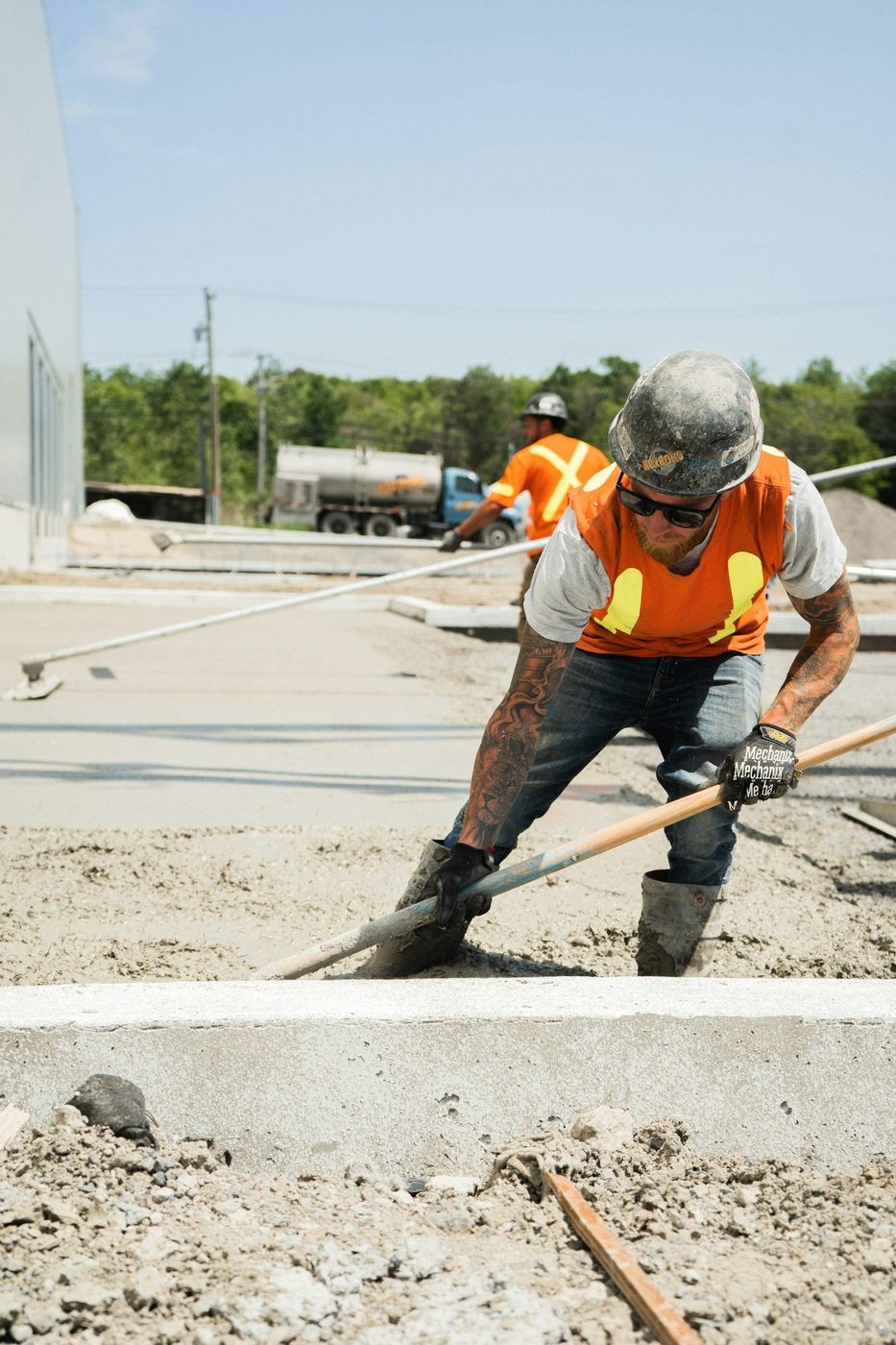
Hose off your patio on the first warm Saturday of the year and watch what runs into the grass with the water.
There's a Saturday in early April when half of Littleton is outside with a hose. Furniture comes back out, winter grit gets pushed off the patio, and water runs across the concrete for the first time since October. Watch what leaves with it. On a healthy slab, dirt. On a slab that lost its winter, sand. Fine gray grit coming off in a slurry, far more than dust could explain.
That's the top of your concrete washing away, which means the paste layer holding everything together at the surface has been beaten out of it. Resurfacing fixes exactly that and almost nothing else. So the useful conversation isn't color or texture. It's whether what failed is the top quarter inch or the four inches under it, because those cost wildly different amounts to solve.
Concrete is stone and sand in a cement paste, and the top of a slab is the paste-rich layer finishers work up while it's plastic. That layer is the wearing surface, and it takes every insult: sun, freeze-thaw, shovel edges, road chemical off tires.
Once it starts letting go the process runs one direction. Water gets into the exposed sand, freezes overnight, lifts a little more off. By the third or fourth spring the surface is visibly rough, the color has gone patchy, and the sand rinsing away is an annual event instead of a curiosity. None of that means the slab is bad. Under the ruined surface there's usually four inches of sound concrete on a base that never moved. It has decades left. It needs a new face.
Here's how we sort it in ten minutes. Scaling, dusting, popouts, and a sandy texture are surface conditions, they're everywhere on older flatwork, and a topping is built to answer them. Cracks wider than a credit card, sections at different heights, a slab that rocks underfoot, a corner dropped away from the house: that's the ground talking, and no surface material has ever fixed ground.
The middle cases are where honesty matters. A tight crack in a stable slab gets routed, filled, and then carried up into the new surface as a cut joint. Hollow areas mean the surface is already separating from the concrete below, and anything bonded to that leaves with it. A driveway with base failure at the apron keeps failing there whatever goes on top. We'd rather lose the sale than sell a topping with six months in it.
| What went wrong | How it shows now | Does a new surface hold |
|---|---|---|
| Water worked into the finish | Weak, dusty top layer that never stopped shedding | Yes. Blast the loose material off, bond to solid concrete |
| Rain during finishing | Pitted, sandy patches where the storm caught it | Yes, one of the better candidates we see |
| Deicer on young concrete | Flaking in sheets, worst at the apron | Yes, if it's shallow and the slab below rings solid |
| No air entrainment in the mix | Even surface loss across the whole slab | Yes, but seal it and skip deicer permanently |
| Sealed too soon after the pour | Cloudy film peeling in patches, dull beneath | Yes, once the old film is fully stripped |
| Base washed out under a section | One area lower than the rest, sometimes rocking | No. Fix the ground or replace that section |
The wet slab tells us more than a dry one does. We'll walk it, sound it, and tell you whether a topping is money well spent. Free estimate.
Resurfacers go on thin, which puts them at the mercy of weather in a way a full slab isn't. We want daytime temperatures well above fifty and climbing, nights above freezing for several days after, and no storm cell building while material is going down. That's a real season from late April through early October, with the shoulder weeks judged one at a time.
Spring adds a requirement people don't expect: the slab has to be dry. Concrete that sat under snow and then got hosed in April is holding water deep in its pores, and a topping bonded over damp concrete either lifts later or blooms white. Fall is the easier season anyway. September brings mild days, cool nights, dry air, and no storms arriving at four in the afternoon. Winter is out for exterior work, though a garage or lower level runs any month.
Most of these calls come from older properties around Columbine and Southbridge, where the original flatwork has had every winter thrown at it. Newer streets call less about damage and more about looks. Ken Caryl is where we check drainage first, since a slope that concentrates runoff across one part of a patio explains why that part failed while the rest held.
People think we're being difficult when we tap around a slab with a hammer before quoting anything. We're listening for the hollow. Solid concrete rings. A surface already coming loose sounds like a drum.Our crew lead, after the walkthrough
Still unsure about something?
Call the crew at (303) 569-4046 and we will talk it through.

Get a free, no-obligation estimate from a crew that knows Colorado soil, Colorado weather, and how to finish concrete that lasts.
Accessibility
Adjust the site to fit how you read and browse. Your choices are saved on this device.