
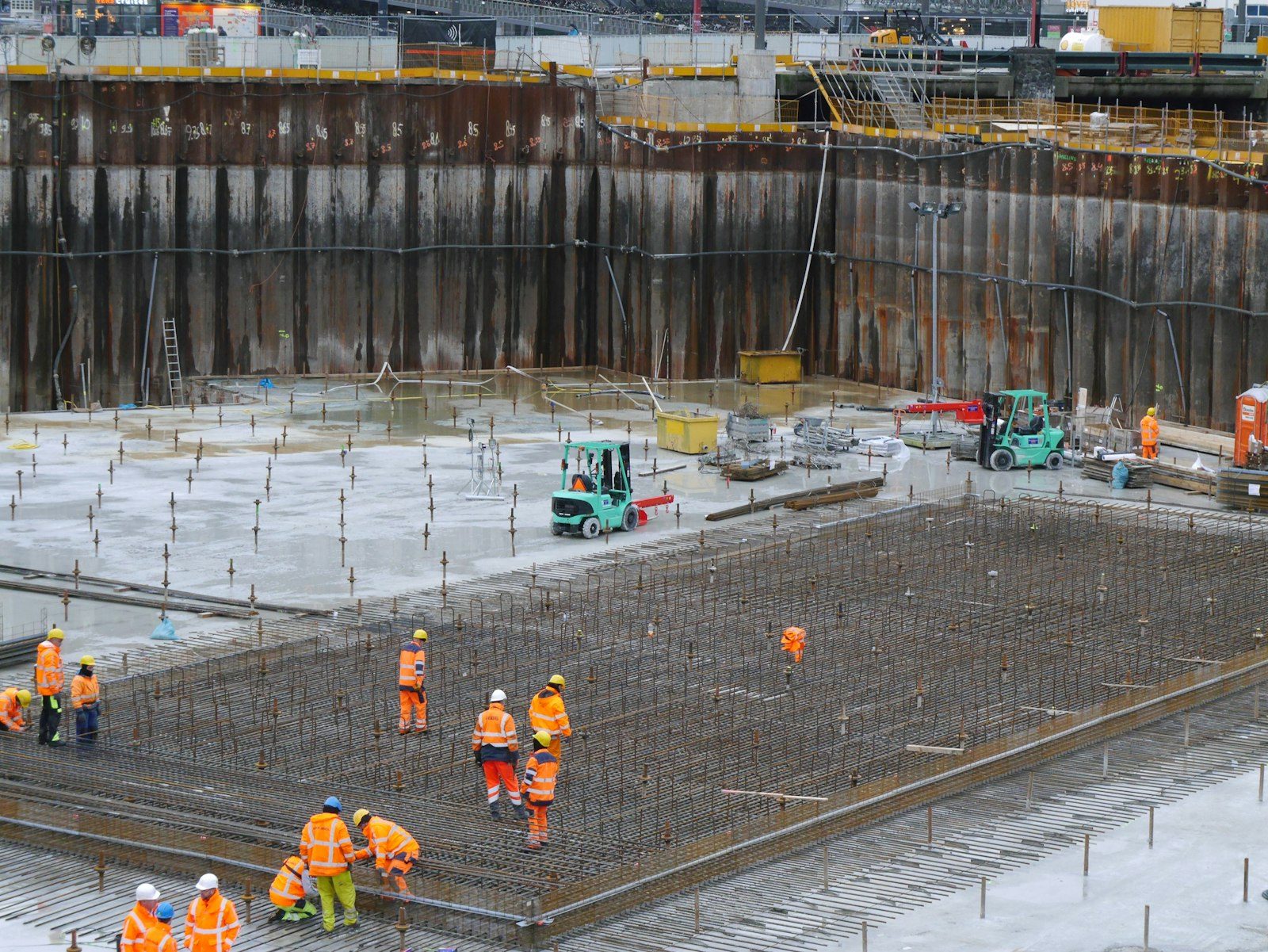
Prep runs three hours, placing runs twenty minutes, and the order of those two things is the whole job.
Repair work runs on the material's clock, not the crew's. Once patch mix is wet you have a working window measured in minutes, and every minute spent chasing dust out of a crack that should have been blown clean an hour ago comes off the finishing end. So we front-load everything. Saw cuts, routing, dowel holes, forms, void filling: all of it happens before a bag gets opened.
Which is why nothing seems to happen for the first stretch of the morning. You watch from the window, see four people with brooms and a chalk line, and wonder when the concrete shows up. Prep is the job. What follows is a real repair day on Littleton flatwork, in the order it unfolds.
We sound the slab before deciding anything. Butt end of a hammer tapped down the length of a crack, listening for the moment a tight knock turns dull. Dull means the dirt that held that panel up is gone. Nothing placed over a void survives a winter, so that quick test reshapes more estimates than any measurement we take.
Then the paint goes down. Cracking reads differently depending on which part of town we're standing in. Against the slope in Ken Caryl, cracks run with the fall of the lot and open wider at the downhill end, because ground on a grade creeps sideways as well as settling straight down. Out on the flatter ground around Columbine and Southbridge the failures are blockier: corners dropping at joints, edges crumbling where runoff has snuck under the same spot for fifteen years. Two different stories, two different repairs.
| Working window once it's wet | Back in service | Where it belongs | |
|---|---|---|---|
| Routed and sealed crack | Minutes, and it skins fast in dry air | Walk it the same afternoon | Tight cracks over solid support |
| Partial-depth patch mortar | Under an hour warm, less with wind | Foot traffic in hours, tires next day | Spalled edges, chipped joints, shallow loss |
| Full panel in ready-mix | One continuous placement, no stopping | Walk in a day or two, park at a week | Panels cracked through, rocking, or bridging a void |
| Epoxy injection | Pot life of minutes per batch | Bonded and holding overnight | Cracks where two faces must act as one |
We'll sound the slab and price both the repair and the replacement, so you can compare them side by side.
Littleton sits a little over 5,300 feet, and the air up here pulls water out of fresh concrete faster than most people believe. Add sun and a breeze and the top can dry while the body of the placement is still soft, which is exactly how a patch ends up crazed with hairlines in week one. So we work the shaded side first when the layout allows, keep an evaporation retarder on the truck, and fog between passes on the ugly days.
The finish gets matched, never copied. Nobody blends new concrete invisibly into forty-year-old concrete. What we can do is run the broom the same direction, land new joints on the existing lines, and tool the edges the same way, so from ten feet back your eye reads one surface. Color closes the gap over a couple of seasons.
Joints get sawed the same day, often within hours. A slab picks where it wants to crack long before you're ready to argue. Cut early and the crack follows the blade.
Cure is the part you own. Keep new work damp for the first several days if we ask you to, and stay off it longer than feels necessary. A replacement panel needs a day or two before foot traffic stops marking it and roughly a week before a car belongs on it. Design strength lands at twenty-eight days.
Sealer waits. Green concrete has to give up its moisture first, so we come back later rather than trapping it, and decorative surfaces want a fresh coat every two to three years after that anyway.
Winter has one rule and it isn't up for debate: no deicers on new work, and magnesium chloride never, at any age. Shovel, throw sand for traction, let February sun do the rest. Scheduling is friendlier than people assume. We rout and patch deep into fall, run full replacements until the subgrade freezes hard overnight, and hold the rest for the March window when the ground opens and the calendar is still wide.
Still unsure about something?
Call the crew at (303) 569-4046 and we will talk it through.

Get a free, no-obligation estimate from a crew that knows Colorado soil, Colorado weather, and how to finish concrete that lasts.
Accessibility
Adjust the site to fit how you read and browse. Your choices are saved on this device.