
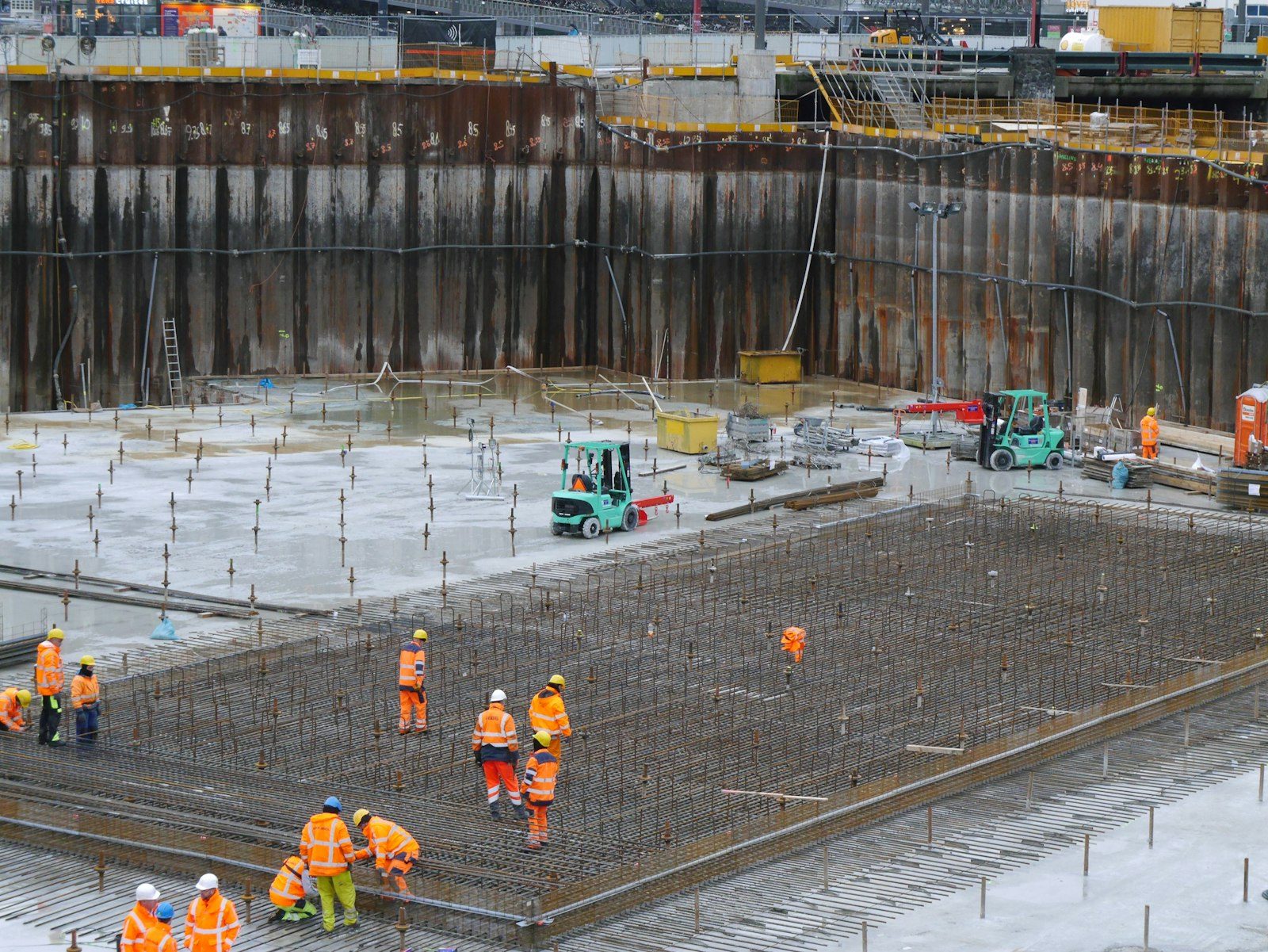
Under a commercial floor, consistency beats strength. That one idea drives everything we do below grade.
Something that surprises owners: under a commercial floor, uniform support beats strong support. A pad that's merely decent everywhere behaves better than one that's excellent under half the building and soft under the rest. Concrete has no trouble carrying weight. It has enormous trouble carrying weight across a line where the support underneath it changes character.
On a lot of Lakewood sites that line is the whole job. Cut a pad into the rise on the west side and you can reach competent rock under one end of a building while the other end rides on fill brought in to make grade. Two honest bearing conditions, one floor spanning between them. Everything we do below a commercial slab points at that: make support even, keep water out, prove both before a truck backs in.
Watch where commercial floors fail and it's rarely the middle of a uniform panel. They fail over a buried transition. Rock to soil. Native ground to fill. A utility trench that was backfilled by a different crew on a different day with whatever was handy. The slab sits still on one side, settles a fraction on the other, and resolves the argument by cracking.
So we treat transitions as designed features rather than accidents. Over-excavation gets stepped or tapered so support changes gradually instead of at a knife edge. Trench backfill goes back in lifts, compacted and tested to the same standard as the pad around it. Where the geotech won't let us make the two halves behave alike, the answer stops being dirt work and becomes structure: piers, grade beams, and a floor designed to span rather than bear. Belmar infill sites and the older commercial pockets near Applewood hand us the trench version constantly, since that ground has been opened and closed a half dozen times.
| Approach | When it gets specified | What it costs the schedule |
|---|---|---|
| Over-excavate and replace with imported granular fill | Poor material is confined to the upper few feet | Truck traffic and export, plus lift-by-lift testing |
| Moisture condition and recompact what's there | Native soil is acceptable but placed dry or loose | Weather dependent, since you have to hit a moisture window |
| Structural fill with geogrid between lifts | Soft subgrade that needs help spreading wheel loads | Adds a material and an inspection point per layer |
| Local over-excavation at the transition only | Half the pad is sound and the other half isn't | Short, but it has to be stepped, not cut square |
| Piers and grade beams with a structural floor | Swell or bearing numbers rule out a ground-supported slab | Longest path, and it changes the floor design entirely |
Soil moisture moves up through concrete as vapor whether the slab looks dry or not. Nobody notices until a coating blisters, a glued floor curls at the seams, or a tenant reports a smell in one corner. The prevention costs almost nothing at the right moment: a clean capillary break of washed stone, a sheet retarder detailed properly, and a pad that isn't sitting in a bowl.
Getting the pad out of the bowl is the part people skip. Roof drains have to discharge past the building line, not onto the backfill beside it, and site grading has to carry water to inlets instead of parking it at the slab edge. Down near Bear Creek and anywhere the ground runs flat, we look hard at where water goes in a real storm rather than where the civil drawing says it goes.
Send both over. We'll tell you which recommendations are load bearing on your budget and which ones are boilerplate. (303) 569-4046.
Compaction is a moisture game. Too dry and the material never locks together no matter how many passes the roller makes. Too wet and it pumps under the drum and you're chasing a sponge. Late spring hands you a subgrade saturated a foot down and beautiful below that, a miserable combination for testing. Deep summer runs the other way: clay bakes hard, tests fine, then takes on water later and changes its mind.
Winter is the honest one. Frozen material does not compact, it bridges, and a pad built on frozen lifts has voids in it by April. We either heat and protect, import material that behaves in cold, or we wait. Concrete pours fine in cold weather with warm mix water, non-chloride accelerators, and blankets. It's the dirt underneath that decides whether a winter start makes sense on your site.
Still unsure about something?
Call the crew at (303) 569-4046 and we will talk it through.

Get a free, no-obligation estimate from a crew that knows Colorado soil, Colorado weather, and how to finish concrete that lasts.
Accessibility
Adjust the site to fit how you read and browse. Your choices are saved on this device.