
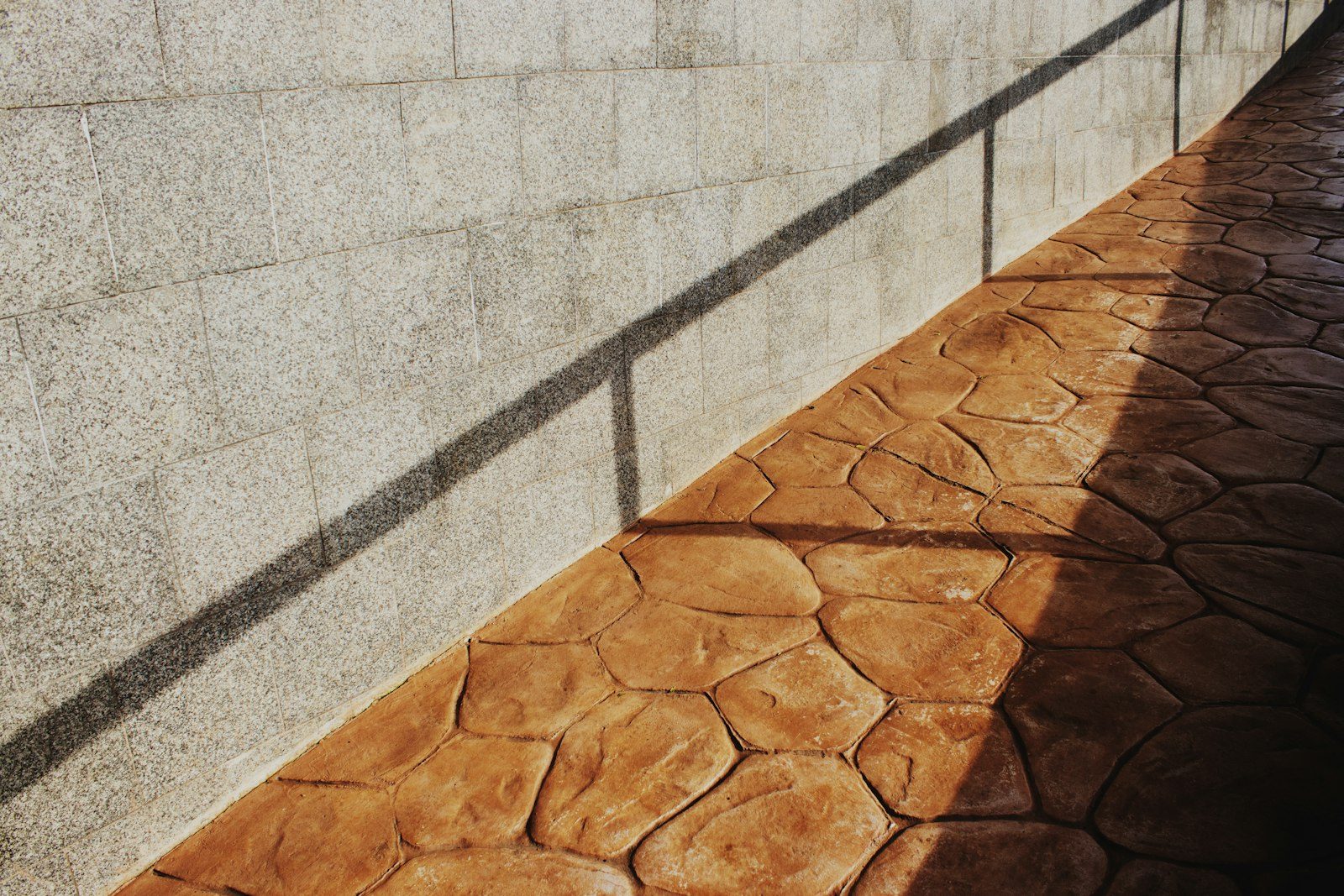
Front walks and side paths laid out, poured, and jointed before the afternoon heat shows up.
Pour day starts before the sun clears the ridge. The mixer is booked for seven, so our crew is standing in your grass at six with string line, a laser, and a can of orange paint. Walkways look like the simplest thing we build. They aren't. Nearly everything that decides how a walk ages happens in the ninety minutes before any concrete shows up.
Most folks picture a walk as a strip of gray you pour and forget about. We treat it as three problems stacked on each other: where the route belongs, where the water goes, and how a ribbon of concrete three feet wide survives a Douglas County winter. Nail those and the walk lasts as long as the siding. Miss one and you'll be catching a shoe on a tipped panel by the third spring.
Six o'clock is layout. We paint the route onto the sod, pull the curves with a garden hose until the line reads right from the front door and again from the street, then shoot the fall end to end. Six-thirty, sod comes off and digging starts. We go deeper than the slab needs, because the strip has to land on material we brought in, not on the black dirt your lawn grew out of.
Base goes down in lifts after that, each one run over with a plate compactor until it quits moving under a boot heel. Forms follow, bent to the curve and staked tight, checked one more time against the laser. Steel or mesh sits up on chairs. By the time the truck backs to the curb, the only thing left to decide is which way we broom.
Placing a walk takes minutes. Finishing it takes hours. We screed, bull float, and then we wait, because working a surface while bleed water is still sitting on it is how you build something that dusts off in two winters. Once that sheen burns away we edge, broom across the direction people travel, and saw the joints the same day. Plastic goes over the whole run if the sky looks interested in us.
| Walk type | Width | Fall across it | Joints |
|---|---|---|---|
| Front entry walk | Four feet, so two people aren't single file | Around two percent, aimed at the lawn | Square cuts, roughly every four feet |
| Side path out to the gate | Three feet, wider if the trash cans travel it | Away from the wall, no exceptions | Every three to four feet |
| Garden or utility run | Two and a half feet does the job | Follow the ground you already have | Spacing matched to the width |
| Approach to a landing or stoop | Five feet at the door, tapered back | Off the threshold in every direction | Break the panel where the landing starts |
We paint the layout on your lawn during the estimate so you can walk it in your slippers. Free, and nobody chases you afterward.
A driveway is heavy enough to argue with the ground. Three feet of walk isn't. That's the whole reason narrow flatwork is the first thing to lift around here: not much mass sitting on soil that swells when it freezes wet, and a lot more edge for water to sneak beneath. So we overbuild the part nobody sees. Deeper dig, more base, compaction in layers, and a slab pitched to drain instead of holding a puddle at the low end.
Shade is the other thing worth mapping before we pour. A north-side path in Southridge can carry ice for weeks after the front walk has gone dry, and that shady stretch is exactly where people go down. We broom those harder for grip and pitch them so melt has somewhere to run. Over in The Hearth the calls are usually for a side path that was never poured at all, where the builder ran a walk to the front door and left the trip out to the gate on bare dirt.
On timing: late April through the middle of October is easy work. Early fall is our favorite window for walks, since cool nights slow the set and hand us more finishing room than a July afternoon ever will. Winter walks do happen; small pours are simpler to protect than big ones, and a couple of blankets cover a front walk fine. What stops us cold is frozen ground. Base and concrete don't go over frost, so a January job waits on a thaw window.
Narrow walks are where you can see who cut corners. Anybody can make four feet of concrete look flat on day one. Come back after two freeze seasons and the ones poured on native dirt are the ones with a lip that catches your shoe.From the crew lead on these jobs
Still unsure about something?
Call the crew at (303) 569-4046 and we will talk it through.
Get a free, no-obligation estimate from a crew that knows Colorado soil, Colorado weather, and how to finish concrete that lasts.
Accessibility
Adjust the site to fit how you read and browse. Your choices are saved on this device.