
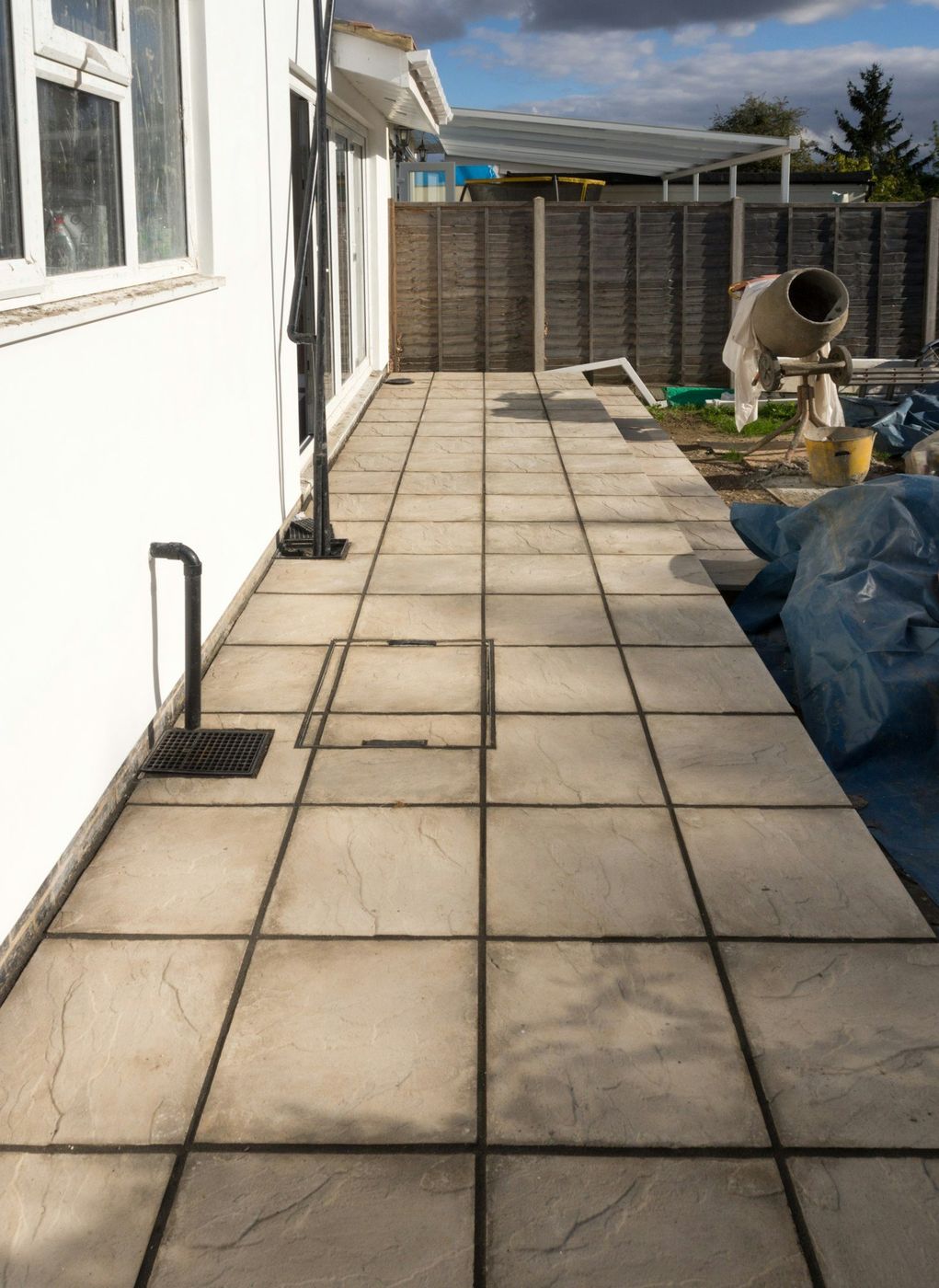
Poured for the loaded weight, the wet feet, and the three times a year you drain the thing.
A hot tub is a machine that holds several hundred gallons, runs a fifty-amp circuit, and gets emptied onto your yard three or four times a year. The pad under it has to answer all three of those facts. Most of the failed pads we replace answered only the first one, and not very well.
Think about how you'll actually use it. You walk out in December with bare feet and a towel. You lift a cover that weighs more than it looks. A service tech eventually needs to pull a side panel and reach the pump. Twice a year you run a hose to the drain valve and dump a tub's worth of water somewhere. A slab poured with those moments in mind feels completely different from one poured as a plain rectangle in the grass.
Dry weight on the brochure is the least useful figure in the whole spec sheet. Fill a six-person tub and add six people, and the loaded weight can climb past three tons. That load doesn't spread out evenly either. It comes down through the cabinet corners and the base frame, which turns a nice distributed load into a handful of concentrated ones right at the perimeter.
So we pour for the corners. An air-entrained 4,000 PSI mix at four inches, with number four bar tied on a 24-inch grid, handles most residential tubs sitting on compacted base. Big swim spas and anything with a long unsupported span move us to five or six inches and a tighter grid. Under all of it goes a road base four to six inches deep, compacted in lifts, because steel and thickness can't rescue a slab floating on loose fill.
Level matters more here than almost anywhere else we pour. A tub that sits out of level puts uneven pressure on the shell, throws the waterline off across the seats, and can trip a flow sensor. We shoot the pad and hold it inside a quarter inch, then pitch the surrounding walkway away from the house so meltwater has somewhere to go.
Finish matters too. Wet feet plus a hard freeze is the worst combination in a Colorado backyard, so we run a firm broom texture on the approach and around the perimeter rather than a slick steel-troweled surface. We rough the edges of any step. And we build the pad a little larger than the tub footprint, because standing on frozen grass while you towel off is a mistake you only design into a yard once.
Drainage is the piece homeowners forget. When you empty the tub, hundreds of gallons hit one spot in the lawn. We slope the pad so that water leaves toward daylight, not toward your foundation, and on tighter lots in Westridge and older parts of Southridge we'll run a channel drain or a buried line out to a low point instead of letting it soak the backfill next to the house.
Filled weight, footprint, and panel location are all we need to size the pad and the conduit.
| Setup | Slab and steel | What else changes |
|---|---|---|
| Two to four person tub, open yard | 4 inches, #4 bar at 24 inches | Standard base depth, simple surface pitch away from the house |
| Six to eight person tub | 4 inches with tightened bar spacing at the corners | Wider apron, cover lifter clearance behind the unit |
| Swim spa or oversized shell | 5 to 6 inches, engineered layout | Deeper compacted base, thickened edge under the long sides |
| Tub set into an existing patio | New pad poured separately with an isolation joint | Elevation matched to the old surface so nobody catches a toe |
| Tub on a slope or a cut bank | Slab plus a retaining element | Drainage behind the wall, and often an engineer's eyes on it |
| Under a pergola or a roofed structure | Pad plus footings for the posts | Post bases set during the pour, not drilled in afterward |
Still unsure about something?
Call the crew at (303) 569-4046 and we will talk it through.
Get a free, no-obligation estimate from a crew that knows Colorado soil, Colorado weather, and how to finish concrete that lasts.
Accessibility
Adjust the site to fit how you read and browse. Your choices are saved on this device.