
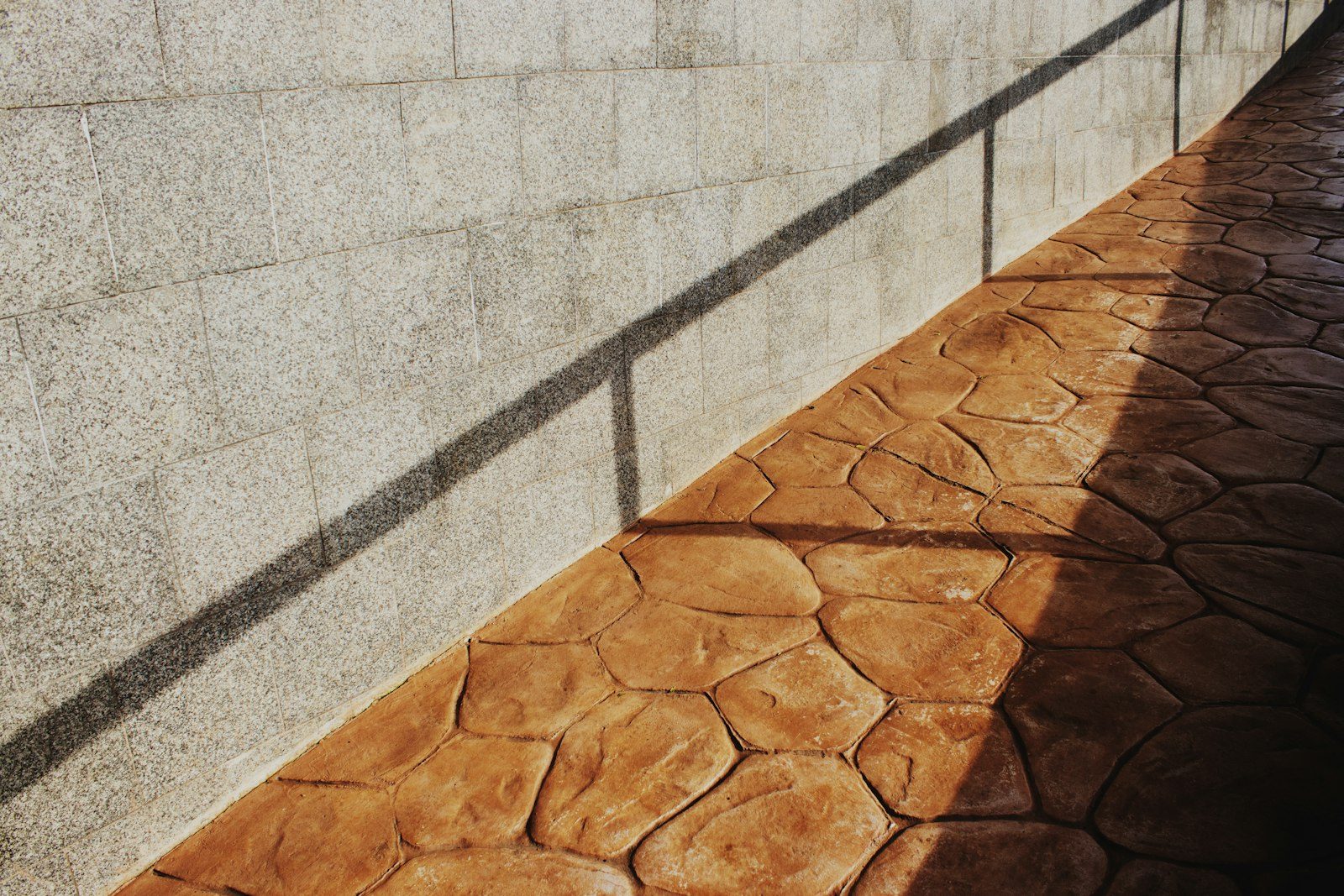
Cut lines that turn a plain slab into a pattern, laid out before anybody starts a saw.
Late October is when we get these calls. The sun drops low enough that it rakes across a patio instead of beating down on it, and suddenly every line in the concrete is throwing a shadow. Homeowners who never gave their control joints a second thought spend a week looking at four random rectangles and thinking about how much better that surface could read. Then the snow comes and they think about it all winter.
Scoring is the fix, and it's the least invasive decorative work we do. We cut shallow lines into cured or freshly finished concrete, laid out on a plan, so the slab reads as a field of tiles, a diamond grid, a running border, or a set of large panels that look chosen. No topping, no color required, no tear-out. Just geometry, a diamond blade, and a layout worth the trouble.
Anybody with a saw can cut a straight line. Deciding where the line goes is the actual work, and we do it with chalk before a blade spins. First the sight lines. Where you enter, where you sit, what the pattern looks like from the kitchen window and from the street. Then we set the grid off something real, usually the house wall, so it squares with the architecture instead of floating at an angle nobody can name but everybody feels.
Existing control joints are the constraint we design around. Those cuts are structural and they stay, so the trick is folding them in until they stop reading as joints and start reading as part of the grid. Ignore them and you get two competing systems on one slab. We'd rather shift a pattern six inches than fight a joint that was there first.
Scale follows the space. A small entry pad takes a tight tile pattern without looking busy. A wide driveway needs big panels or a plain border, because fine detail across that much area turns into noise from the street. A curving walk wants lines running square to the direction of travel rather than chasing the curve.
| Pattern | Scale | Good on | Notes |
|---|---|---|---|
| Square tile grid | One to two feet per tile | Entry pads, porches, small patios | Reads formal. Square it to the door, not the yard |
| Diagonal or diamond | Two to three feet across | Patios and courtyards | Makes a narrow space feel wider. More cuts, more labor |
| Ashlar, mixed rectangles | Varied sizes in a repeating set | Big patios and pool surrounds | Hides existing joints better than any other layout |
| Running border, plain field | Band twelve to eighteen inches | Driveways and long walks | Cheapest way to make a big slab look designed |
| Large panels | Four feet and up | Modern homes, wide drives | Quiet and clean. Works with the joints, not around them |
On a new pour there's a choice. Green cutting with a soft blade happens within hours of finishing and leaves a slightly softer line with less dust. Waiting a few days and dry cutting gives crisper edges and better control, which is what we pick for decorative work where line quality is the point. Structural joints get no such luxury. Those go in the same day, on schedule, regardless of the pattern plan.
Cured concrete is the easier job. Cuts come out clean and predictable, and we can run this work most months of the year. We want dry, still days above freezing, since slurry that freezes in a fresh cut is miserable to clean out. Fall is our favorite window: cool enough to work all day, and it puts the pattern in place before the first storm.
One local caution. Score lines collect water, and that water freezes and thaws all winter. Fine on a sound slab with sensible depth. Bad on concrete that's already spalling, or anywhere you're tempted to cut deep for drama. So we keep lines shallow, skip shaded north-facing walks that stay damp for weeks, and put every scored patio on a reseal schedule.
We will lay out the grid on your actual slab so you can stand on it before deciding. Call (303) 569-4046.
The best compliment on a scoring job is that nobody can tell which lines we cut and which ones were already there. That only happens when you spend the first two hours with chalk and a tape instead of a saw. Everybody wants to hear the blade start. Patience is the whole trade here.What our crew lead tells homeowners
Still unsure about something?
Call the crew at (303) 569-4046 and we will talk it through.

Get a free, no-obligation estimate from a crew that knows Colorado soil, Colorado weather, and how to finish concrete that lasts.
Accessibility
Adjust the site to fit how you read and browse. Your choices are saved on this device.