
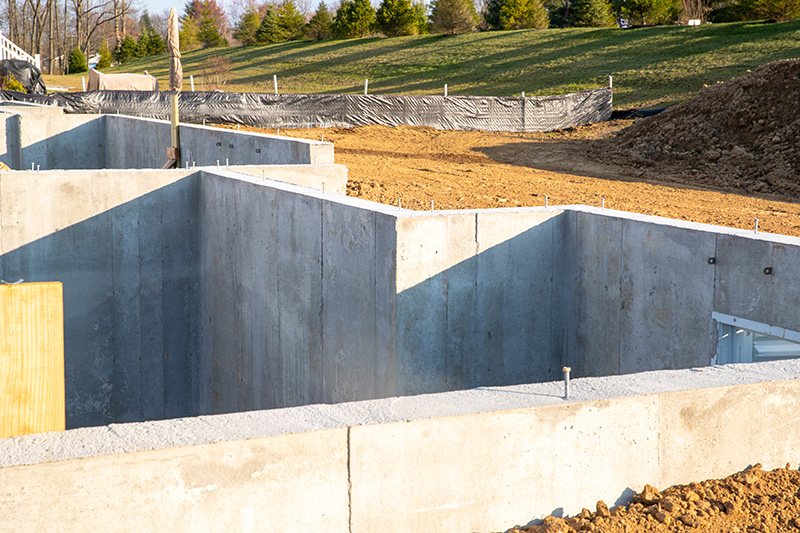
The floor you already own, ground flat and brought up to shine.
A polished floor changes how a room gets used, and that's the part worth thinking about before the grit sequence or the gloss number. Dogs come in wet off the yard and nothing soaks in. Kids drag bikes across the basement and there's no seam to catch a tire. You sweep, you damp mop, you go do something else. The maintenance conversation basically ends the day the crew rolls out.
Most of the floors we polish in Highlands Ranch are basement slabs and garage slabs that were poured with the house and then buried under carpet, tile, or nothing at all. Grinding one is not resurfacing and it's not a coating. We're cutting into the concrete itself with progressively finer diamonds until the surface closes up and starts reflecting. What you get is the actual slab, permanently, with no film on top waiting to peel.
Start with the cleaning, since that's the daily reality. Dust mop for the dry stuff, damp mop with a neutral cleaner when it needs it, and skip the vinegar and the bleach because acid dulls a polished surface faster than shoes do. That's it. No grout to scrub, no seams collecting crumbs, no baseboard gap breeding dust.
Then the noise. A hard floor in an open basement bounces sound, so plan rugs into the layout the way you'd plan lighting. Two or three under the seating handle it. Felt pads under every chair leg, always, because a dragged metal leg leaves a mark you can see in raking light.
What people notice most after a month is the light. A polished floor throws daylight deeper into a room than carpet ever did, which counts for something in the walkout levels common through Southridge and Eastridge.
| Stage | What we are doing | What it means for the finished floor |
|---|---|---|
| Metal bond, coarse | Cutting off coatings, glue, and high spots | Any flaw left here is locked in for good. Nobody should rush this stage |
| Metal bond, medium | Erasing the scratch pattern the coarse heads left behind | Determines how clean the final reflection reads |
| Densifier | Chemical hardener soaks in and reacts inside the pores | Hardens the surface so the shine holds up to traffic instead of wearing off |
| Resin, low grit | First honing passes on the hardened surface | A matte or satin floor can stop right here and look excellent |
| Resin, high grit | Finer diamonds closing the surface | Each step adds reflectivity. Gloss level gets decided here |
| Guard and burnish | Protective treatment burnished in at high speed | Adds stain resistance and final depth to the shine |
We can usually tell from a photo whether your slab is a good candidate. Call (303) 569-4046.
People ask us to polish patios and front walks. We turn it down almost every time, for two local reasons. A closed glassy surface gives water nowhere to go, so it holds a film and turns into a skating rink on any February morning. And repeated freezing works moisture into that tightened top layer until it pops. Polishing belongs under a roof. Outside, take a broom finish or stone and keep your footing.
Garages sit in between and work well, since they're covered and the traffic is tires rather than weather. We do add grit to the guard coat near the door, because a car dripping snowmelt turns the first six feet of a glossy garage into a hazard.
Scheduling favors the cold months, which surprises people. No pour, no cure, so weather barely enters into it, and winter is when our exterior calendar has room. The one requirement is airflow during the wet stages, meaning a January job needs a cracked window and a fan for a while.
Not every floor should get polished, and we'd rather say so on the first visit than halfway through the grind. We look for reasonable flatness, no moisture pushing up from below, and cracking that has gone quiet. Old adhesive, paint, and thinset come off in the first pass, so none of that worries us.
Moisture is the real disqualifier. Plenty of basement slabs around here went in without a vapor barrier beneath them, and if ground water is wicking through, it shows up later as haze or lifts a guard coat loose. We test before we quote, and when a slab reads wet we tell you what to do instead.
Still unsure about something?
Call the crew at (303) 569-4046 and we will talk it through.
Get a free, no-obligation estimate from a crew that knows Colorado soil, Colorado weather, and how to finish concrete that lasts.
Accessibility
Adjust the site to fit how you read and browse. Your choices are saved on this device.