
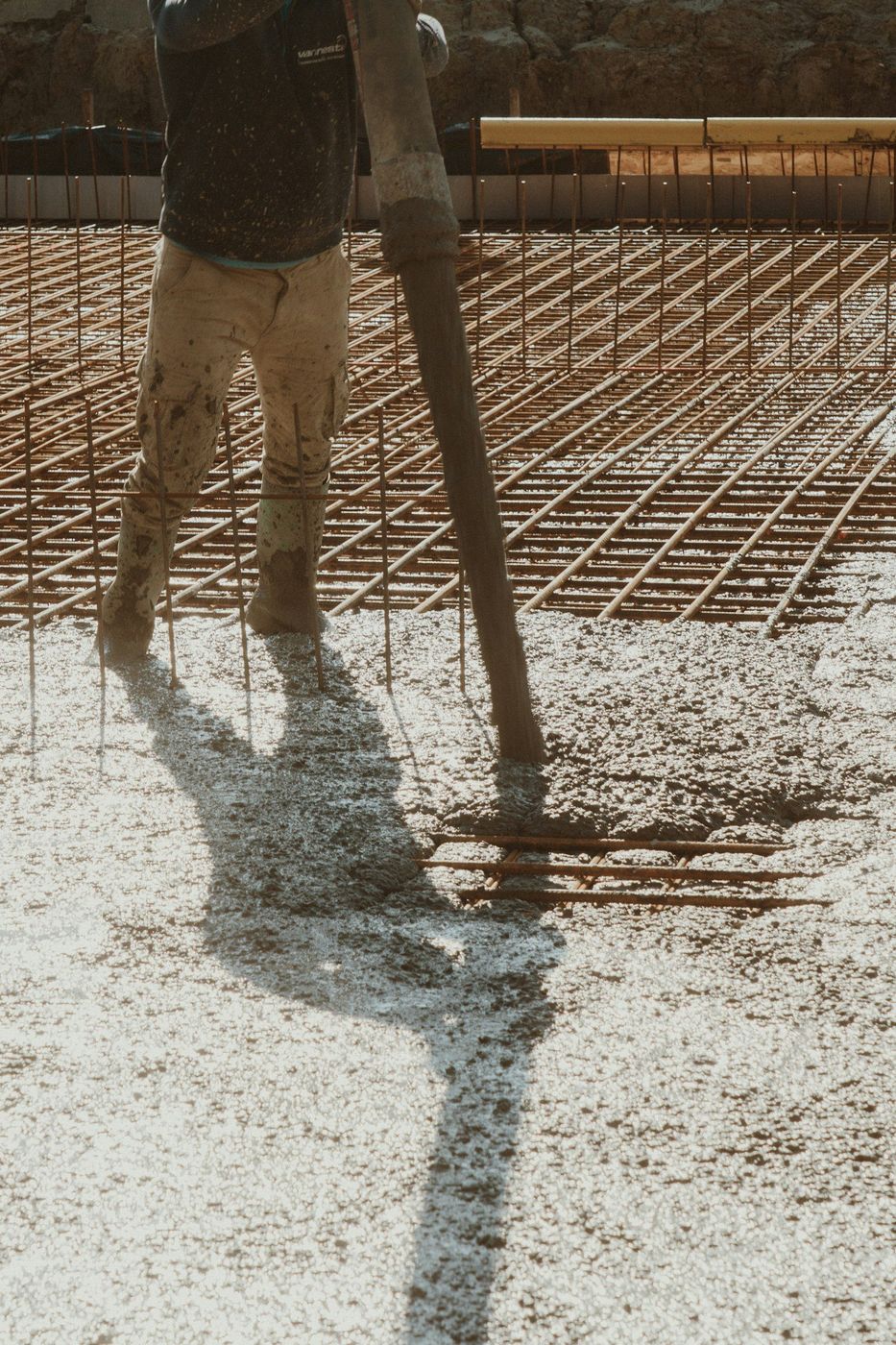
Most of a warehouse floor barely gets touched. The rest of it gets crossed a thousand times a week, and that is where the money belongs.
Stand in a working building for twenty minutes and watch the wheels. They don't go everywhere. They come off the dock, run one main aisle, turn at the same two spots, stop at the same staging area. Huge stretches under the racking get driven on a few times a year. The strip inside the overhead door gets crossed more before lunch than the back corner sees all season.
That's the problem with warehouse and shop slabs in the flex and light industrial buildings across the south and east side of Fort Collins, out toward The Landing and along Harmony. A floor gets specified as one thing and used as five. We build for how it gets used, which means spending where the wheels are.
Draw a heat map of a building's traffic and it's lopsided every time. A small share of the square footage takes the overwhelming majority of the wheel passes, the turning, the braking, and the dropped loads. So a uniform spec is either overbuilt across most of the building or underbuilt exactly where it matters.
What we vary is thickness at the heavy zones, steel where point loads land, joint layout so cuts stay out of wheel paths, and flatness in the aisles where equipment moves fast. What we never vary is mix quality or curing. Cut either one and you own a floor that dusts under every tire for twenty years.
Pallet jacks are worse than forklifts, which surprises people. Small hard wheels, no suspension, loaded heavy, rolling across a joint edge hundreds of times a day. Every pass is a small hammer blow to that corner, and joints fail from the edges inward long before anything fails mid-panel.
Forklifts add torque. A counterbalance truck turning under load twists the surface instead of just pressing on it, and it does that in the same few spots forever. Rack posts are a different problem entirely: a loaded upright drives its whole column of weight through a base plate the size of your hand, permanently. Then there's everything nobody plans for. Loads dropped hard, battery acid, hydraulic fluid, wash water, and all winter a steady delivery of snow, grit, and chloride tracked off trailers into a puddle right inside the door.
| Zone | What it takes all day | What we build there |
|---|---|---|
| The strip just inside the overhead door | Every wheel in the building, plus snow, grit, and standing water | Extra thickness, tight joints, slope to a drain, best mix on the job |
| The main drive aisle | Constant travel at speed, loaded and empty | Highest flatness on the floor, joints kept out of the wheel path |
| Turns at the ends of rack rows | Equipment pivoting under weight, over and over | Added thickness and steel, because torsion breaks corners |
| Under the racking | No traffic, but permanent concentrated post loads | Thickened areas under uprights, not a heavier whole floor |
| Staging, wrap, and charging corners | Dropped pallets, dragged loads, spills, equipment parked for hours | Hardened surface, impact reinforcement, and joints detailed to keep liquid out |
Walk it with us. Joint spalling, dusting, and a slab that shakes a pallet jack are three problems with three different fixes.
Interior slabs are supposed to be weatherproof work. They mostly are, right up until you're placing inside an unheated shell in November with the doors not hung. Then it's an outdoor pour with a roof on it: frozen subgrade, air colder inside than out, and a crew fighting a slab that won't set.
So we plan for it. Enclosure and temporary heat well ahead of the pour, not the morning of. Subgrade thawed and verified, never placed frozen. Temperature held steady through the cure instead of blasted with direct heat, which dries the top and hands you a floor that dusts forever. After placement the slab needs time nobody wants to give it: light equipment inside a week, loaded racking and full-weight forklifts at twenty-eight days. Every trade on the job will want on it sooner, and protecting it through that window is as much coordination as concrete.
Still unsure about something?
Call the crew at (303) 569-4046 and we will talk it through.
Get a free, no-obligation estimate from a crew that knows Colorado soil, Colorado weather, and how to finish concrete that lasts.
Accessibility
Adjust the site to fit how you read and browse. Your choices are saved on this device.