
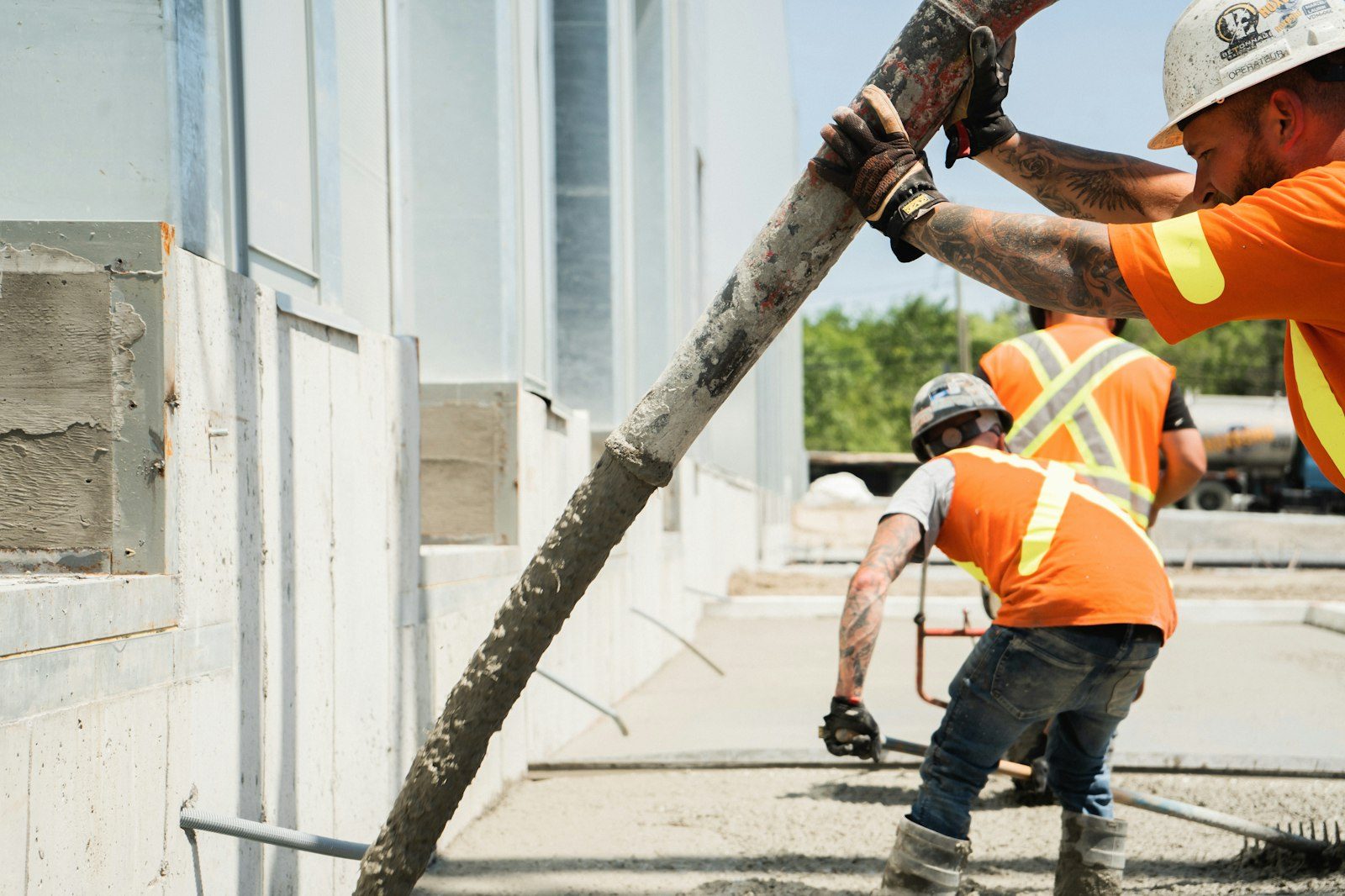
A curb machine reproduces exactly what you tell it, which is why the string goes up long before the mix shows up.
Here's the thing about extruded curb. The machine has no judgment. It follows a stringline and a trimmed subgrade with perfect obedience, and if either one is off by half an inch across forty feet, you get a permanent record of that mistake in concrete. So the part of the day that decides whether your gutter drains is the part where nothing is happening yet: a laser, a string, a couple of people arguing about an elevation.
We run curb and gutter across Fort Collins on commercial sites and inside associations. Retail and office along Harmony, service drives and back lots near Old Town, association drive lanes out in Rigden Farm. What follows is how a placement day unfolds, start to finish, so you know what you're looking at when our crew is on your property.
| Stage | What we're actually deciding | What rushing it does to you |
|---|---|---|
| Shoot grade and set the string | Where every gallon of water on the property ends up | A flat spot you cannot fix later without cutting the curb out |
| Trim and compact the subgrade under the run | Whether the curb sits on something or floats on loose fill | Settlement in the first spring, usually in one obvious dip |
| Position the machine and check the mix | Whether the shape stands up or slumps leaving the mold | A sagging profile that never matches the rest of the run |
| The extrusion pass itself | Line, height, and the gutter cross slope | Wandering line and a gutter that holds water instead of moving it |
| Hand form radii, ramps, and inlet transitions | How curb meets everything that isn't a straight line | A visible seam at every corner |
| Tool the joints, then cure and backfill | Where the curb cracks, and whether the edge survives week one | Random cracking, chipped edges, tire marks pressed into soft gutter |
This catches people off guard on site. A slab mix that flows nicely off a chute is useless in a curb machine, because extruded curb has to hold its own shape the instant it leaves the mold with nothing supporting it. So we order low slump, and when a truck shows up wetter than we asked, that load either gets adjusted or it goes back. We're not putting a soft load into a shape that has to stand on its own.
Timing between trucks matters just as much. The machine likes to keep moving, and long gaps leave cold joints, visible steps where one truck ended, and a run that never reads as one continuous piece. We plan the delivery interval before the day starts, and we'd rather push a pour a week than fight a plant that can't keep us fed.
We'll walk your flowline, mark the sections holding water, and tell you which ones can wait another year without getting worse.
Machines love straight lines. Your property has corners, ramp landings, inlet pans, driveway transitions, and the odd tight radius around an island. All of that gets formed and placed by hand, matched to the extruded profile so the eye doesn't catch a change. Get it wrong and the whole run looks like two contractors argued about it.
Weather has an outsized say on curb because curb is thin. Lots of surface area, very little mass, which means it gains and loses heat far faster than a slab does. On a hot dry breezy afternoon the surface flashes off before we've finished tooling. On a cold night the same low mass loses heat so quickly that a run placed without protection can be damaged before morning. Up here that pushes the sensible season toward May into September. Shoulder-month curb is doable with the mix water warmed, a chloride-free accelerator, and insulation going on the moment we finish tooling, and we'd rather give you the honest window than promise an October date we'd regret.
If a customer only watches one hour of the whole job, I tell them to come out while we're setting string. That hour is the one that decides whether they call us back in five years about a puddle.
From the crew lead on these jobs
Still unsure about something?
Call the crew at (303) 569-4046 and we will talk it through.

Get a free, no-obligation estimate from a crew that knows Colorado soil, Colorado weather, and how to finish concrete that lasts.
Accessibility
Adjust the site to fit how you read and browse. Your choices are saved on this device.