
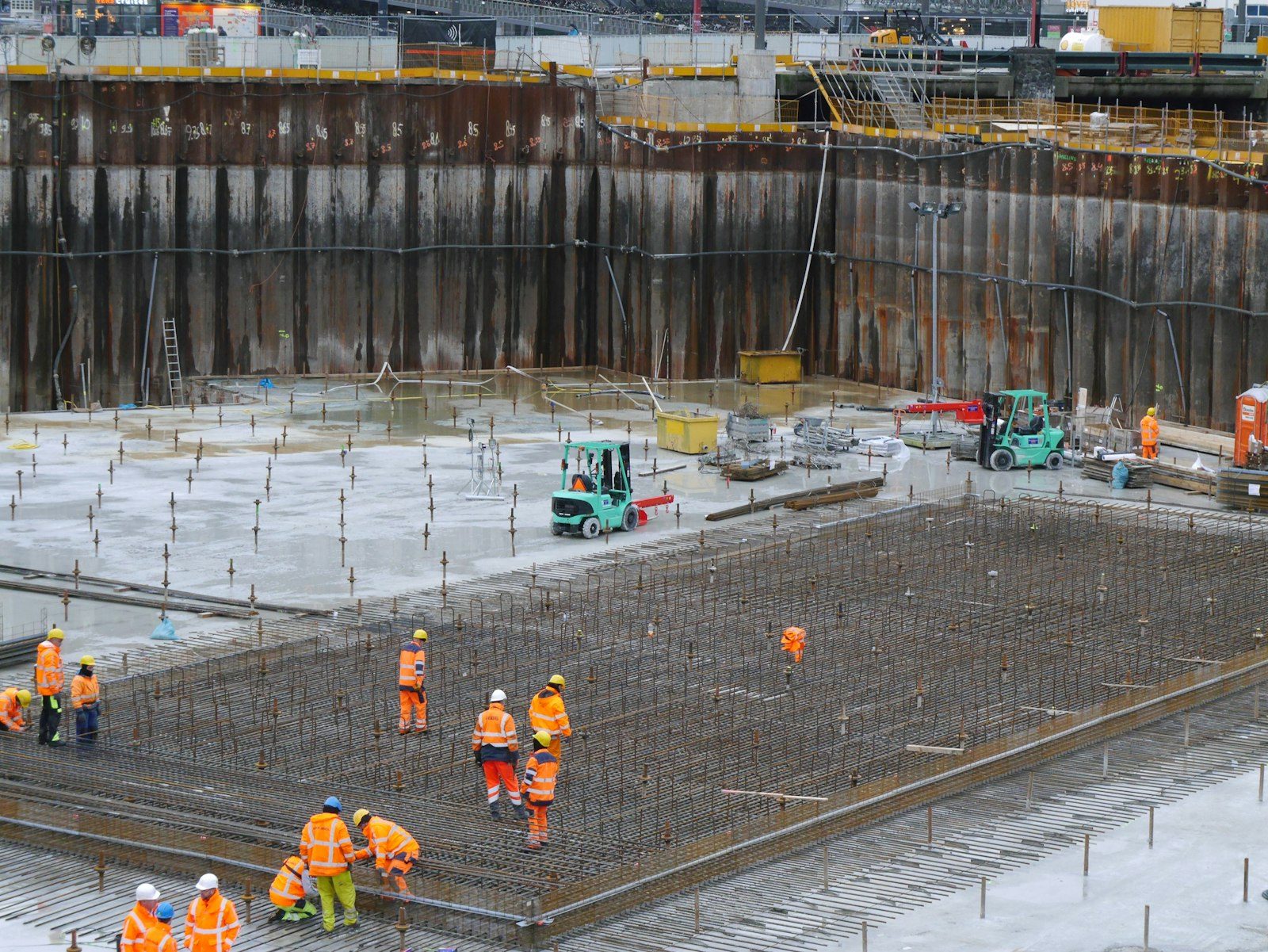
Break out a failing panel in April and the hole answers every question the surface was refusing to answer.
Cut a square out of a lot that keeps breaking, do it the second week of April, and look in the hole. Half the time there's standing water at the bottom. Not from rain. From snowmelt that ran off the surface, found an open joint, soaked into loose material nobody compacted, and sat there because there's clay a foot down acting like a bathtub. That water is why the panel above it broke, and it will break the replacement too if the only thing we change is the concrete.
We build and rebuild concrete lots throughout Fort Collins, from tight back-of-building parking near Old Town to the larger retail and flex-space fields along Harmony and out toward The Landing. This page is about the part of the job you'll never see once we leave, because on a parking lot that part is the job.
Four things turn up over and over when we open a Fort Collins lot.
First, base that's thinner than the spec ever said. Somebody spread rock, ran a plate over it once, and called it done. Second, base that's plenty thick but placed in one big lift, which compacts on top and stays fluffy underneath. Third, a trench line running straight across the failure, backfilled with whatever came out of it and never brought back to density. Fourth, and this is the quiet killer, no separation between clean aggregate and the fine soil below, so the two have slowly mixed until the base stopped behaving like base at all.
None of that shows on a satellite image and none of it shows in a photo of the cracking. It shows in a test hole. So we dig them, several of them, in the good areas as well as the bad ones. Comparing a sound section against a failed section on the same property is worth more than any general statement about regional soil.
Surface drainage gets all the attention because you can see a puddle. Fine. We set continuous fall to inlets, no flat spots, no birdbaths, and we keep the flowline out of the main wheel paths where the site allows it.
But the water that wrecks lots up here is the water that already got in. Once it's under the slab and winter arrives, it freezes, expands, and heaves the section above it. Then it thaws and the section drops back down. Do that fifteen or twenty times between November and March, which is an ordinary winter this far north, and the panel is being flexed like a paperclip. So we build with drainage in the section itself: free-draining aggregate, a separation fabric where fines want to migrate up, and where the grade traps water against a curb line or a building, an actual edge drain with somewhere to go.
| The move | When it's the right call | The tradeoff you're accepting |
|---|---|---|
| Over-excavate and replace with imported aggregate | Soft pocket is shallow and has clear limits | The most truck traffic and the most haul-off of any option |
| Moisture condition and recompact what's already there | Material is decent but too wet or too dry to hit density | Weather dependent. A rainy stretch can stall it for days. |
| Geogrid over the subgrade with a thicker aggregate section | Soft material runs deeper than anyone wants to dig out | Adds material cost, saves enormous excavation and disposal |
| Thicken the slab and add steel, leave the subgrade alone | Small area, light use, and digging would disturb something worse | Buys years, not decades. We say so up front. |
| Underdrain plus any of the above | Water is arriving from off site or from a landscape zone | Needs an outfall. No outfall, no underdrain, no exceptions. |
Let us open a test hole in one of them and one in a good area. The comparison usually settles the whole argument in an afternoon.
Still unsure about something?
Call the crew at (303) 569-4046 and we will talk it through.
Get a free, no-obligation estimate from a crew that knows Colorado soil, Colorado weather, and how to finish concrete that lasts.
Accessibility
Adjust the site to fit how you read and browse. Your choices are saved on this device.