
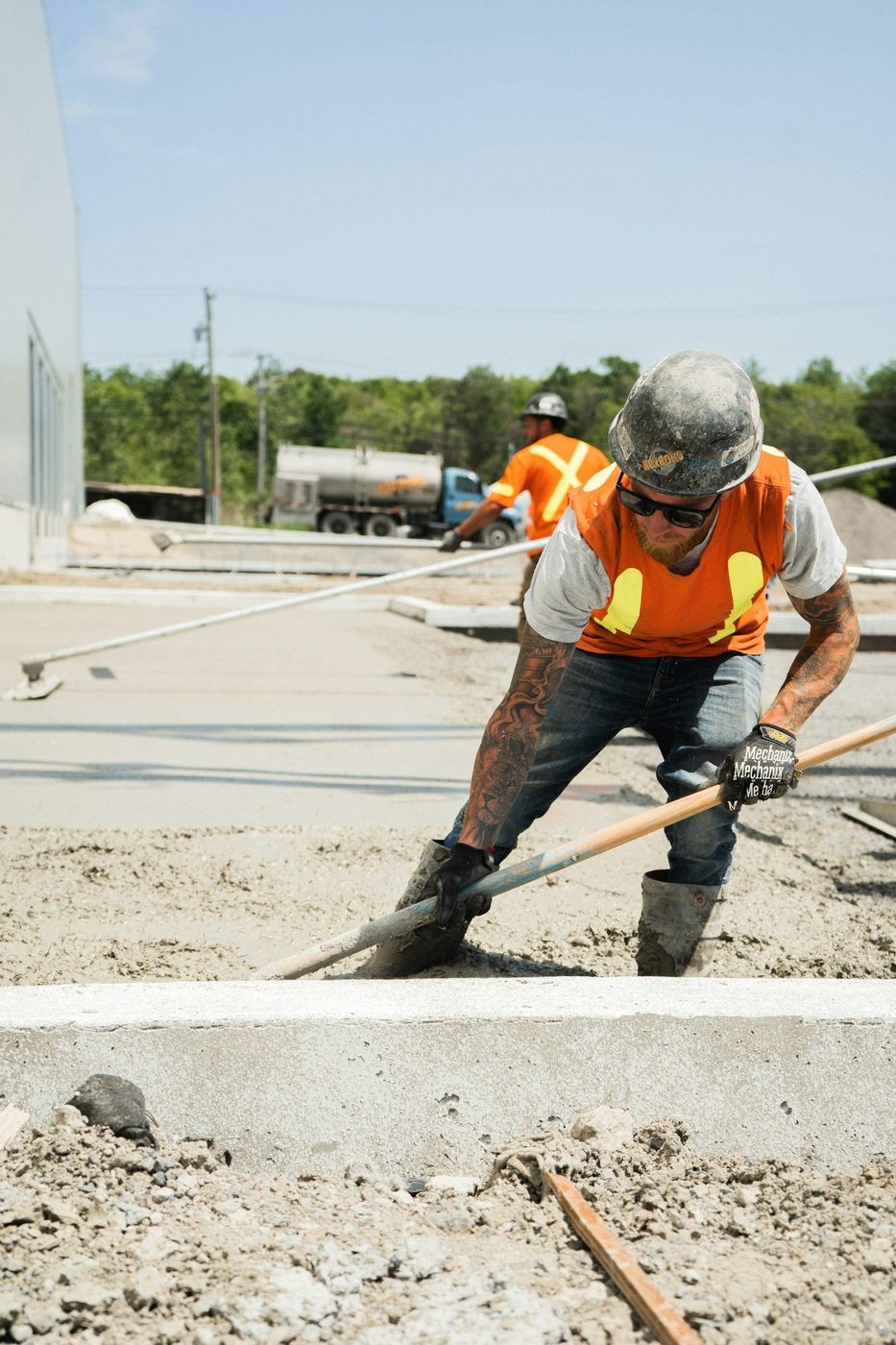
A board can grade every panel in the community in one afternoon with a can of spray paint, and that walk beats any proposal.
Somebody on the board gets an email with a photo attached. A shoe next to a lifted panel, shot from three feet away, captioned with a question about what the association intends to do. That photo is now the whole concrete discussion for two meetings, which is a terrible way to run a program, because the panel in the picture may not crack the worst ten on the property.
Community concrete here takes a beating that boards in warmer parts of the state never think about. We work with associations through Rigden Farm, Registry Ridge, Fossil Creek, and The Landing, and the pattern repeats: a few dozen panels that truly need to come out, a few hundred that look worn and are fine, and no shared language for telling them apart. So build one. Here's the system we hand boards before quoting anything.
A step at a joint means one panel moved and the one beside it didn't. That's it. Not that the walk is failing, not that the community needs a full replacement, not that the concrete was poor. Something under one specific slab changed.
The usual suspects are short: a tree root under the panel, irrigation soaking one edge season after season, water tracking along a utility line, or a spot nobody compacted when the community went in. All local. All produce a lifted panel with sound concrete on both sides. And all are fixable one panel at a time, which is good news for a reserve budget.
Watch instead for the other pattern. Failures scattered across unrelated areas, whole runs dishing rather than stepping, surface going at the same rate everywhere. That's a walk reaching the end of its life as a system, and panel replacement never keeps up.
| Grade | What you're looking at | Where it belongs in the plan |
|---|---|---|
| A | Flat, tight joints, surface intact, no movement underfoot | Leave it alone. Re-walk it in three years. |
| B | Hairline cracking or light wear, no level change | Note it and move on. Nothing to fund. |
| C | A visible step at a joint, or a panel that rocks | Next budget year. Mark and photograph it now. |
| D | A step you catch a toe on, cracked apart, or holding water | This year. These are what the program exists for. |
| Any grade, near a mailbox, entry, or shaded run | Same defect, more traffic or faster decline | Bump it up a grade. Exposure counts as much as condition. |
Northern Front Range winters cycle harder than people credit. It isn't the depth of the cold, it's the repetition. Sun at this elevation warms a south-facing walk into the forties while ground three feet away, shaded by a fence, never thaws at all. Half the community freezes and thaws daily; the other half stays locked up. The seam between them is where panels move most.
Irrigation makes it worse, and it's the piece a board can actually control. Heads throwing onto a walk, or spray landing on soil right at the panel edge, keep that ground saturated all summer, and saturated soil is the soil that heaves in December. Plenty of our repeat offenders have a sprinkler aimed straight at them, and leaving the head alone sends the new panel the way of the old one.
Deicer is the third factor. Magnesium chloride strips the surface off concrete, and association walks get plenty of it from well-meaning residents. Put a no-magnesium-chloride clause in the snow contract, and hold new panels to sand through their first winter.
Send the panel count and a handful of photos. We'll price the program off your grades and say if we'd move anything between years.
Once the D panels are counted, packaging is easy. We group by block so a crew finishes an area completely instead of scattering, which cuts the days any one household is affected down to about two. Barricades come down when the concrete is ready, not when a resident moves them.
Season is the real constraint. Good weeks run out sooner this far north, so a program approved in March goes smoothly while one approved in August turns into a scramble. Get us the board's decision over the winter and we'll be on the property in May.
Still unsure about something?
Call the crew at (303) 569-4046 and we will talk it through.
Get a free, no-obligation estimate from a crew that knows Colorado soil, Colorado weather, and how to finish concrete that lasts.
Accessibility
Adjust the site to fit how you read and browse. Your choices are saved on this device.