
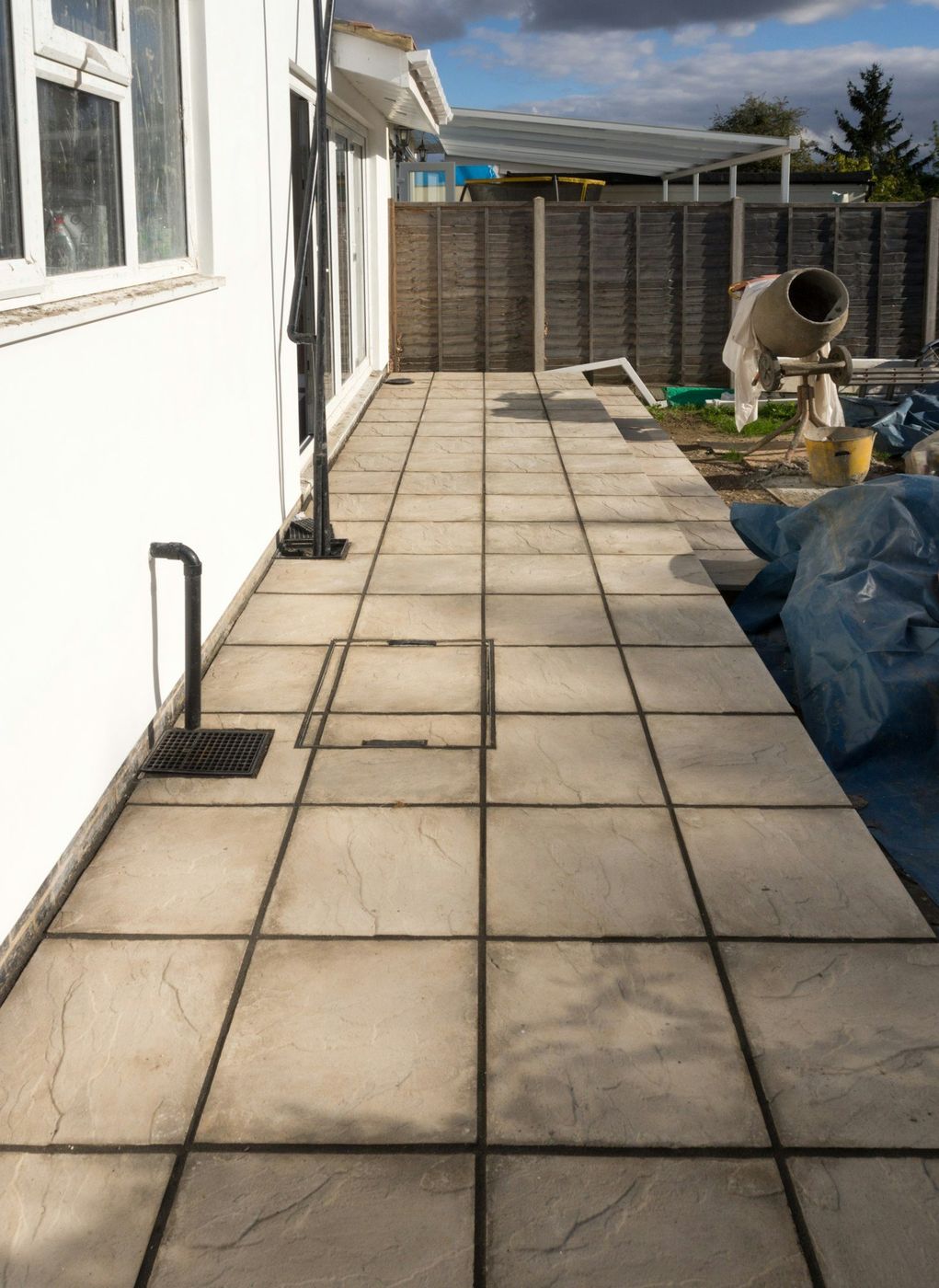
The dirt under your patio decides more than the finish on top of it.
Everybody shops for a patio by the surface. Broom or stamped, gray or colored, square or curved. Fair enough; that's the part you'll look at for the next twenty years. But the part that decides whether you actually get twenty years is buried the day we pour, and it's the first thing we bring up at a kitchen table in Rigden Farm or Fossil Creek: what's going under the slab.
Under most Fort Collins backyards sits clay that swells when spring snowmelt soaks in and shrinks hard by August. Pour directly on that and the ground itself will break your patio inside a few seasons; no mix design rescues it. So we build a sandwich. Compacted subgrade at the bottom, several inches of compacted road base in the middle, steel and air-entrained concrete up top. Boring to describe. Everything to own.
Expansive clay doesn't push evenly. It lifts the wet corner by the downspout and drops the dry middle, and a slab caught bridging that fight snaps wherever the stress collects. Compacted road base referees the match. It spreads loads out, gives water a path away from the underside, and hands the slab one consistent thing to sit on. This far north on the Front Range the frost drives deeper and returns more often than it does around Denver, so saturated ground beneath a patio becomes a slow jack that runs all winter.
Water management finishes the job. Every patio we pour is pitched away from the foundation, downspouts get rerouted if they dump at the slab edge, and the final grade gives snowmelt an exit. A patio draining toward the house isn't a patio problem. It's a basement problem on layaway.
| Layer | What goes in | The job it does |
|---|---|---|
| Subgrade | Native soil cut to grade and compacted | The foundation of the foundation; loose fill here dooms everything above it |
| Base course | Compacted road base | Even support plus a drainage path, so water can't camp under the slab |
| Reinforcement | Steel set on chairs at mid-slab height | Holds cracks tight when the ground moves anyway |
| Concrete | 4,000 PSI exterior mix with entrained air | Shrugs off the freeze cycles that shred plain mixes up here |
| Joints | Sawed within hours of the pour | Gives shrinkage a straight, planned place to happen |
| Finish and sealer | Broom, exposed aggregate, stamped, or stained | The part you see, and the first line of defense against sun and water |
Book a fall or winter estimate and you're first on the list when pouring season opens. (303) 569-4046.
Altitude changes patio math. The sun up here carries more punch than sea-level sun, and a west-facing slab with no shade can be unusable at four on a July afternoon. So we ask about shade before we ask about square footage. East-facing patios earn their keep on summer evenings. South-facing ones stretch the season deep into October, which counts for a lot in a town where fall is the best month on the calendar.
Size should follow furniture, not instinct. A dining set needs room to slide chairs out without anyone stepping into the grass. A fire pit wants breathing room from the fence and the eaves. In newer yards out in The Landing and Registry Ridge, lots run tighter, and a well-planned mid-size patio beats a big empty slab that swallows the whole backyard. We'll chalk the outline on the grass before we commit anything to concrete.
The call I hate is the beautiful two-year-old patio with a crack straight through the middle of the stamped medallion. Gorgeous work on top, nothing underneath. Whoever poured it spent all the money where the client could see it, and the ground called the bluff.Our crew lead, after the walkthrough
Still unsure about something?
Call the crew at (303) 569-4046 and we will talk it through.
Get a free, no-obligation estimate from a crew that knows Colorado soil, Colorado weather, and how to finish concrete that lasts.
Accessibility
Adjust the site to fit how you read and browse. Your choices are saved on this device.