
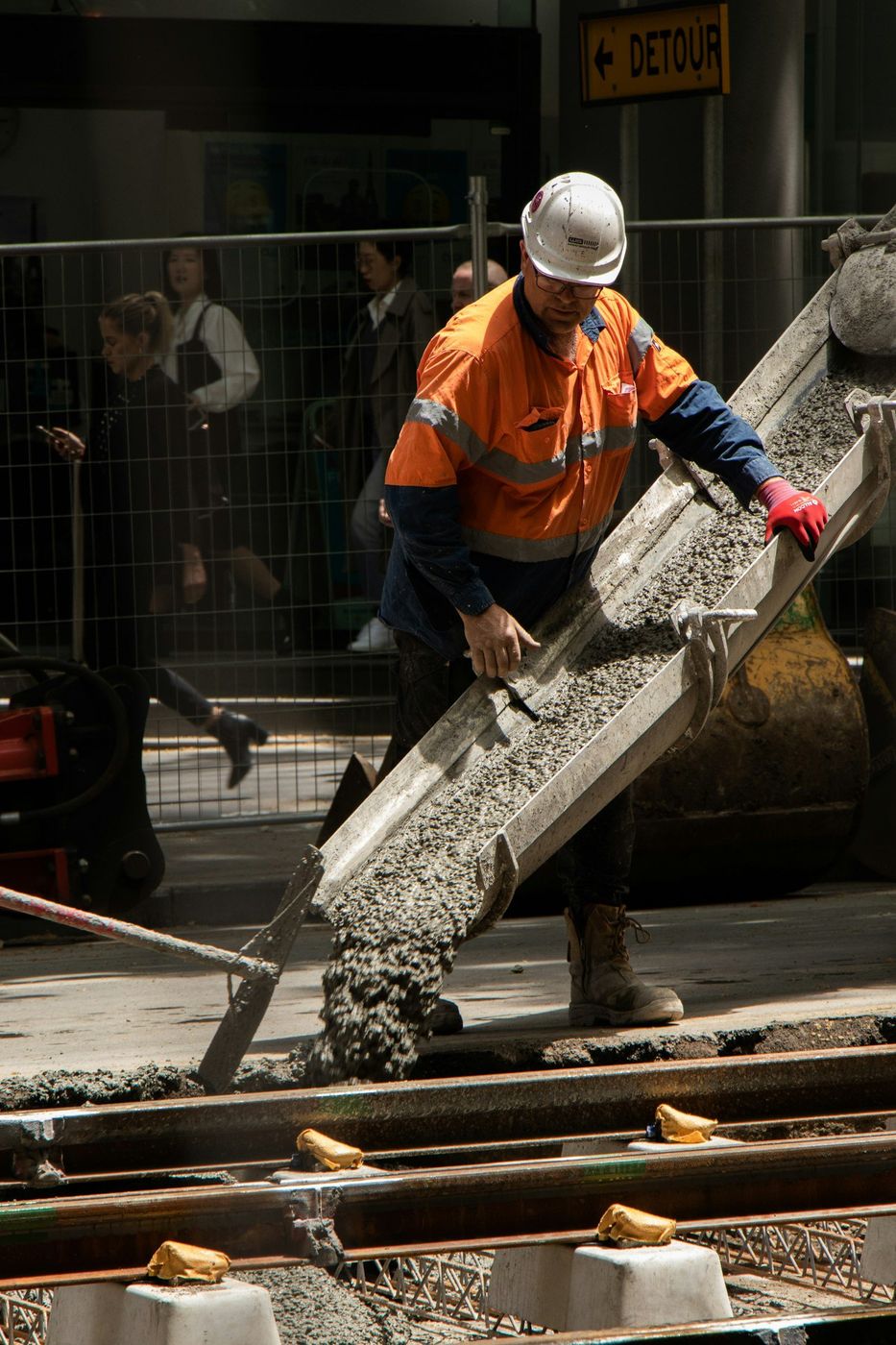
What actually happens on pour day, from the first truck to the last saw cut.
A new driveway in Fort Collins starts long before the concrete shows up. The forms went in the day before. The road base got compacted, wetted, and compacted again. So when the first ready-mix truck pulls up around seven, the hard thinking is already finished and what's left is speed: chutes swinging, screeds riding the forms, a crew of five moving like they've done this a thousand mornings. Because they have.
We pour driveways across the whole city, from tight Old Town lots where the truck has to thread between parked cars and mature trees to wide new builds out in Registry Ridge and The Landing. The steps don't change. The weather does. Larimer County sits at the north end of the Front Range, winter bites earlier and hangs on longer here, and that shapes everything from our mix design to our calendar. Here's the whole day, start to finish.
Concrete gives you one shot. Once water meets cement the clock is running, and in our dry air at 5,003 feet it runs quicker than the instructions on a bag would have you believe. That's why anything that can happen ahead of the pour already has. Grade checked twice. Steel tied and set on chairs so it stays in the middle of the slab instead of sinking into the dirt. Expansion material placed against the garage slab and the city walk so the new concrete can move without grinding on its neighbors.
Then the pour itself. Trucks are spaced so the mix never sits in the drum getting old. One of us runs the chute, two pull the screed, one floats right behind, and the finisher watches the surface for the exact moment it will take a broom. Miss that moment in either direction and the texture is wrong for the life of the driveway. Hit it and you'll never think about it again.
| Stage | When | What you'll see |
|---|---|---|
| Forms and base | The day before | Grading, road base compaction, forms staked, steel tied and chaired |
| First truck arrives | Early morning | Chutes out, concrete placed low and spread, never dropped from height |
| Screed and bull float | Right behind the placement | The surface gets leveled and flattened while the mix is still workable |
| Broom finish | Mid-morning | Texture dragged across once the water sheen leaves the surface |
| Saw cuts | That same afternoon | Control joints cut in before shrinkage picks its own crack lines |
| Cure and cleanup | Days one through seven | Curing compound down, forms stripped, edges backfilled |
Slots go quick once the ground thaws. Call (303) 569-4046 and we'll walk your driveway this week.
Our window is real but it isn't tiny. May through October is the comfortable stretch, and early fall might be the best of it: warm afternoons, nights that stay above freezing, and a full cure in the bank before the first hard cold. Winter shows up sooner in Fort Collins than it does in Denver and it freezes deeper, so we watch overnight lows closer than most outfits would bother to.
Cold-month pours still happen. Heated mix water, a non-chloride accelerator, insulated blankets over the fresh slab, and one rule with no exceptions: we never place concrete on frozen ground. Summer collects its own tax. Storms build over the foothills most July afternoons, so hot-season pours start at dawn and plastic sheeting rides on the truck, because rain worked into a surface that's still being finished leaves it soft and dusty for good.
And the first winter matters most of all. No deicers on young concrete, magnesium chloride least of all. Sand for traction. A shovel for the rest.
Old Town pours keep you honest. Narrow lots, big trees, sometimes a pump truck just to reach the back of the property. The concrete doesn't care how hard the site is. It sets on its own schedule either way, so the tricky sites get planned twice.The crew lead's read on it
Still unsure about something?
Call the crew at (303) 569-4046 and we will talk it through.

Get a free, no-obligation estimate from a crew that knows Colorado soil, Colorado weather, and how to finish concrete that lasts.
Accessibility
Adjust the site to fit how you read and browse. Your choices are saved on this device.