
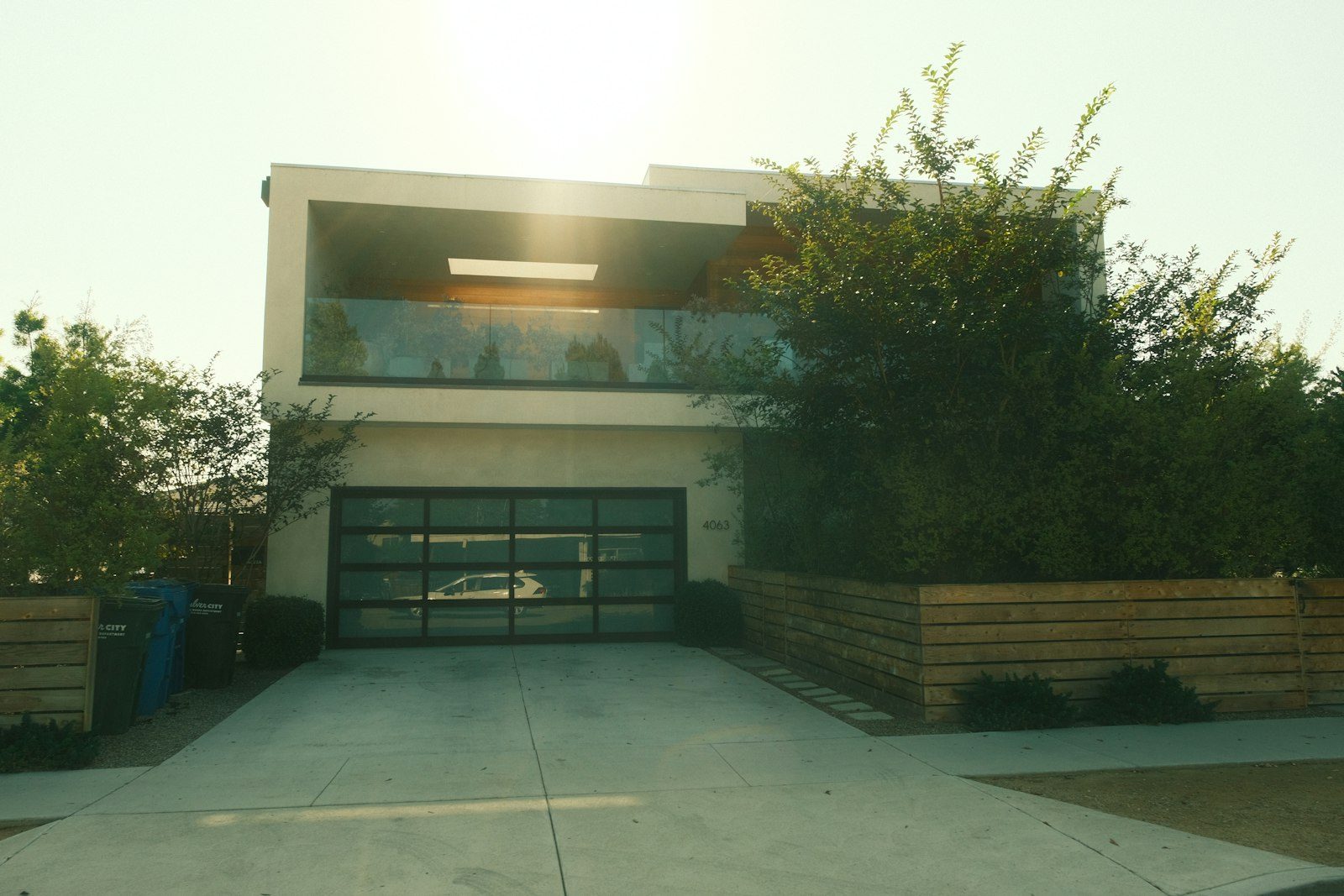
A driveway is a work surface, a parking spot, and a sidewalk for your own family. We pour it for all three.
Add up what your driveway does in a normal week. Cars in and out four times a day. Trash bins dragged to the curb and dragged back. A bike dumped flat where somebody has to step over it. The delivery van that backs halfway up because the street is tight. Somebody's loaded truck parked over the joint by the garage while a water heater comes off the tailgate. That is the actual job description.
We build around that week instead of around square footage. Older blocks in Northwest Englewood run a narrow strip past the house to a detached garage in back, so every tire follows the same two ruts year after year. Cherry Hills Vista and Broadway Estates tend toward shorter and wider drives where the whole load piles up near the apron. Same city, same soil, two different wear patterns, two different builds.
Watch a car turn in off the street. The wheels roll onto the apron at an angle, the front tires scrub sideways, and the whole weight of the vehicle crosses the one strip of slab that has street runoff underneath it, plow spray on top of it, and the least support behind it. That is why the section nearest the road goes first on so many older drives here. It isn't weak concrete. It's the hardest duty on the shortest piece.
So we thicken that edge, carry steel out to it rather than stopping short, and pack the base under it like a slab that holds a truck.
| What happens | What it does to the slab | What we build in for it |
|---|---|---|
| Two cars in and out, twice a day | Every tire follows the same narrow path until that strip polishes smooth and the joints there flex hardest | Reinforcement carried across the full width, not just a ribbon down the center |
| Bins dragged to the curb every week | Wears a track through the surface paste and chips the lip where the drive meets the street | A tight, hard-worked edge at the apron and a texture that hides scuffing |
| A truck backing up to unload | Drops a heavy rear axle onto the least supported three feet of the whole pour | Extra depth at the apron with the base compacted to match |
| A car sitting overnight with snow on it | Drips salted meltwater onto the same square yard every winter night | Air-entrained mix and enough fall that the water leaves instead of sitting |
People park in the same place. Not roughly the same place. Exactly the same place, within a foot, for years. That habit concentrates everything. Engine drips land there. Winter slush slides off the rocker panels and pools there. Road salt tracked home from the highway melts out of the wheel wells and sits on that patch until it dries.
Concrete handles the weight fine. What chews on it is that repeated wet-then-frozen cycle in one small area, especially at 5,371 feet where a sunny February afternoon can thaw a slab and the same night can lock it back up. An air-entrained exterior mix gives that water somewhere to expand into. Slope gives it somewhere to go. Between the two, the parking spot stops being the first place the surface starts to fret. And skip deicer entirely the first season. New concrete has no business meeting magnesium chloride while it's still gaining strength.
Trailer, work truck, three drivers, a hoop at the end. It all changes the spec. Free estimate at (303) 569-4046.
April through October is the easy stretch. Ground is workable, the mix behaves, and a crew can finish without fighting the surface. Fall is quietly the best of it: cool mornings, long finishing windows, and no three o'clock thunderstorm building over the foothills while somebody is still on knee boards.
Summer means early starts. Rain landing during finishing pulls cement to the surface and leaves a slab that dusts and flakes later, so we'd rather be textured by mid-morning than gamble on an afternoon cell. Plastic rides on the truck all season.
Winter work happens, with warmed water, a non-chloride accelerator, and blankets left down until the slab has strength. What we won't do is pour on frozen subgrade. Concrete placed over ice settles when that ice leaves. We'll build base in the fall and hold the pour instead.
You can tell where a family parks without asking anybody. There's a shadow of it on the concrete. That's the spot we're thinking about while we're still moving dirt.The crew lead's read on it
Still unsure about something?
Call the crew at (303) 569-4046 and we will talk it through.

Get a free, no-obligation estimate from a crew that knows Colorado soil, Colorado weather, and how to finish concrete that lasts.
Accessibility
Adjust the site to fit how you read and browse. Your choices are saved on this device.